Advertisement

VA Life Insurance for Veterans with Mesothelioma: SGLI, VGLI, and Service-Disabled Coverage to Protect Your Family

The Question Every Veteran Asks

You have mesothelioma. You are facing difficult treatments. You are worried about your family. What will happen to them when you are gone? How will they pay for the mortgage, the car payments, the kids’ college?

You want to leave something behind. You want to know your family will be okay.

Life insurance is the answer. But here is the problem. Many private life insurance companies will not cover someone with a terminal cancer diagnosis. If they do, the premiums are astronomical.

Here is what you need to know. The VA offers life insurance programs for veterans. Some of these programs are available to veterans with service-connected disabilities like mesothelioma.

This guide will walk you through everything you need to know about VA life insurance for veterans with mesothelioma. You will learn about Servicemembers’ Group Life Insurance (SGLI), Veterans’ Group Life Insurance (VGLI), Service-Disabled Veterans’ Life Insurance (S-DVI), and VALife (a newer program for disabled veterans).

No complicated government language. No confusion. Just clear, honest information to help you protect your family’s future.


Part 1: Why Life Insurance Matters for Mesothelioma Veterans

The Financial Impact of Mesothelioma

Mesothelioma is a devastating disease. It often strikes later in life, after retirement. But it can also strike younger veterans who were exposed to asbestos decades ago.

If you are the primary breadwinner for your family, your death could leave them in a difficult financial situation. Life insurance provides:

  • Money to pay off the mortgage
  • Money for your children’s education
  • Money to cover daily living expenses
  • Money for funeral and burial costs
  • Peace of mind for you

The Challenge of Private Life Insurance

Private life insurance companies use medical underwriting. They ask about your health. They request your medical records. If you have mesothelioma, you will almost certainly be denied coverage. Or you will be offered a policy with premiums that are impossibly high.

The VA does not use medical underwriting for its life insurance programs in the same way. If you qualify for the program, you are covered regardless of your health condition.


Part 2: Servicemembers’ Group Life Insurance (SGLI)

What Is SGLI?

Servicemembers’ Group Life Insurance (SGLI) is life insurance for active-duty service members, Guard members, and reservists. It provides up to $400,000 in term life insurance coverage.

Who Is Eligible for SGLI?

  • Active-duty service members
  • Ready Reserve and National Guard members
  • Commissioned Corps of the Public Health Service and NOAA

SGLI for Veterans with Mesothelioma

If you are no longer on active duty, you are not eligible for SGLI. However, you may be able to convert your SGLI to VGLI when you leave the service (see Part 3).

How Much Does SGLI Cost?

Premiums are deducted automatically from your pay. The rate is very low – approximately 0.06per0.06per1,000 of coverage per month.

Example: 400,000coveragecostsapproximately400,000coveragecostsapproximately24 per month.

Key Feature: Traumatic Injury Protection (TSGLI)

SGLI includes an automatic rider for traumatic injury protection. This is not relevant for mesothelioma (which is not a traumatic injury), but it is part of the SGLI package.


Part 3: Veterans’ Group Life Insurance (VGLI)

What Is VGLI?

Veterans’ Group Life Insurance (VGLI) is term life insurance for veterans who had SGLI while on active duty. You can convert your SGLI to VGLI when you leave the service.

VGLI provides up to $400,000 in coverage. You do not need to prove you are healthy. If you had SGLI, you can convert to VGLI regardless of your health condition.

Who Is Eligible for VGLI?

  • Veterans who had SGLI while on active duty
  • You must apply within 1 year and 120 days of leaving active duty
  • For mesothelioma veterans who served decades ago, you may have missed the window

What If You Missed the VGLI Deadline?

If you have a service-connected disability (like mesothelioma), you may be eligible for an extension. Contact the VA Office of Servicemembers’ Group Life Insurance (OSGLI) at 1-800-419-1473.

How Much Does VGLI Cost?

VGLI premiums increase every 5 years as you age. For a veteran in their 60s or 70s (typical age for mesothelioma diagnosis), premiums can be high.

Example 5-year term rates (age 65-69):

  • 100,000coverage:Approximately100,000coverage:Approximately120 per month
  • 200,000coverage:Approximately200,000coverage:Approximately240 per month
  • 400,000coverage:Approximately400,000coverage:Approximately480 per month

Is VGLI Right for Mesothelioma Veterans?

If you already have VGLI, keep it. You cannot get a better rate elsewhere with a mesothelioma diagnosis.

If you do not already have VGLI, you may not be able to get it now. The application window is limited. However, there are other VA life insurance programs for disabled veterans (see Parts 4 and 5).


Part 4: Service-Disabled Veterans’ Life Insurance (S-DVI)

What Is S-DVI?

Service-Disabled Veterans’ Life Insurance (S-DVI) is life insurance for veterans with service-connected disabilities (like mesothelioma). It was available to veterans who were rated for a service-connected disability within 1-2 years of leaving active duty.

Who Is Eligible for S-DVI?

  • Veterans who received a service-connected disability rating within 2 years of leaving active duty
  • The disability must be rated at 0 percent or higher (all service-connected disabilities qualify)

The Problem with S-DVI for Mesothelioma Veterans

Here is the challenge. Mesothelioma usually develops 20-50 years after asbestos exposure. Most veterans with mesothelioma were exposed during service but not diagnosed until decades later. They did not have a service-connected disability rating within 2 years of leaving active duty. Therefore, they are not eligible for S-DVI.

For Veterans Who Are Eligible

If you are one of the rare mesothelioma veterans who received a rating soon after service, S-DVI provides:

  • Up to $40,000 in coverage
  • Premiums deducted from your VA disability compensation
  • No medical exam required

Cost: Approximately 0.60per0.60per1,000 of coverage per month.

Note: The S-DVI program has been largely replaced by VALife (see Part 5). New applications for S-DVI are no longer accepted as of January 1, 2023, except for veterans with an existing S-DVI policy who want to increase coverage.


Part 5: VALife (Veterans Affairs Life Insurance)

What Is VALife?

VALife is a newer VA life insurance program for veterans with service-connected disabilities. It replaced S-DVI for new applicants starting January 1, 2023.

VALife is designed specifically for veterans who did not apply for life insurance within the 2-year window after leaving service. This includes most veterans with mesothelioma.

Who Is Eligible for VALife?

  • Veterans with a service-connected disability rating of 0 percent or higher
  • You must apply within 2 years of receiving your service-connected disability rating

For mesothelioma veterans: This means you must apply for VALife within 2 years of receiving your 100 percent rating for mesothelioma.

How Much Coverage Can You Get?

  • Standard coverage: Up to $40,000
  • Increments: 10,000,10,000,20,000, 30,000,or30,000,or40,000

How Much Does VALife Cost?

VALife premiums are based on:

  • Your age at enrollment
  • Your coverage amount
  • Your premium is fixed for life (does not increase as you age)

Example estimated premiums: Approximately 0.50to0.50to1.50 per $1,000 of coverage per month, depending on your age.

How to Apply for VALife

Step One: Have a service-connected disability rating (100 percent for mesothelioma).
Step Two: Apply online at VA.gov within 2 years of receiving your rating.
Step Three: No medical exam is required.

Processing time: 30-60 days after receiving all required documents.

Important Waiting Period

VALife has a waiting period before full benefits are paid.

  • First 2 years: If you die within 2 years of enrollment, the benefit is limited to the return of premiums plus interest (no death benefit).
  • After 2 years: Full death benefit is paid.

For veterans with advanced mesothelioma: This waiting period is a significant limitation. If you have a terminal diagnosis, VALife may not provide a death benefit for your family if you die within 2 years of enrollment.


Part 6: VALife vs. VGLI vs. S-DVI: Which Is Best for You?

FeatureVALifeVGLIS-DVI
EligibilityService-connected disability rated within 2 years of applicationHad SGLI, apply within 1 year 120 days of leaving serviceRated within 2 years of leaving service (closed to new applicants)
Coverage10k10k−40kUp to $400kUp to $40k
PremiumsFixed for lifeIncrease every 5 yearsDeducted from disability comp
Medical examNoNo (conversion from SGLI)No
Waiting period2 years (before full benefit)NoNo
Best for mesothelioma veteransYes (if newly rated)Yes (if already have it)Rarely

Recommendation for Mesothelioma Veterans

If you are newly rated (100 percent for mesothelioma): Apply for VALife as soon as possible. The waiting period means your family will not receive the full death benefit if you die within 2 years, but it is better than nothing.

If you already have VGLI: Keep it. Do not let it lapse. You cannot get a better policy elsewhere.

If you have neither: Explore private life insurance options carefully. Some companies offer guaranteed issue life insurance policies (no medical exam) for seniors, but the premiums are high and the death benefits are low.


Part 7: VA Life Insurance for Surviving Spouses

When a veteran with VA life insurance dies, the surviving spouse may receive benefits from the policy. But there is no separate VA life insurance for surviving spouses.

What Surviving Spouses Should Know

  • File a claim: As soon as the veteran dies, contact the VA Office of Servicemembers’ Group Life Insurance at 1-800-419-1473.
  • Documents needed: Veteran’s death certificate, policy number, your ID
  • Payment timeline: Usually 30-60 days after claim is approved

CHAMPVA and Other Survivor Benefits

Life insurance is separate from other survivor benefits like:

  • DIC (Dependency and Indemnity Compensation) – monthly tax-free payment
  • CHAMPVA – health insurance
  • VA burial benefits

You can receive life insurance proceeds AND DIC AND CHAMPVA. They do not affect each other.


Part 8: Private Life Insurance Options

If you do not qualify for VA life insurance, or if you want additional coverage, here are private options to consider.

Guaranteed Issue Life Insurance

Some companies offer guaranteed issue life insurance. No medical exam. No health questions. Everyone is accepted.

Trade-offs:

  • Low death benefits (typically 5,000to5,000to25,000)
  • High premiums relative to death benefit
  • Waiting period (usually 2 years before full benefit is paid)

Example: Colonial Penn, AARP, Globe Life

Burial Insurance

Burial insurance is a type of whole life insurance designed to cover funeral expenses. Typically 5,000to5,000to25,000 in coverage. No medical exam for some policies.

Trade-offs:

  • Low death benefits
  • Higher premiums than traditional life insurance

Term Life Insurance

Traditional term life insurance requires a medical exam. Unless you are in remission, you will likely be denied. If your mesothelioma is in remission (no active disease for 2-5 years), you may qualify for a standard policy. Talk to an independent insurance broker.


Frequently Asked Questions

Can I get VA life insurance if I already have mesothelioma?
Yes, if you apply for VALife within 2 years of receiving your service-connected disability rating.

How long does it take to get approved for VALife?
Typically 30-60 days after submitting all required documents.

Does VA life insurance pay for suicide?
Yes, after the waiting period. During the waiting period, suicide may result in return of premiums only.

Can I name anyone as my beneficiary?
Yes. You can name your spouse, children, parents, siblings, a trust, or even a charity.

What if I die during the VALife waiting period?
Your beneficiary will receive a return of your premiums plus interest (not the full death benefit).

Can I have both VALife and VGLI?
No. You cannot have multiple VA life insurance policies.


Resources


Final Thoughts: Protect Your Family’s Future

You have mesothelioma. You are fighting for your life. But you also need to think about what happens after you are gone. Your family will need financial support. The mortgage will still be due. The kids may still need college tuition.

VA life insurance can help. If you are newly rated for mesothelioma, apply for VALife. The waiting period is a challenge, but something is better than nothing.

If you already have VGLI, keep it. Do not let it lapse.

Do not leave your family unprotected. Apply for VA life insurance today.


Disclaimer: This article provides general information about VA life insurance programs for veterans with mesothelioma. It does not constitute financial advice, insurance advice, or official VA guidance. VA benefits rules change. Every veteran’s situation is different. Always consult with a qualified financial advisor, insurance professional, or the VA directly about your specific situation. If you have been diagnosed with mesothelioma, speak with a doctor immediately and contact a VA-accredited claims agent or an attorney to understand your benefits, including life insurance.
VA Dental Care for Veterans with Mesothelioma: What’s Covered, Who Qualifies, and How to Get Treatment

The Missing Piece of Healthcare

You have VA health care for your mesothelioma. You have coverage for doctor visits, hospital stays, chemotherapy, and surgery. But what about your teeth?

Dental care is often the forgotten part of healthcare. For veterans with mesothelioma, the last thing you want to worry about is a toothache. But dental problems can be serious. Infections can spread. Pain can interfere with your ability to eat, sleep, and focus on your cancer treatment.

Here is what you need to know. The VA does provide dental care for some veterans. But the rules are different from medical care. Not every veteran qualifies for VA dental benefits. However, veterans with a 100 percent service-connected disability (like mesothelioma) are in the highest priority group for VA dental care.

This guide will walk you through everything you need to know about VA dental care for veterans with mesothelioma. You will learn who qualifies, what services are covered, how to enroll, and how to get emergency dental treatment.

No complicated government language. No confusion. Just clear, honest information to help you get the dental care you need.


Part 1: Why Dental Care Matters for Mesothelioma Patients

The Connection Between Oral Health and Cancer Treatment

If you are undergoing treatment for mesothelioma, your dental health matters more than ever.

Chemotherapy and dental health: Chemotherapy can cause mouth sores, dry mouth, and increased risk of infection. Existing dental problems can become much worse during chemo.

Immunotherapy and dental health: Some immunotherapy drugs can cause inflammation of the mouth and gums.

Pain and nutrition: Tooth pain can make it hard to eat. Good nutrition is essential during cancer treatment. Dental problems should be addressed before they interfere with your ability to eat.

Infection risk: A dental infection during chemotherapy can be dangerous. Your immune system may be weakened. An infection that would be minor for a healthy person can become serious for a cancer patient.

Before starting treatment: Ideally, you should have a dental exam before starting chemotherapy or immunotherapy. Address any cavities, gum disease, or other issues in advance.


Part 2: Do You Qualify for VA Dental Care?

VA dental care is not automatic. Unlike medical care, which is available to all enrolled veterans, dental care has stricter eligibility requirements.

Priority Groups for VA Dental Care

The VA classifies veterans into eight classes for dental care. Class I has the highest priority. Class VIII has the lowest.

Class I (Highest Priority): Veterans with a 100 percent service-connected disability. This includes veterans with mesothelioma.

Class II: Veterans who have a service-connected dental condition (not just any condition – a dental condition specifically caused by service).

Class III: Former prisoners of war.

Class IV: Veterans with a service-connected disability rated at 10 percent or higher who are receiving VA care for that disability and have a dental condition related to that disability.

Class V: Veterans who are participating in a VA vocational rehabilitation program.

Class VI: Veterans who are receiving VA care for a service-connected disability and have been homeless for more than 60 days.

Class VII: Veterans who have been rated at 100 percent for less than 180 days (transitional coverage).

Class VIII (Lowest Priority): All other veterans (limited to once-per-year exam and cleaning if space and resources are available).

For Mesothelioma Veterans: You Are Class I

Because you have a 100 percent service-connected disability (mesothelioma), you are in Class I . This means you are eligible for comprehensive dental care through the VA. There is no waiting list. There is no limitation on services.

What Class I includes:

  • Comprehensive dental exams
  • Cleanings and preventive care
  • Fillings and restorations
  • Root canals and endodontic treatment
  • Extractions and oral surgery
  • Crowns and bridges (prosthodontics)
  • Dentures (full and partial)
  • Periodontal (gum disease) treatment
  • Dental implants (in some cases, may require approval)

Part 3: What Dental Services Are Covered for Class I Veterans?

For veterans with a 100 percent service-connected disability, the VA provides comprehensive dental care. Here is what is typically covered.

Preventive Care (100% Covered)

  • Annual comprehensive exam: A complete evaluation of your teeth and gums
  • Cleanings (prophylaxis): Usually every 6 months (more often if needed)
  • X-rays: Bitewing, panoramic, and periapical X-rays as needed
  • Fluoride treatment: For patients at high risk for cavities
  • Oral cancer screening: Included in your annual exam

Restorative Care (100% Covered)

  • Fillings: Composite (tooth-colored) or amalgam (silver) fillings
  • Crowns: For teeth that are too damaged for fillings
  • Inlays and onlays: For larger cavities that do not require full crowns
  • Root canals (endodontic therapy): To save infected teeth
  • Extractions: Removal of teeth that cannot be saved

Prosthodontic Care (100% Covered)

  • Full dentures: For patients missing all teeth on upper or lower arch
  • Partial dentures: For patients missing some teeth
  • Implant-supported dentures: In some cases (may require approval)
  • Bridgework: For replacing missing teeth

Periodontal (Gum) Care (100% Covered)

  • Deep cleaning (scaling and root planing): For gum disease
  • Periodontal maintenance: Ongoing care after gum disease treatment
  • Gum surgery: For advanced gum disease (may require referral to periodontist)

Oral Surgery (100% Covered)

  • Wisdom tooth extraction
  • Removal of impacted teeth
  • Biopsy of oral lesions
  • Pre-prosthetic surgery (bone smoothing, ridge reduction)

Emergency Dental Care (100% Covered)

  • Emergency exams
  • Pain management
  • Temporary fillings
  • Extractions for pain relief

Part 4: What Is NOT Covered by VA Dental Care?

Even for Class I veterans, some dental services may not be covered.

Generally Not Covered

  • Cosmetic dentistry: Teeth whitening, veneers (unless medically necessary)
  • Orthodontics: Braces for adults (unless medically necessary for jaw surgery)
  • Dental implants for cosmetic purposes: May be covered for functional reasons with approval
  • Private dental lab fees: If you go outside the VA system

What “Medically Necessary” Means

The VA defines medically necessary as treatment that is needed to:

  • Prevent serious dental disease
  • Treat existing dental disease
  • Restore oral function (chewing, speaking)
  • Relieve pain
  • Address conditions that affect your overall health

Cosmetic improvements are generally not covered.


Part 5: How to Enroll in VA Dental Care

Step One: Enroll in VA Health Care (If You Haven’t Already)

You must be enrolled in VA health care to receive VA dental care. If you are not already enrolled, complete VA Form 10-10EZ.

Apply online: VA.gov
Apply by mail: Contact your local VA medical center
Apply in person: At your local VA medical center

Step Two: Get Your VA Health Care ID Card

Once enrolled, you will receive a VA health care ID card. Bring this card to all dental appointments.

Step Three: Request a Dental Appointment

Call your local VA medical center. Ask for the dental clinic. Tell them you are a Class I veteran (100 percent service-connected disability). Schedule an initial exam.

If your local VA does not have a dental clinic: Ask about the VA Dental Community Care Program (see Part 7).

Step Four: Attend Your Initial Exam

The dentist will perform a comprehensive exam. They will take X-rays. They will create a treatment plan. You will discuss any urgent needs.


Part 6: VA Dental Care for Veterans Who Are Not 100% Disabled

If you have mesothelioma and are receiving treatment but do not yet have a 100 percent rating, you may still qualify for some dental care.

What You May Qualify For

  • Once-per-year dental exam and cleaning (if space and resources are available at your local VA)
  • Emergency dental care for pain or infection
  • Dental care related to your service-connected condition (if your dental problems are caused by your mesothelioma treatment – e.g., jaw problems from radiation)

How to Get Emergency Dental Care

If you have a dental emergency (severe pain, swelling, bleeding, broken tooth), call your local VA dental clinic. They will see you even if you are not a Class I veteran.

Getting a Higher Rating

If your mesothelioma is active and you are undergoing treatment, you should have a 100 percent rating. If you do not, file for an increased rating. Work with a VSO or VA-accredited attorney.


Part 7: VA Dental Community Care Program

If your local VA medical center does not have a dental clinic, or if the wait time is too long, you may be eligible for the VA Dental Community Care Program. This is similar to the VCCP for medical care.

How It Works

  • You receive dental care from a local, non-VA dentist
  • The VA pays the dentist directly
  • You pay nothing out of pocket (same as VA dental clinic)

Eligibility for Dental Community Care

You qualify if:

  • You are a Class I veteran (100 percent service-connected), AND
  • Your local VA cannot provide care within 30 days, OR
  • You live more than 40 miles from the nearest VA dental clinic, OR
  • The VA does not have a dental clinic in your area

How to Access Dental Community Care

Step One: Call your local VA dental clinic.
Step Two: Ask if you qualify for Dental Community Care.
Step Three: The VA will provide a referral to a local dentist.
Step Four: Schedule your appointment with the community dentist.


Part 8: Dental Care While Traveling for Mesothelioma Treatment

If you are traveling to a specialized mesothelioma center (like MD Anderson or Mayo Clinic) for treatment, you may be away from home for weeks or months. You may need dental care while you are away.

What to Do

  • Call the VA dental clinic at your travel destination. Explain that you are a Class I veteran who is temporarily in the area for mesothelioma treatment.
  • Ask for an appointment. They should accommodate you.
  • If they cannot see you, ask about Community Care in that area.

Emergency Dental Care While Traveling

If you have a dental emergency while traveling:

  • Go to a local emergency room or urgent care for pain relief.
  • Call the VA Beneficiary Travel office within 72 hours.
  • They may reimburse you for emergency dental care.

Part 9: Dental Care for Surviving Spouses and Dependents

The VA does not provide dental care for surviving spouses or dependents of veterans who died from mesothelioma. However, there are other options.

CHAMPVA Dental Coverage

If you have CHAMPVA as a surviving spouse, CHAMPVA does not cover routine dental care. It only covers dental care that is:

  • Emergency dental care (from an accident)
  • Dental care related to a covered medical condition (e.g., jaw surgery for cancer)

For routine dental care (cleanings, fillings, crowns), you will need separate dental insurance or pay out of pocket.

TRICARE Dental (For Some Dependents)

Some surviving spouses and dependents may be eligible for TRICARE dental benefits if the veteran was retired from active duty. Contact TRICARE for details.


Frequently Asked Questions

Do I need a referral from my primary care doctor to see a VA dentist?
No. You can schedule directly with the VA dental clinic.

How often can I get my teeth cleaned?
Most Class I veterans receive cleanings every 6 months. If you have gum disease or other conditions, you may be scheduled more often.

Does the VA cover dental implants?
Sometimes. Implants may be covered if they are medically necessary for functional reasons (e.g., you cannot eat or speak without them). Cosmetic implants are not covered.

Can I see my own dentist and have the VA pay?
Only if you are approved for the VA Dental Community Care Program. You cannot choose any dentist – the VA must refer you.

What if I need a root canal?
Root canals are covered for Class I veterans and for veterans with service-connected dental conditions.

What if I am homeless?
Homeless veterans (Class VI) are eligible for comprehensive dental care, including cleanings, fillings, extractions, and dentures.


Resources


Final Thoughts: Do Not Neglect Your Teeth

When you are fighting mesothelioma, dental care may not be at the top of your priority list. But your oral health affects your overall health. Infections can spread. Pain can interfere with your ability to eat and sleep.

You have earned comprehensive dental care through the VA. As a Class I veteran (100 percent service-connected disability), you are eligible for cleanings, fillings, root canals, crowns, dentures, and more. All at no cost to you.

Do not wait for a dental emergency. Schedule your annual exam today. Get your teeth cleaned. Address any problems before they become serious.

You served your country. You earned this benefit. Use it.


Disclaimer: This article provides general information about VA dental care for veterans with mesothelioma. It does not constitute medical advice, dental advice, or official VA guidance. VA benefits rules change. Dental eligibility and covered services are subject to change. Every veteran’s situation is different. Always consult with your local VA dental clinic and a qualified dentist about your specific dental needs. If you have been diagnosed with mesothelioma, speak with a doctor immediately and contact a VA-accredited claims agent or an attorney to understand your benefits, including dental care.

VA Travel Reimbursement for Mesothelioma Veterans: Getting Paid for Mileage, Meals, and Lodging When You Travel for Treatment

The Cost of Getting to Care

You have mesothelioma. You need specialized treatment. The nearest VA hospital that offers the care you need is 100 miles away. Or 200 miles. Or across the state.

You are already dealing with fatigue, pain, and shortness of breath. Now you have to add hours of driving to every appointment. Gas is expensive. Tolls add up. Sometimes you need a hotel room. Sometimes you need to eat on the road.

The costs add up quickly. And when you cannot work because of your illness, every dollar matters.

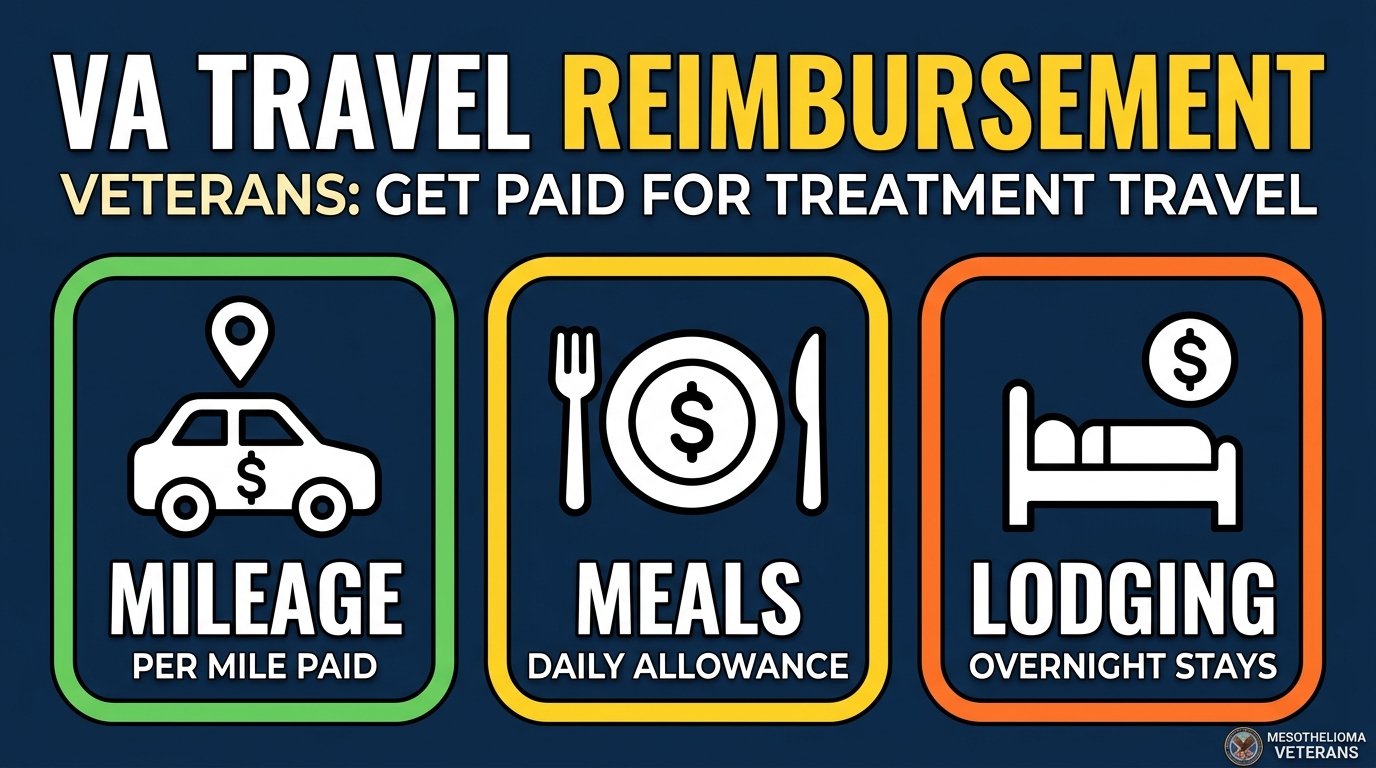
Here is something you need to know. The VA has a program that reimburses veterans for travel to VA-approved medical appointments. It is called the Beneficiary Travel Program. It pays for mileage, tolls, parking, and in some cases, meals and lodging.

For veterans with mesothelioma who travel long distances for specialized care, this program can save you hundreds or even thousands of dollars per year.

This guide will walk you through everything you need to know about VA travel reimbursement for veterans with mesothelioma. You will learn who qualifies, how much you can get, what expenses are covered, how to claim your reimbursement, and how to get pre-approved for long-distance travel.

No complicated government language. No confusion. Just clear, honest information to help you get paid for the miles you drive to get the care you need.


Part 1: What Is the VA Beneficiary Travel Program?

The Simple Explanation

The VA Beneficiary Travel Program reimburses eligible veterans for travel expenses to and from VA-approved medical appointments. This includes:

  • Mileage (per mile rate set by the VA)
  • Tolls
  • Parking fees
  • In some cases, meals and lodging

The program exists because the VA recognizes that veterans should not have to choose between getting medical care and paying their bills. If you need to travel for treatment, the VA will help cover the cost.

Why This Matters for Veterans with Mesothelioma

Mesothelioma is a rare cancer. Not every VA hospital has specialists who can treat it. Many veterans with mesothelioma must travel to specialized centers like:

  • MD Anderson Cancer Center (Houston, Texas)
  • Brigham and Women’s Hospital (Boston, Massachusetts)
  • Memorial Sloan Kettering Cancer Center (New York, New York)
  • Mayo Clinic (Rochester, Minnesota)

These centers may be hundreds of miles from your home. The Beneficiary Travel Program can help cover those travel costs.


Part 2: Do You Qualify for Travel Reimbursement?

Basic Eligibility Requirements

You qualify for VA travel reimbursement if you meet any of the following criteria.

Criterion 1: You have a service-connected disability rated at 30 percent or higher.

For veterans with mesothelioma (rated at 100 percent), you qualify automatically. This is the most common path for mesothelioma veterans.

Criterion 2: You are traveling for a VA-approved service related to your service-connected condition.

Your appointment must be at a VA facility or a VA-approved community care provider. The appointment must be for treatment of your service-connected condition (mesothelioma qualifies).

Criterion 3: You have a low income (if your disability rating is below 30 percent).

This does not apply to mesothelioma veterans since you have a 100 percent rating.

Criterion 4: You are traveling for a VA-approved transplant or other specialized procedure.

What Appointments Are Covered?

  • VA hospital or clinic appointments
  • Community care (VCCP) appointments at non-VA facilities
  • VA-approved C&P exams
  • VA-approved mental health appointments
  • VA-approved dental appointments
  • VA-approved pharmacy pickups (if the pharmacy is more than 20 miles away)

What Appointments Are NOT Covered?

  • Appointments you miss or cancel without rescheduling
  • Appointments for conditions not related to your service-connected disability (unless you have a 50 percent or higher rating)
  • Routine trips for non-medical purposes

Part 3: How Much Does the VA Pay for Travel?

Mileage Rate (2026)

The VA reimburses at a rate per mile. The rate is set annually and is typically close to the federal business mileage rate.

2026 VA mileage rate: Approximately 0.22to0.22to0.25 per mile (varies slightly by region)

Example: You drive 100 miles one way to a VA appointment. Round trip is 200 miles. At 0.22permile,yourreimbursementis0.22permile,yourreimbursementis44.00.

Deductible

Here is something important to know. For each one-way trip, the VA subtracts a deductible. The deductible is $6.00 per one-way trip (2026 rate).

Why the deductible exists: The VA assumes the first few miles of any trip are your responsibility (like your daily commute). The deductible reduces the total reimbursement.

Example: Your one-way trip is 100 miles. Reimbursement: 100 miles x 0.22=0.22=22.00. Subtract 6.00deductible=6.00deductible=16.00 for one way. Round trip = $32.00.

Note: Some veterans are exempt from the deductible. See Part 4 below.

Tolls and Parking

In addition to mileage reimbursement, the VA reimburses for:

  • Tolls: Actual cost of tolls for the most direct route
  • Parking: Actual cost of parking at the VA facility (not for valet parking)

Keep your receipts for tolls and parking. Submit them with your claim.

Meals and Lodging (Long-Distance Travel)

If you need to travel more than 100 miles one way, you may be eligible for reimbursement of meals and lodging.

Meal allowance: Approximately 1515−20 per meal (breakfast, lunch, dinner)

Lodging allowance: Up to the local federal per diem rate for hotels

Pre-approval required: You must get pre-approval from the VA Beneficiary Travel office before you travel for meals and lodging reimbursement. Call before you go.

Special Mode Transportation (Ambulance, Medivan, Air)

If you are too sick to drive yourself, the VA may pay for:

  • Ambulance transport (emergency and non-emergency)
  • Medivan or wheelchair van transport
  • Commercial airfare (for very long distances)

Pre-approval required: Always required for special mode transportation.


Part 4: Who Is Exempt from the Deductible?

Some veterans are exempt from the $6.00 per trip deductible.

You are exempt if:

  • You have a service-connected disability rated at 50 percent or higher (mesothelioma veterans qualify)
  • You are traveling for a VA-approved transplant
  • You are traveling for a VA-approved C&P exam
  • You are a former prisoner of war
  • You receive Aid and Attendance benefits

For mesothelioma veterans: Because you have a 100 percent rating, you are exempt from the deductible. You do not need to subtract $6.00 per trip.

Example with exemption: 100 miles one way x 0.22=0.22=22.00. No deductible. 22.00foroneway.Roundtrip=22.00foroneway.Roundtrip=44.00.


Part 5: How to Claim Your Travel Reimbursement

Option 1: Online Through VA.gov (Fastest)

This is the easiest and fastest way to claim travel reimbursement.

Step One: Log into VA.gov.
Step Two: Navigate to “Beneficiary Travel” under the “Health Care” section.
Step Three: Enter the date, location, and purpose of your appointment.
Step Four: Enter the number of miles driven.
Step Five: Submit your claim.

Payment time: 7-14 days via direct deposit (if you have VA direct deposit set up) or by check.

Option 2: In-Person Kiosk at VA Facility

Many VA medical centers have self-service kiosks for travel reimbursement.

Step One: After your appointment, find a travel reimbursement kiosk (usually near the pharmacy or main lobby).
Step Two: Scan your VA ID card.
Step Three: Confirm your appointment information.
Step Four: The kiosk will print a voucher.
Step Five: Submit the voucher to the travel office (or it may be automatically processed).

Payment time: 7-14 days

Option 3: By Mail (Slowest)

If you cannot use online or kiosk, you can submit a paper claim.

Step One: Complete VA Form 10-3542 (Application for Reimbursement of Travel Expenses).
Step Two: Attach copies of your toll and parking receipts.
Step Three: Mail to your local VA medical center’s Beneficiary Travel office.

Payment time: 4-8 weeks


Part 6: Pre-Approval for Long-Distance Travel

If you need to travel for specialized mesothelioma treatment at a distant facility, you should get pre-approval before you go.

Why Pre-Approval Matters

  • It confirms that the VA will pay for your travel
  • It allows you to claim meals and lodging
  • It prevents claim denials

How to Get Pre-Approval

Step One: Ask your VA provider for a referral to the distant facility (if not already approved).
Step Two: Call the Beneficiary Travel office at your local VA medical center.
Step Three: Tell them you need to travel for specialized mesothelioma treatment.
Step Four: They will issue an authorization letter.

Appointments that may require pre-approval:

  • Out-of-state travel
  • Travel for clinical trials
  • Travel for specialized surgery or HIPEC
  • Travel for initial consultation at a distant cancer center

Part 7: Travel Reimbursement for Caregivers

If you are a caregiver driving a veteran to appointments, you may also be eligible for travel reimbursement.

Caregiver Eligibility

  • You must be the veteran’s primary family caregiver
  • The veteran must be unable to drive themselves
  • You must be traveling to a VA-approved appointment

How Caregivers Claim Travel

The veteran must claim the travel reimbursement on behalf of the caregiver. The veteran completes the claim online or by paper.

Documents needed:

  • A note from the veteran’s doctor stating the veteran is unable to drive
  • The caregiver’s name and relationship to the veteran

Payment

The reimbursement is paid to the veteran, not to the caregiver. The veteran can then reimburse the caregiver.


Part 8: Special Considerations for Mesothelioma Veterans

Frequent Appointments

Mesothelioma treatment often involves frequent appointments. Chemotherapy every 3 weeks. Radiation daily for several weeks. Follow-up scans every few months.

You can claim travel reimbursement for every appointment. There is no limit on the number of claims.

Community Care (VCCP) Appointments

If you are receiving treatment at a local non-VA hospital through the Veterans Community Care Program (VCCP), those appointments are also covered. You can claim travel reimbursement for VCCP appointments just like VA appointments.

Ambulance Transport

If you need emergency ambulance transport to the hospital, call the Beneficiary Travel office within 72 hours. You may be reimbursed for the ambulance cost.

Air Travel

For very long distances (e.g., living in Alaska and needing treatment in Houston), the VA may approve commercial air travel. Pre-approval is always required. You cannot fly first class – only economy.


Frequently Asked Questions

How long does it take to get reimbursed?
Online claims: 7-14 days. Kiosk claims: 7-14 days. Paper claims: 4-8 weeks.

Do I need to keep receipts?
Yes. Keep receipts for tolls and parking. You do not need receipts for mileage (the VA uses your stated miles).

What if I drive an electric car?
The VA pays the same per-mile rate regardless of fuel type. You do not get extra for electricity.

What if I carpool with another veteran?
Each veteran can claim their own travel reimbursement. You do not need to divide the miles.

What if I miss my appointment?
You cannot claim reimbursement for missed appointments. If you reschedule, you can claim for the new appointment.

What if the VA says my claim is denied?
You can appeal. Contact the Beneficiary Travel office at your local VA medical center. Ask why it was denied. Provide additional documentation if needed.


Resources

  • VA Beneficiary Travel Information: www.va.gov/health-benefits/beneficiary-travel/
  • File a Travel Claim Online: www.va.gov (log in, go to Health Care, then Beneficiary Travel)
  • Beneficiary Travel Helpline: 1-800-827-1000 (ask for Beneficiary Travel)
  • VA Form 10-3542: Download from VA.gov
  • Find Your Local VA Medical Center: www.va.gov/find-locations/

Final Thoughts: Get Reimbursed for Every Mile

You are already dealing with enough. Fatigue. Pain. Treatment side effects. Worry about your family. Worry about money.

You should not have to worry about the cost of driving to your appointments. The VA Beneficiary Travel Program is here to help. It reimburses you for mileage, tolls, and parking. For long-distance trips, it can cover meals and lodging.

You have a 100 percent service-connected disability. You are exempt from the deductible. You qualify for full reimbursement.

Do not leave money on the table. File your travel claims after every appointment. Use the online system – it takes two minutes. Get paid.

Every dollar helps. You earned it.


Disclaimer: This article provides general information about the VA Beneficiary Travel Program for veterans with mesothelioma. It does not constitute legal advice or official VA guidance. VA benefits rules change. Travel reimbursement rates and deductibles are subject to change. Every veteran’s situation is different. Always consult with your local VA Beneficiary Travel office about your specific situation. If you have been diagnosed with mesothelioma, speak with a doctor immediately and contact a VA-accredited claims agent or an attorney to understand your benefits, including travel reimbursement.

VA Caregiver Support Program for Mesothelioma Families: Stipends, Training, and Respite for Those Who Care for Our Heroes

The Unsung Heroes

You did not sign up for this. You are a spouse, an adult child, a sibling, or a close friend. You love a veteran who has mesothelioma. And without anyone asking, without any training, without any pay, you became a caregiver.

You drive them to chemotherapy appointments. You cook their meals. You clean the house. You manage their medications. You help them bathe and dress. You hold their hand when they are scared. You cry in the car so they do not see you.

You are exhausted. You are stressed. You are worried about money. You feel guilty for being tired because they are the one who is sick.

Here is something you need to know. The VA has a program for people like you. It is called the Program of Comprehensive Assistance for Family Caregivers (PCAFC) . It provides a monthly stipend, training, mental health support, and respite care to family caregivers of seriously disabled veterans.

For veterans with mesothelioma (rated at 100 percent), you may qualify for this program. The stipend can be thousands of dollars per month. The training can help you provide better care. The respite care can give you a much-needed break.

This guide will walk you through everything you need to know about the VA Caregiver Support Program for families of veterans with mesothelioma. You will learn who qualifies, how much the stipend pays, what services are available, and how to apply.

No complicated government language. No confusion. Just clear, honest information to help you get the support you deserve.


Part 1: What Is the VA Caregiver Support Program?

The Simple Explanation

The Program of Comprehensive Assistance for Family Caregivers (PCAFC) is a VA program that provides financial and emotional support to family caregivers of seriously disabled veterans.

The program recognizes that family caregivers save the VA billions of dollars each year by providing care at home instead of in nursing homes or VA facilities. The stipend is a way of saying “thank you” and helping you make ends meet.

Two Tiers of Support

The VA offers two levels of caregiver support.

Tier 1: PCAFC (Comprehensive Assistance) – For caregivers of veterans who need help with daily living activities (bathing, dressing, eating, toileting, transferring). This tier includes a monthly stipend, training, mental health support, and respite care.

Tier 2: General Caregiver Support – For caregivers of veterans who do not meet the daily living needs threshold. This tier includes training, mental health support, and respite care, but NO monthly stipend.

For veterans with mesothelioma, most qualify for Tier 1 (PCAFC) because the disease eventually affects the ability to perform daily tasks.


Part 2: Do You Qualify for the Caregiver Stipend?

Basic Eligibility Requirements

To qualify for the PCAFC stipend, you and the veteran must meet all of the following requirements.

Veteran requirements:

  • The veteran must have a serious service-connected disability (mesothelioma qualifies)
  • The veteran must need help with at least one activity of daily living (bathing, dressing, eating, toileting, transferring)
  • The veteran must be unable to live independently without caregiver support

Caregiver requirements:

  • You must be a family member (spouse, adult child, parent, sibling, or extended family)
  • You must live with the veteran (or provide care at the veteran’s home)
  • You must complete caregiver training
  • You must pass a background check

What Qualifies as “Help with Daily Living”?

The VA looks at six activities of daily living (ADLs):

  • Bathing: Can the veteran bathe themselves without assistance?
  • Dressing: Can they put on clothes, button buttons, tie shoes?
  • Eating: Can they feed themselves?
  • Toileting: Can they get on and off the toilet and clean themselves?
  • Transferring: Can they get in and out of bed or a chair?
  • Incontinence: Can they manage bladder and bowel functions?

For veterans with mesothelioma, common reasons for needing ADL help include:

  • Shortness of breath makes bathing and dressing difficult
  • Fatigue makes it hard to cook or clean
  • Pain makes it hard to move or transfer
  • Weakness makes it hard to walk or stand

What If the Veteran Is in a Nursing Home?

If the veteran is in a nursing home or other institution, you generally cannot receive the caregiver stipend. The program is designed for in-home care.


Part 3: How Much Is the Monthly Caregiver Stipend?

The caregiver stipend is based on two factors:

  1. The level of care the veteran needs (Tier 1, 2, or 3)
  2. The geographical location (cost of living in your area)

2026 Estimated Stipend Ranges

TierLevel of CareEstimated Monthly Stipend
Tier 1Minimal assistance (1-2 hours/day)1,0001,000−1,500
Tier 2Moderate assistance (3-5 hours/day)1,8001,800−2,500
Tier 3Maximum assistance (6+ hours/day, 24/7)2,5002,500−3,500

Important: These are estimates. Your actual stipend will be calculated based on your specific situation and location.

Is the Stipend Taxable?

No. The VA caregiver stipend is not considered taxable income. You do not need to report it on your federal income taxes.

Does the Stipend Affect Other Benefits?

The stipend is not counted as income for:

  • VA disability compensation
  • Social Security benefits
  • Medicaid eligibility
  • Supplemental Security Income (SSI)
  • Food stamps (SNAP)
  • Housing assistance

However, it may affect your eligibility for certain needs-based programs. Talk to a benefits counselor.


Part 4: What Other Services Does the Program Provide?

The caregiver stipend is just one part of the PCAFC. The program also provides:

Caregiver Training

The VA provides free training to help you become a better caregiver. Topics include:

  • How to bathe, dress, and transfer the veteran safely
  • How to manage medications
  • How to use medical equipment (oxygen, hospital beds, wheelchairs)
  • How to handle medical emergencies
  • How to manage your own stress

Training can be done in person or online.

Mental Health Support

Caregiving is stressful. The VA offers:

  • Individual counseling for caregivers
  • Support groups (in-person and online)
  • Crisis support through the Caregiver Support Line

Respite Care

Respite care gives you a break. The VA will pay for a trained caregiver to take over for a short time so you can rest, run errands, or take a vacation.

How respite care works:

  • You can get up to 30 days of respite care per year
  • Care can be provided in your home or at a VA facility
  • The VA pays the cost. You pay nothing.

Travel Reimbursement

If you drive the veteran to VA appointments, you may be reimbursed for mileage, tolls, and parking.

CHAMPVA for Caregivers

If you are not already covered by health insurance, you may be eligible for CHAMPVA (Civilian Health and Medical Program of the VA). CHAMPVA covers doctor visits, hospital stays, prescriptions, and mental health care.


Part 5: How to Apply for the Caregiver Support Program

Step One: Talk to the Veteran’s VA Provider

The veteran’s VA doctor or social worker must certify that the veteran needs caregiver support. Start by making an appointment with the veteran’s VA primary care provider.

Step Two: Complete the Application

The veteran (or someone acting on their behalf) must complete VA Form 10-0103 (Application for the Program of Comprehensive Assistance for Family Caregivers).

The form asks for:

  • The veteran’s information
  • The caregiver’s information
  • The veteran’s daily living needs
  • The caregiver’s availability and willingness

Step Three: Submit the Application

Mail or fax the completed form to your local VA medical center’s Caregiver Support Coordinator.

Find your local coordinator: Visit www.va.gov/family-member-benefits/comprehensive-assistance-for-family-caregivers/ and enter your zip code.

Step Four: Assessment and Home Visit

A VA social worker will conduct an assessment. This may include:

  • An interview with the veteran
  • An interview with the caregiver
  • A home visit to assess the living environment

Step Five: Approval and Enrollment

If approved, you will receive a letter confirming your tier level and monthly stipend amount. You will be scheduled for caregiver training.

Processing time: 3-6 months


Part 6: Applying for Expedited Processing

If the veteran has a terminal diagnosis (like advanced mesothelioma), you can request expedited processing.

How to request:

  • Check the box on the application that says “Terminal Illness”
  • Include a doctor’s statement confirming the terminal diagnosis

Expedited timeline: 2-4 weeks


Part 7: What If You Are Denied?

Denials happen. Do not give up.

Common Reasons for Denial

  • The veteran’s care needs do not meet the threshold
  • The veteran does not have a service-connected disability (not an issue for mesothelioma)
  • The caregiver does not live with the veteran
  • The caregiver did not complete training
  • The caregiver failed the background check

How to Appeal

Step One: Request a higher-level review. A senior VA official will review your case.

Step Two: If denied again, request a hearing with the Board of Veterans’ Appeals.

Step Three: Get help from a Veterans Service Officer (VSO) or VA-accredited attorney.


Part 8: General Caregiver Support (No Stipend)

If the veteran does not need help with daily living activities but still needs some support, you may qualify for General Caregiver Support (Tier 2). This includes:

  • Caregiver training
  • Mental health support
  • Support groups
  • Respite care

No monthly stipend: Tier 2 does not include financial payment.

How to access: Call the Caregiver Support Line at 1-855-260-3274.


Frequently Asked Questions

Can I receive the caregiver stipend if I am also receiving VA disability compensation?
Yes. The stipend is separate from VA disability compensation. You can receive both.

Can I receive the caregiver stipend if I am working full-time?
Yes. The program does not require you to be unemployed. However, you must be available to provide care.

Can multiple family members receive the stipend?
No. Only one primary caregiver can receive the stipend for a veteran. Other family members may provide care but will not receive payment.

What if the veteran is in hospice care?
The veteran can still receive caregiver support, including the stipend, if they are receiving hospice care at home.

What if I am caring for more than one veteran?
You can only receive one stipend, even if you are caring for multiple veterans. You would need to apply separately for each veteran.

What if the veteran passes away?
Notify the VA Caregiver Support Program immediately. The stipend will stop. However, you may be eligible for other survivor benefits (DIC, CHAMPVA, etc.).


Resources


Final Thoughts: You Deserve Support

You are doing one of the hardest jobs in the world. You are caring for someone you love who is dying. You are exhausted. You are stressed. You are grieving even before they are gone.

But you are not alone. The VA Caregiver Support Program is here for you. The monthly stipend can help with lost income. The training can help you provide better care. The respite care can give you a break. The mental health support can help you cope.

You served your country indirectly by caring for someone who served. You deserve to be supported.

Apply today. Call the Caregiver Support Line. Talk to your local coordinator. Get the help you need.

You cannot pour from an empty cup. Take care of yourself. You matter too.


Disclaimer: This article provides general information about the VA Caregiver Support Program for families of veterans with mesothelioma. It does not constitute legal advice or official VA guidance. VA benefits rules change. Every situation is different. Always consult with a qualified Veterans Service Officer, VA-accredited attorney, or the VA directly about your specific situation. If you are caring for a veteran with mesothelioma, speak with the veteran’s VA provider immediately and contact the Caregiver Support Line to understand your benefits.

VA Vocational Rehabilitation for Veterans with Mesothelioma: Employment Help, Retraining, and Career Support When You Need It Most

When Work Is No Longer Possible – Or When You Want a New Path

You have mesothelioma. The diagnosis turned your world upside down. You may be facing difficult treatments. You may be exhausted, in pain, or struggling to breathe.

Work may be impossible right now. And that is okay. Your health comes first.

But what if you still want to work? What if your mesothelioma is in remission? What if you cannot go back to your old physically demanding job but could work in a less demanding role? What if you need retraining for a new career?

The VA has a program for exactly this situation. It is called Vocational Rehabilitation and Employment (VR & E) . It is sometimes called “Chapter 31” or “VRE.”

This program helps veterans with service-connected disabilities prepare for, find, and keep meaningful employment. For veterans with mesothelioma, VRE can provide job retraining, education benefits, resume help, interview coaching, and even assistive technology.

This guide will walk you through everything you need to know about VA Vocational Rehabilitation for veterans with mesothelioma. You will learn who qualifies, what services are available, how to apply, and how to get the support you need to return to work – or to find a new path forward.

No complicated government language. No confusion. Just clear, honest information to help you take the next step in your career journey.


Part 1: What Is VA Vocational Rehabilitation (VR&E)?

The Simple Explanation

VA Vocational Rehabilitation and Employment (VR & E) is a program that helps veterans with service-connected disabilities prepare for, find, and keep jobs that are a good fit for their skills and limitations.

The program is also called Chapter 31 (referring to the section of US law that created it).

VRE is not just about finding any job. It is about finding a job that works with your disability. If your mesothelioma prevents you from doing physical labor, VRE can help you retrain for an office job. If you need a wheelchair or oxygen, VRE can help you find an employer who will accommodate you. If you want to start your own business, VRE can help with that too.

Why This Matters for Veterans with Mesothelioma

Mesothelioma is a devastating disease. But it affects everyone differently. Some veterans with early-stage mesothelioma are still able to work. Others want to work but cannot return to their old jobs.

  • A former construction worker with mesothelioma may not be able to handle the physical demands of the job but could work as a construction estimator or safety coordinator.
  • A former Navy machinist’s mate may not be able to work on ships but could work in a supervisory or training role on land.
  • A veteran whose mesothelioma is in remission may want to start a small business.

VRE can help with all of these scenarios.


Part 2: Do You Qualify for VA Vocational Rehabilitation?

Basic Eligibility Requirements

To qualify for VA Vocational Rehabilitation, you must meet all of the following requirements.

Requirement 1: You have a service-connected disability rating of at least 10 percent. (For mesothelioma, you have 100 percent, so you qualify.)

Requirement 2: You have an employment handicap. This means your disability makes it harder for you to find or keep a job. For mesothelioma, the employment handicap is obvious – the disease affects your physical abilities, energy levels, and ability to work consistently.

Requirement 3: You are not already employed in a job that is suitable for your skills and disability. If you are unemployed or underemployed (working a job that does not use your skills or pays below your potential), you may qualify.

Requirement 4: You have an honorable or general discharge (no dishonorable discharge).

Special Rules for Seriously Disabled Veterans

If you have a 100 percent disability rating (like mesothelioma), you are automatically considered to have a serious employment handicap. This means you do not need to prove that your disability affects your ability to work – the VA presumes it does.

What If You Cannot Work at All?

If your mesothelioma is advanced and you cannot work at all, VRE may not be the right program for you. However, the VA has other programs for veterans who are totally and permanently disabled, including:

  • Total Disability Individual Unemployability (TDIU) – pays you at the 100 percent rate even if your rating is lower (covered in a previous post)
  • Independent Living Program – helps veterans who cannot work learn to live as independently as possible

If you are not sure whether VRE is right for you, apply anyway. A VRE counselor will evaluate your situation and recommend the best path.


Part 3: What Services Does VA Vocational Rehabilitation Provide?

VRE offers five “tracks” or services. Depending on your needs, you may use one or more of these tracks.

Track 1: Reemployment (Returning to Your Old Job)

If you left your job because of your mesothelioma but want to return (if your condition improves or treatment allows), VRE can help.

Services include:

  • Working with your former employer to accommodate your disability
  • Advocating for reasonable accommodations (flexible schedule, lighter duties, work from home)
  • Job coaching to help you transition back to work

Track 2: Direct Job Placement (Finding a New Job)

If you cannot return to your old job but you have skills that could be used in a different job, VRE can help you find a new position.

Services include:

  • Job search assistance
  • Resume writing and interview coaching
  • Networking with employers who hire veterans
  • Job placement services

Track 3: Retraining (Education and Training)

If you need new skills to find a suitable job, VRE can pay for education or training.

What VRE will pay for:

  • College degree (associate’s, bachelor’s, master’s)
  • Vocational or technical training (certificate programs)
  • Apprenticeships and on-the-job training
  • Online courses
  • Licensing and certification exams

What VRE provides while you are in school:

  • Full tuition and fees (to a public college or university; some private schools covered)
  • Monthly living stipend (based on your school’s location and your number of dependents)
  • Books and supplies (up to an annual limit)
  • Computer and equipment (if needed for your studies)

2026 living stipend examples (full-time student):

  • No dependents: Approximately $780 per month
  • One dependent: Approximately $970 per month
  • Each additional dependent: Additional money

Track 4: Supported Employment (For Veterans with Significant Disabilities)

If you have a severe disability that makes it hard to work independently, VRE can provide ongoing support.

Services include:

  • Job coaches who work with you on the job
  • Ongoing support to help you maintain employment
  • Assistance with workplace accommodations

Track 5: Independent Living Program (For Veterans Who Cannot Work)

If you cannot work at all, VRE can help you live as independently as possible.

Services include:

  • Home modifications (ramps, roll-in showers, grab bars)
  • Assistive technology (wheelchairs, oxygen equipment, communication devices)
  • Vocational counseling and adjustment to disability
  • Recreational therapy and community reintegration

Part 4: How to Apply for VA Vocational Rehabilitation

Step One: Determine If You Are Ready

VRE is not for every veteran at every stage of their illness. Consider applying if:

  • You are in remission or your condition is stable enough to consider working
  • You want to return to work but need accommodations or a different job
  • You want to retrain for a new career

If you are actively in treatment and cannot work, focus on your health. You can apply for VRE later when you are ready.

Step Two: Complete VA Form 28-1900

VA Form 28-1900 is the “Disabled Veterans Application for Vocational Rehabilitation.”

The form asks for:

  • Your personal information
  • Your VA disability rating
  • Your employment history
  • Your education history
  • Your employment goals

Where to get the form:

  • Download from VA.gov
  • Pick up from your local VA regional office
  • Apply online through VA.gov (easiest)

Step Three: Submit Your Application

Apply online at VA.gov. You can also apply by mail or in person.

Step Four: Attend Your VRE Orientation and Evaluation

Once your application is received, the VA will schedule an orientation session. You will learn more about the program. You will also undergo an evaluation to determine your employment handicap and your vocational goals.

Step Five: Develop Your Individualized Plan

If you are accepted into VRE, you will work with a VRE counselor to develop an Individualized Plan for Employment (IPE) . This plan outlines:

  • Your employment goal (what job you are working toward)
  • The services you will receive (education, training, job placement)
  • The timeline for completing your plan

Step Six: Start Your Plan

Once your IPE is approved, you can start your education, training, or job search. Your VRE counselor will support you throughout the process.


Part 5: Education Benefits Under VRE (Chapter 31 vs. Chapter 33)

VRE education benefits are different from the Post-9/11 GI Bill (Chapter 33). Here is how they compare.

FeatureVRE (Chapter 31)GI Bill (Chapter 33)
PurposeOvercome employment handicap from disabilityGeneral education benefit for all veterans
EligibilityService-connected disability (10%+), employment handicap90+ days active duty after 9/10/2001
Length of benefitsUp to 48 monthsUp to 36 months
Monthly living stipendBased on school location and dependentsBased on school location and service
Tuition coverageFull tuition (public schools); limited privateFull tuition (public); capped private
Books and suppliesUp to annual limitUp to $1,000/year
ComputerYes (if needed)No

Can you use both VRE and GI Bill? Yes, but not at the same time. You can use up to 48 months of total combined benefits. Many veterans use VRE first (since it offers a higher living stipend in some cases), then use their GI Bill for additional education.


Part 6: Special Considerations for Veterans with Mesothelioma

Physical Limitations

If your mesothelioma causes shortness of breath, fatigue, or pain, your VRE counselor will work with you to find jobs that accommodate your limitations.

Example accommodations:

  • Sedentary work (desk job, computer-based work)
  • Flexible schedule (work from home, part-time hours)
  • Ergonomic equipment (adjustable desk, supportive chair)
  • Medical leave for treatments

Prognosis and Terminal Illness

If your mesothelioma is advanced, you may still qualify for VRE services – but your plan will be adjusted to reflect your prognosis. The Independent Living Program may be more appropriate than employment-focused services.

Treatment Schedule

VRE can accommodate your treatment schedule. Your IPE can include breaks for chemotherapy, surgery, or recovery. You can pause your plan and restart later.


Part 7: VRE and TDIU: Can You Receive Both?

This is a common question.

Total Disability Individual Unemployability (TDIU) pays you at the 100 percent rate because you cannot work. If you are receiving TDIU, you are telling the VA that you cannot work.

If you apply for VRE, you are telling the VA that you want to work. These two positions are contradictory in the eyes of the VA.

The rule: Generally, you cannot receive both TDIU and VRE at the same time. If you are approved for VRE, the VA may reduce or terminate your TDIU payments.

But there is an exception. If you are approved for the Independent Living Program (not employment-focused), you can keep your TDIU.

What to do: Talk to your VSO or VRE counselor. Be honest about your goals. If you want to work, VRE may be the right path. If you cannot work, focus on TDIU and the Independent Living Program.


Frequently Asked Questions

How long does it take to get approved for VRE?
The application process typically takes 2-4 months. Once approved, you can start your plan right away.

Can I use VRE if I am already employed?
Yes. VRE can help you advance in your current job, get accommodations, or transition to a better job.

What if my VRE plan is denied?
You can appeal. The appeals process is similar to other VA claims. A VSO can help.

Can I use VRE for graduate school?
Yes. If a master’s degree or professional certification is necessary for your employment goal, VRE will pay for it.

Does VRE pay for online programs?
Yes. VRE covers online degree programs and online certificate programs.

What if my health worsens and I cannot complete my VRE plan?
You can withdraw from the program or request a leave of absence. You can reapply later if your health improves.


Resources


Final Thoughts: A Second Chance at Work

Mesothelioma changes everything. It may take away your ability to do the job you once loved. But it does not have to take away your ability to work entirely.

VA Vocational Rehabilitation is a second chance. It is a program designed to help veterans with service-connected disabilities find meaningful employment that works with their limitations, not against them.

If you are in remission. If your treatment is working. If you want to get back to work. Apply for VRE.

You served your country. You have skills, experience, and value to offer. Let the VA help you find a job that honors your abilities and works with your health.

You are not done yet. There is still work to be done. And you can do it.


Disclaimer: This article provides general information about VA Vocational Rehabilitation and Employment (VR&E) for veterans with mesothelioma. It does not constitute legal advice or official VA guidance. VA benefits rules change. Every veteran’s situation is different. Always consult with a qualified Veterans Service Officer, VA-accredited attorney, or the VA directly about your specific situation. If you have been diagnosed with mesothelioma, speak with a doctor immediately and contact a VA-accredited claims agent or an attorney to understand your benefits, including VR&E.

State Veterans Benefits for Mesothelioma: Additional Financial Help Beyond Federal VA Programs

The Benefits You May Not Know About

You have filed your federal VA claim for mesothelioma. You are receiving disability compensation. You have health care through the VA. You may even have Aid and Attendance or DIC.

But here is something many veterans do not know. Your state may offer additional benefits for veterans with service-connected disabilities. These benefits are separate from federal VA benefits. You can receive both. And for veterans with mesothelioma (rated at 100 percent), many of these benefits are automatically available.

Every state has its own veterans benefits agency. Each state offers different benefits. Some states are very generous. Others offer less. But almost every state offers something.

This guide will walk you through the most common state-level benefits for veterans with mesothelioma. You will learn about property tax exemptions, income tax exclusions, vehicle and driver’s license benefits, education benefits for dependents, and more.

No complicated government language. No confusion. Just clear, honest information to help you get every benefit you have earned.


Part 1: Why State Veterans Benefits Matter

The Federal VA Is Not the Only Source

The federal VA provides excellent benefits – disability compensation, health care, home loans, education, and burial benefits. But there are gaps. The federal VA does not pay your property taxes. It does not waive your vehicle registration fees. It does not give your children free college tuition.

That is where state benefits come in.

Each state has its own Department of Veterans Affairs (or similar agency). These agencies administer benefits funded by state taxes. Most states offer benefits specifically for veterans with service-connected disabilities.

The 100 Percent Rating Advantage

Many state benefits require a 100 percent VA disability rating. Mesothelioma is rated at 100 percent. This means you qualify for the highest level of state benefits in almost every state.

If you have a 100 percent rating (or TDIU paying at the 100 percent rate), you should check your state’s benefits. You may be eligible for significant property tax savings, free vehicle registration, free hunting and fishing licenses, and more.


Part 2: Property Tax Exemptions

This is often the most valuable state benefit for veterans with mesothelioma. A property tax exemption reduces or eliminates the property taxes you pay on your home.

How Property Tax Exemptions Work

Most states offer a property tax exemption for veterans with a 100 percent service-connected disability. The exemption amount varies by state.

Full exemption (no property taxes): Some states waive 100 percent of property taxes for 100 percent disabled veterans. This is the most generous benefit.

Partial exemption: Some states waive a portion of property taxes (e.g., the first $50,000 of assessed value).

Income-based exemptions: Some states offer property tax exemptions based on income as well as disability rating.

State Examples

Texas (most generous): 100 percent disabled veterans are exempt from 100 percent of property taxes on their primary residence.

Florida: 100 percent disabled veterans are exempt from 100 percent of property taxes on their primary residence.

California: 100 percent disabled veterans are eligible for a property tax exemption of up to $160,000 of assessed value (partial exemption).

New York: 100 percent disabled veterans are eligible for a property tax exemption of up to 50 percent of assessed value (varies by locality).

Illinois: 100 percent disabled veterans are exempt from 100 percent of property taxes on their primary residence.

Ohio: 100 percent disabled veterans are exempt from 100 percent of property taxes on their primary residence.

How to Apply

Contact your local county tax assessor’s office. They will have the application forms. You will need:

  • Your VA rating decision letter (showing 100 percent disability)
  • Proof of ownership (deed or title)
  • Proof of residency

Pro tip: Apply as soon as you move into your home. Many states require you to apply by a certain date (e.g., April 15) to receive the exemption for that tax year.


Part 3: Income Tax Exemptions

Several states exclude all or part of your VA disability compensation from state income taxes. Some states also offer additional exemptions for disabled veterans.

How Income Tax Exemptions Work

VA disability compensation is already exempt from federal income tax. Most states also exempt it from state income tax. But some states go further – they offer additional deductions or credits for disabled veterans.

State Examples

Pennsylvania: 100 percent disabled veterans are exempt from all state income tax on military retirement pay and disability compensation.

Michigan: 100 percent disabled veterans can deduct up to $20,000 of military retirement pay from state income tax.

Virginia: 100 percent disabled veterans are exempt from state income tax on all military retirement pay.

Georgia: 100 percent disabled veterans can deduct up to $35,000 of military retirement pay from state income tax.

What About Disability Compensation?

In almost every state, VA disability compensation is already exempt from state income tax. You do not need to do anything special. When you file your state taxes, simply do not include your VA disability payments as income.

How to Apply

Check your state’s department of revenue website. Most states do not require a separate application. You simply report the correct information on your annual tax return.


Part 4: Vehicle and Driver’s License Benefits

Many states offer vehicle-related benefits for disabled veterans.

Free or Reduced-Cost Vehicle Registration

Some states offer free or reduced-cost vehicle registration for 100 percent disabled veterans.

State examples:

  • Texas: Free vehicle registration for 100 percent disabled veterans
  • Florida: Free vehicle registration for 100 percent disabled veterans
  • California: Reduced registration fees for disabled veterans
  • New York: Free vehicle registration for 100 percent disabled veterans

Disabled Veteran License Plates

All states offer special license plates for disabled veterans. These plates may allow you to park in disabled parking spaces without a separate placard.

Eligibility: Most states require a 50 percent or higher VA disability rating. Some require 100 percent.

How to apply: Contact your state’s DMV. You will need your VA rating decision letter.

Driver’s License Exemptions

Some states offer free driver’s licenses for disabled veterans. Others offer exemptions from certain testing requirements.

State examples:

  • Texas: Free driver’s license for 100 percent disabled veterans
  • Florida: Free driver’s license for 100 percent disabled veterans

How to Apply

Contact your state’s DMV. Bring your VA rating decision letter and your current driver’s license.


Part 5: Hunting and Fishing Licenses

Almost every state offers free or reduced-cost hunting and fishing licenses for disabled veterans.

How It Works

Most states offer:

  • Free fishing license for 100 percent disabled veterans
  • Free hunting license for 100 percent disabled veterans
  • Reduced-cost combination licenses

State examples:

  • Texas: Free “Super Combo” hunting and fishing license for 100 percent disabled veterans
  • Florida: Free hunting and fishing licenses for 100 percent disabled veterans
  • California: Reduced-cost hunting and fishing licenses for disabled veterans

How to Apply

Contact your state’s fish and wildlife department. You will need your VA rating decision letter.


Part 6: Education Benefits for Dependents

Many states offer tuition assistance or free tuition at state colleges and universities for dependents of 100 percent disabled veterans.

How It Works

If you are rated at 100 percent disabled (or died from a service-connected condition), your spouse and children may be eligible for:

  • Free tuition at state colleges and universities
  • Free room and board
  • Fee waivers for application, registration, and other costs

State Examples

Texas (Hazlewood Act): Dependents of 100 percent disabled veterans are eligible for up to 150 credit hours of free tuition at Texas public colleges and universities.

Florida (Congressional Medal of Honor and Veterans’ Dependents Educational Benefits):Dependents of 100 percent disabled veterans are eligible for free tuition and fees at Florida public colleges and universities.

California (CalVet College Fee Waiver): Dependents of 100 percent disabled veterans are eligible for a fee waiver at California public colleges and universities.

Illinois (Illinois Veteran Grant): Dependents of 100 percent disabled veterans are eligible for free tuition at Illinois public colleges and universities.

New York (Veterans Tuition Award): Dependents of disabled veterans may be eligible for tuition assistance.

How to Apply

Contact your state’s veterans affairs agency or the financial aid office at the college or university. You will need:

  • Your VA rating decision letter (showing 100 percent disability)
  • The dependent’s birth certificate or proof of relationship
  • The dependent’s school enrollment verification

Part 7: Employment and Job Training Benefits

Many states offer employment assistance and job training programs for disabled veterans.

State Veterans Preference

Most states give disabled veterans preference in state government hiring. If you apply for a state job, you may receive additional points on your exam or be placed ahead of non-veteran applicants.

Job Training Programs

Many states offer free or low-cost job training programs for disabled veterans. These include:

  • Vocational rehabilitation
  • Apprenticeship programs
  • On-the-job training
  • Certification programs (CDL, welding, IT, etc.)

How to Apply

Contact your state’s veterans affairs agency or state department of labor.


Part 8: Other State Benefits

Free State Park Access

Many states offer free admission to state parks for disabled veterans.

State examples: Texas, Florida, California, New York, Michigan, Ohio

Reduced-Cost or Free Public Transit

Some states and localities offer reduced-cost or free public transit for disabled veterans.

State examples: New York (MTA reduced fare), Washington (King County Metro reduced fare)

Veterans Treatment Courts

Many states have Veterans Treatment Courts for veterans with legal issues related to their service or disability. These courts focus on treatment rather than punishment.

State Veterans Homes

Most states operate state veterans homes that provide nursing home care, assisted living, and domiciliary care for elderly or disabled veterans. These are often more accessible than VA nursing homes.


Part 9: How to Find Your State’s Benefits

Step One: Find Your State Veterans Agency

Every state has a Department of Veterans Affairs or similar agency. Search online for “[your state] veterans affairs.”

Step Two: Look for “State Benefits for Disabled Veterans”

Most state VA websites have a section listing benefits for disabled veterans. Look for:

  • Property tax exemptions
  • Vehicle and driver’s license benefits
  • Education benefits for dependents
  • Hunting and fishing licenses
  • Employment preference

Step Three: Contact a State Veterans Service Officer (VSO)

Your state has VSOs who can help you navigate state benefits. They are similar to federal VSOs but focus on state programs.

Step Four: Apply

Each benefit has its own application process. You will almost always need:

  • Your VA rating decision letter (showing 100 percent disability)
  • Your DD214
  • Proof of residency

Part 10: State vs. Federal Benefits – Can You Get Both?

Yes. State benefits are separate from federal VA benefits. You can receive both. They do not affect each other.

Examples:

  • You can receive federal VA disability compensation AND a state property tax exemption.
  • You can receive federal VA health care AND free state hunting and fishing licenses.
  • Your dependents can receive federal Chapter 35 DEA benefits AND state tuition assistance.

Do not assume that because you receive federal benefits, you are not eligible for state benefits. Check. Apply. You may be leaving money on the table.


Frequently Asked Questions

Do I need to be 100 percent disabled for state benefits?
Many state benefits require a 100 percent disability rating. However, some have lower thresholds (50 percent, 70 percent). Check your state’s requirements.

What if I have TDIU (paid at 100 percent but not rated 100 percent)?
Most states treat TDIU the same as a 100 percent schedular rating for benefit purposes. Confirm with your state.

Do state benefits affect my federal VA benefits?
No. They are separate.

What if I move to another state?
Your benefits may change. Some states are more generous than others. Research before moving.

Can surviving spouses receive state benefits?
Yes. Many states offer property tax exemptions, education benefits, and other benefits for surviving spouses of veterans who died from service-connected conditions.

How do I prove my disability rating to the state?
Use your VA rating decision letter. You can get a copy from VA.gov or your local VA regional office.


Resources

  • National Association of State Directors of Veterans Affairs: www.nasdva.us (links to every state VA agency)
  • VA Rating Decision Letter: Request from VA.gov or your local VA regional office
  • State VSO Locator: Contact your state VA agency

Final Thoughts: Do Not Leave Benefits on the Table

You served your country. You have mesothelioma. You have a 100 percent VA disability rating. You have earned every benefit available – federal AND state.

Many veterans do not know about state benefits. They receive their federal VA compensation and assume that is all. But your state may offer property tax exemptions worth thousands of dollars per year. Free vehicle registration. Free hunting and fishing licenses. Free tuition for your children.

These benefits are not charity. You earned them. Do not leave them on the table.

Contact your state veterans affairs agency today. Ask about benefits for 100 percent disabled veterans. Apply for everything you qualify for.

You served. You deserve.


Disclaimer: This article provides general information about state veterans benefits for veterans with mesothelioma. State benefits vary significantly by state. Laws change. Every situation is different. Always consult with your state’s veterans affairs agency or a qualified state Veterans Service Officer about your specific situation. If you have been diagnosed with mesothelioma, speak with a doctor immediately and contact a VA-accredited claims agent or an attorney to understand your federal and state benefits.

VA Home Loan Guaranty for Veterans with Mesothelioma: A Complete Guide to Buying a Home with Zero Down Payment

A Home to Call Your Own

You served your country. You worked hard. You raised a family. Then came the diagnosis that changed everything. Mesothelioma.

Now you are facing treatment. You cannot work the way you used to. Your income has dropped. But your dream of owning a home – or staying in the home you already have – still matters.

Here is something you need to know. The VA offers a home loan guaranty program that can help you buy, build, or refinance a home with zero down payment. For veterans with service-connected disabilities like mesothelioma, there are additional benefits. You may be exempt from the VA funding fee. You may qualify for grants to modify your home for accessibility.

This guide will walk you through everything you need to know about the VA Home Loan Guaranty program for veterans with mesothelioma. You will learn who qualifies, how the program works, the benefits for disabled veterans, and how to apply.

No complicated government language. No confusion. Just clear, honest information to help you achieve the dream of homeownership.


Part 1: What Is the VA Home Loan Guaranty?

The Simple Explanation

The VA Home Loan Guaranty is a program that helps veterans, active-duty service members, and surviving spouses buy, build, or refinance a home. The VA does not lend you money directly. Instead, the VA guarantees a portion of the loan to a private lender (like a bank or mortgage company).

Because the VA guarantees the loan, lenders are willing to offer better terms:

  • Zero down payment (no money down, up to the conforming loan limit)
  • No private mortgage insurance (PMI) (saves hundreds per month)
  • Lower interest rates than conventional loans
  • Limited closing costs
  • No prepayment penalty
  • Easier credit requirements

For veterans with mesothelioma who may have irregular income or medical debt, the VA Home Loan is often the most accessible path to homeownership.

Why This Matters for Veterans with Mesothelioma

Mesothelioma can affect your ability to work and earn a steady income. This can make it harder to qualify for a conventional mortgage. The VA Home Loan program is more forgiving. It looks at your residual income (money left after paying bills) rather than just your debt-to-income ratio. This gives you more flexibility.

Additionally, if you are a disabled veteran (mesothelioma is rated at 100 percent), you may be fully exempt from the VA funding fee. This saves you thousands of dollars.


Part 2: Do You Qualify for a VA Home Loan?

Basic Eligibility Requirements

To qualify for a VA Home Loan, you must meet one of the following service requirements.

For veterans who served during wartime:

  • 90 consecutive days of active service

For veterans who served during peacetime:

  • 181 days of active service

For veterans with a service-connected disability:

  • You qualify regardless of length of service

For surviving spouses:

  • If your spouse died from a service-connected condition (like mesothelioma), you may qualify.

For mesothelioma veterans: Because you have a service-connected disability, you qualify regardless of how long you served.

Certificate of Eligibility (COE)

Before you can apply for a VA Home Loan, you need a Certificate of Eligibility (COE) . This document proves to lenders that you are eligible for the VA Home Loan Guaranty.

How to get your COE:

  • Online through VA.gov (fastest)
  • Through your lender (most lenders can pull your COE electronically)
  • By mail using VA Form 26-1880

Documents needed:

  • Your DD214 (military discharge papers)
  • Your VA rating decision letter (if you are a disabled veteran)

Part 3: Benefits for Disabled Veterans with Mesothelioma

Veterans with service-connected disabilities receive additional benefits under the VA Home Loan program.

VA Funding Fee Exemption

Most veterans pay a VA funding fee when they get a VA Home Loan. This fee helps keep the program running. The fee ranges from 1.25 percent to 3.3 percent of the loan amount.

Example: On a 300,000home,thefundingfeewouldbe300,000home,thefundingfeewouldbe3,750 to $9,900.

But here is the good news. If you receive VA disability compensation for a service-connected condition like mesothelioma, you are exempt from the VA funding fee. You do not have to pay it.

How to claim the exemption: Your lender will ask for your VA rating decision letter. Provide it. The fee will be waived.

No Down Payment

Conventional mortgages typically require a 5-20 percent down payment. On a 300,000home,thatis300,000home,thatis15,000 to $60,000.

VA Home Loans require zero down payment for qualified veterans. You can buy a home with no money down.

No Private Mortgage Insurance (PMI)

Conventional loans with less than 20 percent down require private mortgage insurance (PMI). PMI typically costs 100100−300 per month. VA Home Loans do not require PMI. That money stays in your pocket.

Lower Interest Rates

VA Home Loans generally have lower interest rates than conventional or FHA loans. Over the life of a 30-year mortgage, a lower interest rate can save you tens of thousands of dollars.

Easier Credit Requirements

VA lenders are more flexible with credit scores and credit history. If you have medical debt or your credit has been affected by your mesothelioma diagnosis, you may still qualify.

Residual Income Guidelines

VA lenders look at your residual income – the money you have left after paying your monthly bills. This is more flexible than the strict debt-to-income ratios used by conventional lenders.


Part 4: Types of VA Home Loans

Purchase Loan

Use a VA Home Loan to buy a home. Zero down payment. Competitive interest rates. No PMI.

Eligible properties:

  • Single-family homes
  • Condominiums (VA-approved)
  • Multi-unit properties (up to 4 units, you must live in one unit)
  • Manufactured homes (with land)
  • New construction

Cash-Out Refinance

If you already own a home, you can refinance your existing mortgage and take cash out. You can use the cash for any purpose – paying medical bills, home improvements, or debt consolidation.

Requirements:

  • You must occupy the home
  • You must have sufficient equity

Interest Rate Reduction Refinance Loan (IRRRL)

Also called a “VA Streamline Refinance,” this allows you to refinance an existing VA Home Loan to a lower interest rate with minimal paperwork. You may not need an appraisal or income verification.

Native American Direct Loan (NADL)

For Native American veterans who want to buy, build, or improve a home on federal trust land.

Adapted Housing Grants

Veterans with serious service-connected disabilities may qualify for grants to modify their homes for accessibility. See Part 6 below.


Part 5: How to Apply for a VA Home Loan

Step One: Get Your Certificate of Eligibility (COE)

Get your COE online at VA.gov. It takes about 10 minutes.

Step Two: Find a VA-Approved Lender

Not all lenders offer VA Home Loans. Look for lenders that are VA-approved. Many major banks and mortgage companies have VA specialists.

Questions to ask a lender:

  • How many VA Home Loans do you close each month?
  • Do you have experience with disabled veterans?
  • What are your current VA interest rates?
  • What fees do you charge?

Step Three: Get Prequalified

The lender will review your income, credit, and COE. They will tell you how much house you can afford.

Documents you will need:

  • DD214
  • COE
  • VA rating decision letter (if disabled)
  • Tax returns (last 2 years)
  • W-2s or pay stubs (last 2 years)
  • Bank statements

Step Four: Find a Home and Make an Offer

Work with a real estate agent who understands VA Home Loans. Make an offer on a home. The contract should include a VA escape clause (protects you if the home does not appraise at the purchase price).

Step Five: VA Appraisal

The VA will send an appraiser to evaluate the home. The appraiser checks that the home is safe, sanitary, and structurally sound. The appraiser also determines the fair market value.

Important: The VA will not lend more than the appraised value. If the home appraises lower than your offer, you can negotiate with the seller or walk away.

Step Six: Closing

Once your loan is approved, you go to closing. You sign the paperwork. You get the keys. You move into your new home.


Part 6: Adapted Housing Grants for Veterans with Mesothelioma

For veterans with serious service-connected disabilities, the VA offers grants to modify their homes for accessibility. This is especially important for veterans with mesothelioma who may need:

  • Ramps for wheelchair access
  • Widened doorways
  • Roll-in showers
  • Lowered countertops
  • Grab bars
  • Other modifications to make the home safe and accessible

Specially Adapted Housing (SAH) Grant

Maximum grant (2026): $117,937

Who qualifies: Veterans with certain severe service-connected disabilities, including loss of use of limbs, blindness, or severe burns.

For mesothelioma: While mesothelioma alone may not qualify for the full SAH grant, veterans with mesothelioma who also have other qualifying disabilities should apply.

Special Home Adaptation (SHA) Grant

Maximum grant (2026): $23,610

Who qualifies: Veterans with service-connected disabilities that cause loss of use of hands or feet, blindness, or severe burns.

More applicable to mesothelioma: If your mesothelioma causes severe weakness, paralysis, or loss of use of limbs, you may qualify for the SHA grant.

How to Apply for Adapted Housing Grants

Step One: Complete VA Form 26-4555 (Application for Specially Adapted Housing or Special Home Adaptation Grant).

Step Two: Submit the form with your VA rating decision letter and a doctor’s statement describing your functional limitations.

Step Three: Wait for VA approval. Once approved, you can use the grant to modify your existing home or build a new accessible home.


Part 7: VA Home Loans for Surviving Spouses

If your spouse died from mesothelioma, you may be eligible for a VA Home Loan as a surviving spouse.

Eligibility Requirements for Surviving Spouses

  • You have not remarried (if you remarried after age 55, you may still qualify under the PACT Act)
  • Your spouse died from a service-connected condition (mesothelioma qualifies)
  • Your spouse received an honorable discharge

Surviving Spouse Benefits

  • Same zero down payment
  • Same low interest rates
  • Same no PMI
  • Exempt from VA funding fee

How to Apply

You will need your spouse’s DD214 and death certificate showing mesothelioma as the cause. You will also need your Certificate of Eligibility (COE) as a surviving spouse. Apply online at VA.gov.


Part 8: VA Home Loan Limits (2026)

The VA does not have a maximum loan amount. However, if you want zero down payment, your loan amount cannot exceed the conforming loan limit for your county.

Conforming Loan Limit (2026)

  • Most counties: $806,500
  • High-cost counties (California, New York, etc.): Up to $1,209,750

If you want to borrow more than the conforming limit, you can make a down payment on the excess amount.

Jumbo VA Loans

For homes above the conforming limit, you can still use a VA Home Loan. You will need to make a down payment on the portion of the loan above the limit. Many lenders offer VA Jumbo Loans.


Frequently Asked Questions

Can I use a VA Home Loan if I am currently in treatment for mesothelioma?
Yes. As long as you meet the service requirements and can demonstrate the ability to make your mortgage payments (using disability payments, retirement income, or other stable income), you can qualify.

What if I cannot work because of mesothelioma?
Your VA disability compensation counts as income. Many veterans qualify for VA Home Loans using only their disability payments.

Can I use a VA Home Loan to refinance medical debt?
Yes. You can use a VA Cash-Out Refinance to pay off medical bills, credit cards, or other debts.

What if I already have a VA Home Loan but need to modify my home for accessibility?
Apply for a Special Home Adaptation (SHA) grant. The grant can pay for modifications to your existing home.

Can I use a VA Home Loan to buy a home in another state?
Yes. VA Home Loans are available nationwide.

What if I have bad credit?
VA lenders are more flexible than conventional lenders. You may still qualify with a lower credit score, especially if you can explain negative items (like medical debt or missed work due to illness).


Resources


Final Thoughts: A Home Is More Than a Building

A home is where you make memories. It is where you raise your family. It is where you find peace and comfort, especially when facing a serious illness like mesothelioma.

You served your country. You deserve a place to call your own. The VA Home Loan program can help you achieve that dream – with zero down payment, no PMI, and lower interest rates.

If you have mesothelioma and receive VA disability compensation, you are also exempt from the VA funding fee. That saves you thousands of dollars.

Do not let your diagnosis stop you from pursuing homeownership. Talk to a VA-approved lender today. Get your COE. Start the process.

You have earned this benefit. Use it.


Disclaimer: This article provides general information about the VA Home Loan Guaranty program for veterans with mesothelioma. It does not constitute legal advice, financial advice, or official VA guidance. VA benefits rules change. Every veteran’s situation is different. Always consult with a qualified VA-approved lender, financial advisor, or the VA directly about your specific situation. If you have been diagnosed with mesothelioma, speak with a doctor immediately and contact a VA-accredited claims agent or an attorney to understand your benefits.

VA Mental Health Services for Mesothelioma Patients and Caregivers: Counseling, Support Groups, and Getting Help

The Invisible Wound

Mesothelioma attacks the body. But it also attacks the mind.

The fear of death. The anxiety before each scan. The depression that comes with fatigue and pain. The guilt of being a burden. The anger at the companies that caused this. The grief over the life you thought you would have.

These are not signs of weakness. They are normal responses to a devastating diagnosis.

But you do not have to suffer in silence. The VA offers mental health services for veterans with service-connected conditions like mesothelioma. These services include individual counseling, group therapy, marriage and family counseling, and even support for caregivers.

And here is the most important part. You do not need a VA disability rating to access mental health care. Any veteran who served honorably is eligible for VA mental health services. Even if your VA claim is still pending. Even if you were denied in the past. Even for conditions not related to your service.

This guide will walk you through everything you need to know about VA mental health services for mesothelioma patients and their caregivers. You will learn what services are available, how to access them, how to support a loved one with mesothelioma, and how to take care of yourself.

No complicated government language. No confusion. Just clear, honest information to help you and your family through this difficult journey.


Part 1: Why Mental Health Support Matters for Mesothelioma Patients

The Emotional Toll of a Cancer Diagnosis

Mesothelioma is not just a physical disease. It is an emotional one too. Patients commonly experience:

Fear and anxiety: Fear of death. Fear of pain. Fear of leaving family behind. Anxiety before every scan and doctor’s appointment. Anxiety about treatment side effects.

Depression: The fatigue, the pain, the loss of independence. The inability to work or do the things you love. Feeling like a burden to your family.

Anger: Anger at the asbestos companies that caused this. Anger at the Navy or the military for not protecting you. Anger at yourself (even though it was not your fault).

Grief: Grieving the life you thought you would have. The retirement you planned. The grandchildren you might not see grow up. The trips you will never take.

Guilt: Feeling guilty for needing help. Feeling guilty for being tired. Feeling guilty for wanting to give up.

These emotions are normal. But they can become overwhelming. They can interfere with your treatment. They can damage your relationships. They can make you want to give up.

Why Veterans Are at Higher Risk

Veterans face additional mental health challenges. Many were taught to be tough. To not complain. To push through pain. This can make it harder to ask for help.

Veterans also have higher rates of PTSD, depression, and anxiety than the general population. A mesothelioma diagnosis on top of existing mental health conditions can be devastating.

The Good News

Mental health treatment works. Counseling can reduce anxiety and depression. Support groups can reduce isolation. Medications can help with sleep and mood. You do not have to suffer alone.


Part 2: VA Mental Health Services Available to Veterans

The VA offers a wide range of mental health services. Most are free. All are confidential.

Individual Counseling

One-on-one counseling with a licensed mental health professional (psychologist, psychiatrist, social worker, or counselor).

What you can work on:

  • Coping with a mesothelioma diagnosis
  • Managing anxiety and depression
  • Processing anger and grief
  • Improving communication with family
  • Developing coping skills for pain and fatigue

How to access: Request a mental health appointment at your local VA medical center. You can also request telehealth (video) appointments.

Group Therapy and Support Groups

Group sessions where veterans with similar challenges meet to share experiences and support each other.

Types of groups available:

  • Cancer support groups (specifically for veterans with cancer)
  • General mental health groups (depression, anxiety, PTSD)
  • Grief and loss groups
  • Caregiver support groups

Benefits: Reduces isolation. Normalizes your experience. Learn from others who have been where you are.

How to access: Ask your VA mental health provider about available groups.

Marriage and Family Counseling

Mesothelioma affects the whole family. Tensions rise. Communication breaks down. Roles change.

What is covered: Couples counseling to improve communication and reduce conflict. Family sessions to help everyone understand the disease and work together.

How to access: Request couples or family counseling through your VA mental health provider.

PTSD Treatment

Many veterans have PTSD from their service. A mesothelioma diagnosis can trigger or worsen PTSD symptoms.

Evidence-based treatments available:

  • Prolonged Exposure (PE)
  • Cognitive Processing Therapy (CPT)
  • Eye Movement Desensitization and Reprocessing (EMDR)

How to access: Ask your VA provider about PTSD specialty care.

Substance Use Treatment

Some veterans turn to alcohol or drugs to cope with their mesothelioma diagnosis. The VA offers confidential substance use treatment, including detox, counseling, and medication-assisted treatment.

How to access: Contact your local VA medical center’s substance use treatment program.

Suicide Prevention

If you are having thoughts of suicide, help is available immediately.

The Veterans Crisis Line is free, confidential, and available 24/7. You do not need to be enrolled in VA health care to use it.


Part 3: How to Access VA Mental Health Services

You Do Not Need a VA Disability Rating

This is critical to understand. You do not need a VA disability rating to access VA mental health care. Any veteran who served honorably is eligible.

Even if your mesothelioma claim is still pending. Even if your claim was denied. Even if you have never filed a claim. You can still get mental health care.

Step One: Enroll in VA Health Care

If you are not already enrolled, complete VA Form 10-10EZ (Application for Health Benefits). You can:

  • Apply online at VA.gov
  • Apply by mail
  • Apply in person at your local VA medical center

Priority groups: Veterans with service-connected conditions (like mesothelioma) are in Priority Group 1 (highest priority, no copays).

Step Two: Request a Mental Health Appointment

Once enrolled, call your local VA medical center. Ask for a mental health appointment. Tell them you have a mesothelioma diagnosis and need support.

Same-day services: Many VA facilities offer same-day mental health appointments for urgent concerns. Call and ask.

Step Three: Attend Your Appointment

Your first appointment will be an intake. A provider will ask about your symptoms, your history, and your goals. They will help you create a treatment plan.

Telehealth Options

If you cannot travel to a VA facility, telehealth is available. You can have counseling sessions by video from your home. You need a computer or smartphone with a camera and internet connection.

How to access: Ask your VA provider about telehealth options.


Part 4: Mental Health Services for Caregivers

Mesothelioma does not just affect the patient. It affects the whole family. Caregivers – spouses, children, siblings, friends – experience their own mental health challenges.

Common Caregiver Challenges

  • Exhaustion: Physical and emotional exhaustion from round-the-clock care
  • Anxiety: Worry about the patient’s condition, finances, and the future
  • Depression: Feeling hopeless, trapped, or disconnected from your own life
  • Guilt: Feeling guilty for needing a break, thinking about yourself
  • Anger: Anger at the disease, at the patient, at yourself
  • Isolation: No time for friends, hobbies, or self-care

VA Support for Caregivers

The VA offers support for caregivers of veterans with serious illnesses.

Caregiver Support Line: 1-855-260-3274

  • Information and resources for caregivers
  • Connection to local caregiver support coordinators

Caregiver Support Groups: In-person and online groups for caregivers to share experiences and support each other.

Individual Counseling: Caregivers can receive counseling through the VA’s Caregiver Support Program.

Respite Care: Temporary relief for caregivers. The VA can provide in-home care or short-term nursing home placement so you can take a break.

How to access: Call the Caregiver Support Line or ask your VA social worker.


Part 5: Mental Health Services for Surviving Spouses

After a veteran dies from mesothelioma, the surviving spouse may experience complicated grief, depression, anxiety, and PTSD.

VA Services for Surviving Spouses

Bereavement counseling: Individual and group counseling for surviving spouses. Available through VA medical centers and Vet Centers.

CHAMPVA mental health coverage: Surviving spouses with CHAMPVA have coverage for mental health care (25 percent cost-share after deductible).

Vet Centers: Community-based counseling centers for veterans and their families. Vet Centers offer grief counseling, bereavement groups, and individual therapy. You do not need to be enrolled in VA health care to use Vet Centers.

Find a Vet Center: www.vetcenter.va.gov


Part 6: Coping Strategies for Mesothelioma Patients

While you wait for your VA appointment, here are strategies that can help.

For Anxiety

  • Deep breathing: Inhale for 4 seconds, hold for 4 seconds, exhale for 4 seconds
  • Grounding techniques: Name 5 things you can see, 4 things you can touch, 3 things you can hear, 2 things you can smell, 1 thing you can taste
  • Limit news and social media: Constant bad news increases anxiety
  • Talk about it: Say your fears out loud to someone you trust

For Depression

  • Small goals: Do one small thing each day (get dressed, wash your face, sit outside for 5 minutes)
  • Connect: Call or text a friend, even if you do not feel like it
  • Light exposure: Spend time outside or near a bright light
  • Sleep hygiene: Go to bed and wake up at the same time each day

For Anger

  • Use the “stop” technique: When you feel anger rising, say “stop” out loud or in your head
  • Take a time-out: Walk away from the situation for 10-20 minutes
  • Write it down: Journal about your anger. Get it out of your head and onto paper.
  • Physical activity: If you are able, walk, stretch, or do gentle exercise

For Grief

  • Let yourself grieve: Do not try to “be strong.” Crying is healthy.
  • Talk about your loved one: Share memories. Look at photos. Keep their memory alive.
  • Create a ritual: Light a candle, visit a special place, write a letter
  • Join a grief group: Being with others who understand helps

Part 7: How to Support a Loved One with Mesothelioma

If you are a family member or friend of someone with mesothelioma, here is how you can help.

What to Say

  • “I am here for you.”
  • “This is not your fault.”
  • “You do not have to be strong all the time.”
  • “It is okay to be scared, sad, or angry.”
  • “Tell me what you need.”

What NOT to Say

  • “Stay positive.” (Invalidates their real feelings)
  • “Everything happens for a reason.” (Not helpful for someone with a terminal illness)
  • “My uncle’s neighbor had cancer and…” (This is not about them)
  • “You should try…” (Do not give medical advice)

How to Help

  • Ask specific questions: “Can I bring you dinner on Tuesday?” NOT “Let me know if you need anything.”
  • Offer practical help: Rides to appointments, childcare, grocery shopping, lawn mowing, pet care
  • Just be there: Sometimes the best thing you can do is sit quietly with them. Hold their hand. Watch a movie together.
  • Take care of yourself: You cannot pour from an empty cup. Take breaks. Get support for yourself.

Frequently Asked Questions

Do I need a VA disability rating to get mental health care?
No. Any veteran who served honorably is eligible for VA mental health care. You do not need a rating.

Is VA mental health care confidential?
Yes. What you say to your VA mental health provider stays confidential, with the same exceptions as any other provider (danger to self or others, child abuse).

Can I see a therapist outside the VA and have the VA pay for it?
Yes. If the VA cannot provide the mental health care you need in a timely manner, you may be eligible for Community Care (VCCP). Ask your VA provider.

What if I am a caregiver but not a veteran?
Caregivers can access support through the VA’s Caregiver Support Program. You do not need to be a veteran. Call 1-855-260-3274.

What if I am a surviving spouse?
You can access bereavement counseling through Vet Centers. If you have CHAMPVA, mental health care is covered.

What if I am having thoughts of suicide?
Call 988 and press 1 (Veterans Crisis Line). Help is available 24/7. You are not alone.


Resources


Final Thoughts: You Are Not Alone

Mesothelioma attacks the body. But it also attacks the mind. The fear, the sadness, the anger, the grief – these are not signs of weakness. They are signs that you are human.

You do not have to suffer alone. The VA has mental health services for veterans, caregivers, and surviving spouses. Individual counseling. Group therapy. Support groups. Bereavement counseling. All confidential. Most free.

Do not wait until you are in crisis. Reach out today. Call your local VA medical center. Ask for a mental health appointment. Talk to someone.

You served your country. You deserve to be served. Your mental health matters. You matter.


Disclaimer: This article provides general information about VA mental health services for veterans with mesothelioma and their caregivers. It does not constitute medical advice or mental health advice. If you are in crisis, call 988 and press 1 immediately. Every person’s situation is different. Always consult with qualified mental health professionals about your specific needs. If you have been diagnosed with mesothelioma, speak with a doctor immediately and contact your local VA medical center to understand your mental health benefits.

VA Burial Benefits for Mesothelioma Veterans: A Complete Guide to National Cemetery Burial, Headstones, and Financial Assistance

Honoring a Hero’s Final Journey

You have lost a loved one to mesothelioma. The grief is raw. The pain is deep. Your spouse, your parent, your sibling, or your friend served our country. They fought bravely. They worked hard. They raised a family. Then asbestos stole years from their life.

Now comes the task of laying them to rest. You want to honor their service. You want a burial that reflects their sacrifice. You want a headstone that tells the world they were a veteran. But you are worried about the cost.

Here is what you need to know. The Department of Veterans Affairs offers burial benefits for veterans who died from service-connected conditions like mesothelioma. These benefits include:

  • Burial in a VA national cemetery (free)
  • A government-furnished headstone or marker (free)
  • A burial flag (free)
  • A Presidential Memorial Certificate (free)
  • Financial assistance for burial expenses (up to $2,000 for service-connected deaths)

These benefits are not charity. They are a thank-you. They are a recognition of your loved one’s service and sacrifice.

This guide will walk you through everything you need to know about VA burial benefits for mesothelioma veterans. You will learn what is covered, how much financial assistance you can receive, how to apply, and how to honor your loved one with the dignity they deserve.


Part 1: What VA Burial Benefits Are Available?

The VA offers several burial benefits for veterans who died from service-connected conditions like mesothelioma.

Benefit 1: Burial in a VA National Cemetery

Veterans who died from a service-connected condition are eligible for burial in any VA national cemetery that has space available. There are over 150 national cemeteries across the United States.

What is included:

  • A gravesite
  • Opening and closing of the grave
  • A government-furnished headstone or marker
  • A burial flag
  • Perpetual care (the VA maintains the gravesite forever)
  • A Presidential Memorial Certificate

Cost: Free

Note: Spouses and dependent children may also be eligible for burial in the same national cemetery, often at no additional cost.

Benefit 2: Government-Furnished Headstone or Marker

If the veteran is buried in a private cemetery (not a national cemetery), the VA will still provide a headstone or marker at no cost.

Cost: Free

Types available:

  • Upright granite headstone
  • Flat granite marker
  • Bronze marker (for columbariums or flat placement)
  • Niche cover (for cremated remains)

The headstone includes the veteran’s name, rank, branch of service, and dates of birth and death. It can also include a religious symbol and an inscription of your choice.

Benefit 3: Burial Flag

The VA provides a United States flag to drape over the casket or accompany the urn of a deceased veteran.

Cost: Free

After the funeral: The flag is given to the veteran’s next of kin or a close friend. Many families display the flag in a special case or fly it on patriotic holidays.

Benefit 4: Presidential Memorial Certificate

The President of the United States signs a special certificate honoring the memory of the deceased veteran.

Cost: Free

What it says: The certificate expresses the country’s grateful recognition of the veteran’s service. It includes the veteran’s name and the President’s signature.

Benefit 5: Financial Assistance for Burial Expenses (VA Burial Allowance)

The VA provides a financial payment to help cover funeral and burial costs.

For service-connected death (mesothelioma qualifies):

  • Burial allowance: Up to $2,000
  • Plot allowance: Up to $2,000 (if buried in a private cemetery)

Total possible financial assistance: Up to $4,000

For non-service-connected death:

  • Burial allowance: Up to $948
  • Plot allowance: Up to $948

Note: These amounts are for 2026. They are adjusted annually for cost of living.

Benefit 6: Transportation Reimbursement

If the veteran died in a VA facility, the VA may reimburse some of the costs to transport the remains to the place of burial. This is usually up to $1,000. Contact the VA facility where the veteran died for details.


Part 2: Who Is Eligible for VA Burial Benefits?

Eligibility for National Cemetery Burial

A veteran is eligible for burial in a VA national cemetery if they meet any of these criteria:

  • They died while on active duty, OR
  • They received an honorable or general discharge (no dishonorable discharge), AND they meet ONE of the following:
    • They died from a service-connected condition (mesothelioma qualifies)
    • They were receiving VA disability compensation at the time of death (a 100 percent rating for mesothelioma qualifies)
    • They were a former prisoner of war
    • They were awarded the Medal of Honor, Distinguished Service Cross, Navy Cross, Air Force Cross, Silver Star, Purple Heart, or other specified medals

For mesothelioma veterans: Because mesothelioma is a service-connected condition, they qualify for national cemetery burial.

Eligibility for a Headstone or Marker

Same as above. Any veteran with an honorable or general discharge who died from a service-connected condition qualifies for a free headstone or marker.

Eligibility for the Burial Flag

Any veteran who served honorably qualifies for a burial flag. This includes veterans who died from service-connected and non-service-connected causes.

Eligibility for the Presidential Memorial Certificate

Any veteran who served honorably qualifies for the Presidential Memorial Certificate.

Eligibility for Financial Assistance (Burial Allowance)

The VA burial allowance is available to:

  • The surviving spouse of the veteran
  • The veteran’s children (if there is no surviving spouse)
  • The veteran’s parents (if there are no surviving spouse or children)
  • The person who paid for the burial (if no family members are available)

For service-connected deaths (mesothelioma), financial assistance is automatically available.


Part 3: National Cemeteries vs. Private Cemeteries

You have a choice. You can bury your loved one in a VA national cemetery (free) or in a private cemetery (you pay for the plot). Here is how to decide.

VA National Cemetery

Pros:

  • Free gravesite and perpetual care
  • Free headstone or marker
  • Free burial flag
  • Beautiful, well-maintained grounds
  • Other veterans buried nearby (a sense of community)
  • Spouses and children can often be buried in the same plot

Cons:

  • May be far from home (there are over 150 national cemeteries, but not in every county)
  • Cannot choose a private headstone (only VA-approved designs)
  • No religious or fraternal symbols (other than approved religious symbols)
  • Some cemeteries have long wait times for burials

Private Cemetery

Pros:

  • Can choose any location convenient for family
  • Can choose a custom headstone
  • Can include religious or fraternal symbols not approved by VA
  • Family can be buried together in a family plot
  • Can have a graveside service with family traditions

Cons:

  • You pay for the plot (costs vary, average 1,0001,000−5,000)
  • You pay for opening and closing the grave (500500−2,000)
  • You pay for perpetual care or rely on cemetery maintenance
  • The VA will still provide a free headstone and burial flag, but you pay for the plot and opening/closing

Financial Assistance for Private Cemetery Burial

If you choose private cemetery burial, the VA provides:

  • Burial allowance: Up to $2,000 (service-connected death)
  • Plot allowance: Up to $2,000 (if the veteran is buried in a private cemetery)

These payments help offset the cost of the plot and funeral services.


Part 4: How to Apply for VA Burial Benefits

Step One: Determine Which Benefits You Need

  • Burial in a national cemetery
  • Headstone or marker for a private cemetery
  • Burial flag
  • Presidential Memorial Certificate
  • Financial assistance (burial allowance)

You can apply for all of them, or only some of them.

Step Two: Gather Your Documents

You will need:

  • The veteran’s DD214 (military discharge papers)
  • The veteran’s death certificate (showing mesothelioma as cause or contributing cause)
  • The veteran’s VA rating decision letter (if available)
  • Your ID (driver’s license, state ID)
  • Proof of your relationship to the veteran (marriage certificate, birth certificate)
  • Funeral home receipts (if applying for financial assistance)

Step Three: Apply for National Cemetery Burial

Option 1: Through the funeral home (easiest)
Most funeral homes will coordinate with the VA for national cemetery burial. Tell the funeral director you want VA burial benefits. They will handle the paperwork.

Option 2: On your own
Contact the VA National Cemetery Scheduling Office at 1-800-535-1117. They will help you arrange the burial.

Option 3: Online
Visit www.va.gov/burials-memorials/ to start the process online.

Step Four: Apply for a Headstone or Marker

Option 1: Through the funeral home
The funeral home can order the headstone or marker for you.

Option 2: Apply directly
Complete VA Form 40-1330 (Claim for Government Headstone or Marker). Submit it to:

Memorial Programs Service (402A)
National Cemetery Administration
810 Vermont Avenue NW
Washington, DC 20420

Deadline: You can apply anytime after the veteran’s death. There is no strict deadline, but ordering sooner is better.

Step Five: Apply for the Burial Flag

The funeral home will typically provide the burial flag. The VA will automatically send it to the funeral home. If not, you can contact the VA National Cemetery Scheduling Office.

Step Six: Apply for the Presidential Memorial Certificate

Complete VA Form 40-0247 (Application for Presidential Memorial Certificate). Submit it to the same address as the headstone application.

Note: You can apply for multiple certificates to give to different family members.

Step Seven: Apply for Financial Assistance (Burial Allowance)

Option 1: Through the funeral home
Most funeral homes will bill the VA directly for the burial allowance. They will reduce your bill by the amount the VA pays.

Option 2: Apply yourself
Complete VA Form 21P-530 (Application for Burial Benefits). Submit it to your nearest VA regional office.

Documents needed:

  • Funeral home receipt (showing the total cost)
  • Proof of payment (showing what you paid)
  • The veteran’s death certificate
  • The veteran’s DD214

Deadline: You have two years from the date of burial to apply for financial assistance.


Part 5: Financial Assistance – How Much Will You Receive?

For Service-Connected Death (Mesothelioma)

BenefitAmount (2026)
Burial allowance (funeral home costs)Up to $2,000
Plot allowance (private cemetery plot)Up to $2,000
Total possibleUp to $4,000

Example 1: National cemetery burial

  • Funeral home costs: $1,500
  • VA national cemetery: Free
  • VA burial allowance: $1,500 (reimbursed to you)

Example 2: Private cemetery burial

  • Funeral home costs: $2,500
  • Private cemetery plot: $1,000
  • Opening/closing grave: $800
  • Total cost: $4,300
  • VA burial allowance: $2,000
  • VA plot allowance: $1,000
  • Your out-of-pocket cost: $1,300

For Non-Service-Connected Death

BenefitAmount (2026)
Burial allowance (funeral home costs)Up to $948
Plot allowance (private cemetery plot)Up to $948
Total possibleUp to $1,896

Note: Mesothelioma is a service-connected condition. You should receive the higher rate.


Part 6: Cremation and VA Burial Benefits

Veterans who choose cremation are eligible for the same burial benefits as those who choose traditional burial.

Cremated Remains in a National Cemetery

Cremated remains can be buried or placed in a columbarium (a structure with niches for urns) in a VA national cemetery. The same benefits apply:

  • Free inurnment (placement of urn)
  • Free niche cover (the plaque covering the niche)
  • Free headstone or marker
  • Burial flag (draped over the urn)

Cremation and Financial Assistance

The VA burial allowance applies to cremation as well as traditional burial. The allowance is the same amount (up to $2,000 for service-connected death).

Note: Some funeral homes charge less for cremation than for traditional burial. The VA will reimburse up to the actual cost, up to the $2,000 limit.


Part 7: VA Cemeteries vs. State Veterans Cemeteries

In addition to VA national cemeteries, many states have their own state veterans cemeteries. State cemeteries often have similar benefits to VA cemeteries.

Differences

FeatureVA National CemeteryState Veterans Cemetery
EligibilitySameSame
CostFreeFree or low-cost
MaintenanceVAState
Location150+ across USMany states have 1-5 cemeteries
AvailabilityVaries by cemeteryVaries by cemetery

How to find a state veterans cemetery: Visit www.va.gov/find-locations/ and search for “state veterans cemetery” in your state.


Frequently Asked Questions

How long does it take to get a headstone?
Typically 4-6 weeks. For rush orders (e.g., graveside service scheduled), the VA can expedite.

Can I add a personal message to the headstone?
Yes. The VA allows a short personalized inscription (usually 1-2 lines). Examples: “Beloved Husband and Father,” “Semper Fi,” “In Loving Memory.”

What religious symbols are allowed on VA headstones?
The VA has a list of over 60 approved religious symbols, including Christian cross, Star of David, Islamic crescent and star, Buddhist wheel, and others. You can also request a symbol not on the list.

Can I use my own headstone in a national cemetery?
No. VA national cemeteries only allow VA-provided headstones or markers. This is to ensure uniformity across the cemetery.

What if the veteran is already buried? Can I still apply for a headstone?
Yes. You can apply for a headstone or marker for an existing grave at any time. The VA will ship the headstone to the cemetery.

What if the veteran was cremated? Can I still get a headstone?
Yes. Cremated remains in a columbarium receive a niche cover (similar to a headstone). Cremated remains buried in a grave receive a standard headstone.

What if there is no surviving family member?
A friend or a representative of the funeral home can apply for burial benefits on behalf of the veteran. The VA will work with whoever is handling the arrangements.


Resources

  • VA National Cemetery Scheduling Office: 1-800-535-1117 (available 24/7 for burial arrangements)
  • VA Headstone and Marker Inquiries: 1-800-697-6947
  • VA Burial Benefits Information: www.va.gov/burials-memorials/
  • Find a VA National Cemetery: www.va.gov/find-locations/
  • VA Form 40-1330 (Headstone application)
  • VA Form 21P-530 (Burial allowance application)

Final Thoughts: A Final Act of Honor

Your loved one served our country. They worked hard. They raised a family. They fought mesothelioma with courage and dignity. They earned a final resting place that reflects their sacrifice.

The VA burial benefits are not just about money. They are about honor. They are about recognition. They are about saying, “Thank you for your service. We will never forget.”

Do not let the stress of funeral planning overwhelm you. The VA is here to help. The burial allowance can cover most of the costs. The national cemetery provides a beautiful, peaceful resting place. The headstone tells the world that a hero lies there.

You are not alone. Call the VA National Cemetery Scheduling Office. Talk to a funeral director about VA benefits. Apply for the financial assistance you need.

Honor your hero. Give them the burial they deserve.


Disclaimer: This article provides general information about VA burial benefits for veterans who died from mesothelioma. It does not constitute legal advice or official VA guidance. VA benefits rules change. Every situation is different. Always consult with the VA National Cemetery Scheduling Office or a qualified Veterans Service Officer about your specific situation. If you have lost a loved one to mesothelioma, speak with a funeral director immediately and contact the VA to understand your burial benefits.

CHAMPVA for Surviving Spouses: Health Insurance for Families of Veterans Who Died from Mesothelioma

When Your Loved One Is Gone, but the Medical Bills Keep Coming

You lost your spouse to mesothelioma. The grief is overwhelming. But life does not stop. Your children need checkups. You need medications. Someone needs a dentist. Someone else needs glasses.

The bills keep coming. And without your spouse’s income, affording health insurance feels impossible.

Here is something you need to know. The VA offers a health insurance program for surviving spouses and children of veterans who died from service-connected conditions like mesothelioma. It is called CHAMPVA – the Civilian Health and Medical Program of the Department of Veterans Affairs.

CHAMPVA covers doctor visits, hospital stays, prescriptions, mental health care, dental care, vision care, and more. It is not free, but it is very affordable. And it can be a lifeline for families trying to rebuild after a devastating loss.

This guide will walk you through everything you need to know about CHAMPVA for surviving spouses. You will learn who qualifies, what services are covered, how much it costs, how to apply, and how to use it with your other health insurance.

No complicated government language. No confusion. Just clear, honest information to help you and your children get the health care you need.


Part 1: What Is CHAMPVA?

The Simple Explanation

CHAMPVA is a health insurance program for the surviving spouses and dependent children of veterans who:

  • Are permanently and totally disabled from a service-connected condition, OR
  • Died from a service-connected condition (like mesothelioma)

The program pays for most medical services. You can see any Medicare-certified provider. You do not have to go to VA hospitals.

CHAMPVA is not free. But it is very affordable. You pay an annual deductible (about 50perperson,50perperson,100 per family) and then cost-shares (25 percent of allowed amount). There is an annual catastrophic cap (about $3,000 per family) after which CHAMPVA pays 100 percent.

CHAMPVA vs. TRICARE: What Is the Difference?

Many people confuse CHAMPVA with TRICARE. They are different.

FeatureCHAMPVATRICARE
Who qualifies?Surviving spouses of veterans with service-connected deathSurviving spouses of military retirees or active duty
Veteran’s serviceAny service (active, Guard, Reserve)Usually 20+ years active duty or retired
VA facility?No – you see civilian doctorsYes – you can use military facilities
CostDeductible + 25% coinsuranceVaries by plan

If you qualify for TRICARE, you cannot also receive CHAMPVA. You must choose one. But most surviving spouses of veterans who died from mesothelioma qualify for CHAMPVA, not TRICARE.


Part 2: Do You Qualify for CHAMPVA as a Surviving Spouse?

You qualify for CHAMPVA if you meet all of the following requirements.

Requirement 1: You Are the Surviving Spouse of a Veteran

  • You were legally married to the veteran
  • The veteran died from a service-connected condition (mesothelioma qualifies)
  • You have not remarried (or you remarried after age 55 – see PACT Act changes below)

Requirement 2: The Veteran Died from a Service-Connected Condition

For mesothelioma, this means the veteran had a VA rating for mesothelioma, or the VA determined that their mesothelioma was caused by service-related asbestos exposure.

Even if the veteran never filed a VA claim, you can still qualify. You will need to prove that their mesothelioma was caused by military service.

Requirement 3: You Are Not Eligible for TRICARE

If you are eligible for TRICARE (as a surviving spouse of a military retiree), you cannot receive CHAMPVA. You must choose TRICARE.

Requirement 4: You Are Not Eligible for Medicare Part A (Hospital Insurance) at No Cost

If you are eligible for premium-free Medicare Part A, you must take it. CHAMPVA becomes secondary to Medicare.

Requirement 5: The Veteran Was Not Dishonorably Discharged

CHAMPVA requires that the veteran received an honorable or general discharge. Dishonorable discharge disqualifies you.

The PACT Act Change: Remarriage After Age 55

Before the PACT Act of 2022, remarrying at any age would cut off your CHAMPVA benefits. Now, if you remarry after age 55, you can keep your CHAMPVA benefits. This is a critical change for older surviving spouses.


Part 3: What Services Does CHAMPVA Cover?

CHAMPVA covers a wide range of medical services. Here is what is included.

Covered Services

  • Doctor visits: Primary care and specialist consultations
  • Hospital stays: Inpatient and outpatient surgery, emergency room visits
  • Prescription medications: Most drugs, including cancer medications
  • Mental health care: Therapy, counseling, psychiatry
  • Skilled nursing care: Short-term rehabilitation
  • Hospice care: End-of-life care
  • Home health care: Nursing and therapy at home
  • Durable medical equipment: Wheelchairs, oxygen, hospital beds
  • Ambulance services: Emergency and non-emergency transport
  • Physical, occupational, and speech therapy
  • Chiropractic care (limited)
  • Dental care (limited – see below)
  • Vision care (one exam per year, glasses only for certain conditions)
  • Hearing aids (one pair every 3 years)

Dental Coverage (Limited)

CHAMPVA dental coverage is limited to:

  • Emergency dental care (for accidents)
  • Dental care related to a covered medical condition (e.g., jaw surgery)
  • Extractions and other dental care required before radiation therapy for head/neck cancer

For routine dental care (cleanings, fillings, crowns), you need separate dental insurance.

Vision Coverage (Limited)

CHAMPVA covers:

  • One routine eye exam per year
  • Glasses or contact lenses only for specific conditions (cataract surgery, corneal transplant, severe refractive error over 8 diopters)

For routine glasses or contacts, you pay out of pocket.

What CHAMPVA Does NOT Cover

  • Routine dental care (cleanings, fillings, crowns)
  • Routine vision care (glasses, contacts) without a qualifying condition
  • Cosmetic surgery
  • Experimental or investigational treatments
  • Long-term nursing home care (custodial care)
  • Weight loss programs
  • Infertility treatments

Part 4: How Much Does CHAMPVA Cost?

CHAMPVA is not free, but it is very affordable compared to private insurance.

Annual Deductible (2026)

Family StatusDeductible
Individual (single person)$50
Family (two or more people)$100

You pay the deductible once per calendar year. After you meet the deductible, CHAMPVA pays its share.

Cost-Share (What You Pay After Deductible)

CHAMPVA pays 75 percent of the allowed amount. You pay 25 percent.

Example: Your doctor visit costs 200.CHAMPVAsallowedamountis200.CHAMPVAsallowedamountis150. You pay 25 percent of 150=150=37.50. CHAMPVA pays the rest.

Annual Catastrophic Cap

Family StatusCatastrophic Cap (2026)
Individual (single person)$3,000
Family (two or more people)$3,000

Once you pay $3,000 out of pocket in a calendar year, CHAMPVA pays 100 percent of covered services for the rest of the year.

Premiums

There are no monthly premiums for CHAMPVA. You only pay when you use services (deductible and cost-shares).

Comparison: CHAMPVA vs. Private Insurance

FeatureCHAMPVATypical Private Insurance
Monthly premium$0300300−800
Annual deductible5050−1001,0001,000−5,000
Cost-share25%20%-40%
Out-of-pocket max$3,0005,0005,000−10,000

CHAMPVA is significantly more affordable than most private insurance plans.


Part 5: How to Apply for CHAMPVA

Step One: Gather Your Documents

You will need:

  • Your marriage certificate (proving you were legally married to the veteran)
  • The veteran’s death certificate (showing mesothelioma as cause or contributing cause)
  • The veteran’s DD214 (military discharge papers)
  • The veteran’s VA rating decision (if available)
  • Your children’s birth certificates (if applying for them)
  • Your current health insurance cards (if you have other insurance)
  • Your Social Security card

Step Two: Complete VA Form 10-7959c

VA Form 10-7959c is the “Application for CHAMPVA Benefits.” It is a 6-page form.

The form asks for:

  • Your personal information
  • The veteran’s service information
  • The veteran’s cause of death
  • Your family members’ information
  • Your other health insurance information

Where to get the form:

  • Download from VA.gov
  • Request by mail by calling the CHAMPVA help line: 1-800-733-8387

Step Three: Submit Your Application

Mail your completed application and documents to:

VA CHAMPVA Center
PO Box 469028
Denver, CO 80246-9028

Pro tip: Send your application by certified mail with return receipt requested. This proves the VA received it.

Step Four: Wait for Your CHAMPVA ID Card

Processing times vary. It can take 3-6 months to receive your CHAMPVA ID card. You cannot use CHAMPVA until you have your ID card and the VA has processed your application.

While you wait: If you need medical care, you may be able to request expedited processing for urgent conditions. Call the CHAMPVA help line.


Part 6: Using CHAMPVA with Other Insurance

CHAMPVA works with other health insurance. It does not replace it. Here is how coordination works.

CHAMPVA and Medicare

If you are eligible for premium-free Medicare Part A (hospital insurance), you must take it. CHAMPVA becomes secondary to Medicare. Medicare pays first. CHAMPVA pays second.

If you are not eligible for premium-free Medicare, CHAMPVA pays as primary.

CHAMPVA and Employer-Sponsored Insurance

If you have health insurance through your employer, CHAMPVA pays secondary. Your employer insurance pays first. CHAMPVA pays the remaining covered expenses.

Example: Your employer insurance pays 80 percent of a bill. CHAMPVA pays 25 percent of the remaining 20 percent. You pay very little out of pocket.

CHAMPVA and No Other Insurance

If you have no other health insurance, CHAMPVA pays as primary. You pay the deductible and 25 percent cost-share.


Part 7: CHAMPVA for Dependent Children

Your dependent children are also eligible for CHAMPVA.

Who Qualifies as a Dependent Child?

  • Unmarried children under 18
  • Unmarried children between 18 and 23 who are attending school full-time
  • Unmarried children of any age who became permanently disabled before age 18

How to Add Children

Include them on your VA Form 10-7959c application. Provide their birth certificates. If they are over 18 and in school, provide school enrollment records.

What CHAMPVA Covers for Children

The same services covered for adults. Plus:

  • Well-child visits (including immunizations)
  • Pediatric dental care (cleanings, fluoride treatments, sealants)
  • Orthodontia (braces) only for severe medical necessity

Part 8: CHAMPVA Pharmacy Benefits

CHAMPVA covers prescription medications through a mail-order pharmacy program.

How It Works

  • Mail-order (preferred): Use the CHAMPVA mail-order pharmacy. You pay 25 percent of the cost. No deductible applies to medications.
  • Local pharmacy: You can use local pharmacies, but you may pay more.

Covered Medications

Most prescription drugs are covered, including:

  • Cancer medications
  • Pain medications
  • Heart and blood pressure medications
  • Diabetes medications
  • Mental health medications

Not Covered

  • Over-the-counter medications (unless prescribed by a doctor)
  • Experimental drugs
  • Medications for cosmetic purposes

Frequently Asked Questions

How long does it take to get CHAMPVA approved?
Usually 3-6 months. Apply as soon as possible after the veteran’s death.

Can I use CHAMPVA before I receive my ID card?
No. You must have your CHAMPVA ID card and the VA must have processed your application.

What if I have a medical emergency while waiting for CHAMPVA approval?
Get the care you need. Then apply for retroactive CHAMPVA coverage. Keep your receipts.

Can I keep CHAMPVA if I remarry?
If you remarry before age 55, you lose CHAMPVA. If you remarry after age 55, you keep CHAMPVA (PACT Act change).

What if I already have health insurance through my job?
CHAMPVA works as secondary insurance. Your job insurance pays first. CHAMPVA pays second. This can save you money.

What if I am eligible for both CHAMPVA and Medicaid?
You can have both. Medicaid pays first. CHAMPVA pays second.


Resources


Final Thoughts: You Are Not Alone

Losing your spouse to mesothelioma is devastating. The grief is heavy. The practical challenges – bills, insurance, raising children – can feel overwhelming.

But you are not alone. CHAMPVA is here to help. It provides affordable health insurance for you and your children. It covers doctor visits, hospital stays, prescriptions, mental health care, and more. It works with your other insurance. It is there for you.

Do not wait. Apply for CHAMPVA today. Call the CHAMPVA help line with questions. Talk to a Veterans Service Officer for free assistance.

Your spouse served our country. Your spouse died from a disease caused by that service. You deserve this benefit. Use it.


Disclaimer: This article provides general information about CHAMPVA for surviving spouses of veterans who died from mesothelioma. It does not constitute legal advice or official VA guidance. VA benefits rules change. Every situation is different. Always consult with a qualified Veterans Service Officer or the VA directly about your specific situation. If you are the surviving spouse of a veteran who died from mesothelioma, contact the CHAMPVA help line or a Veterans Service Officer to understand your benefits.