

The Missing Piece of Healthcare
You have VA health care for your mesothelioma. You have coverage for doctor visits, hospital stays, chemotherapy, and surgery. But what about your teeth?
Dental care is often the forgotten part of healthcare. For veterans with mesothelioma, the last thing you want to worry about is a toothache. But dental problems can be serious. Infections can spread. Pain can interfere with your ability to eat, sleep, and focus on your cancer treatment.
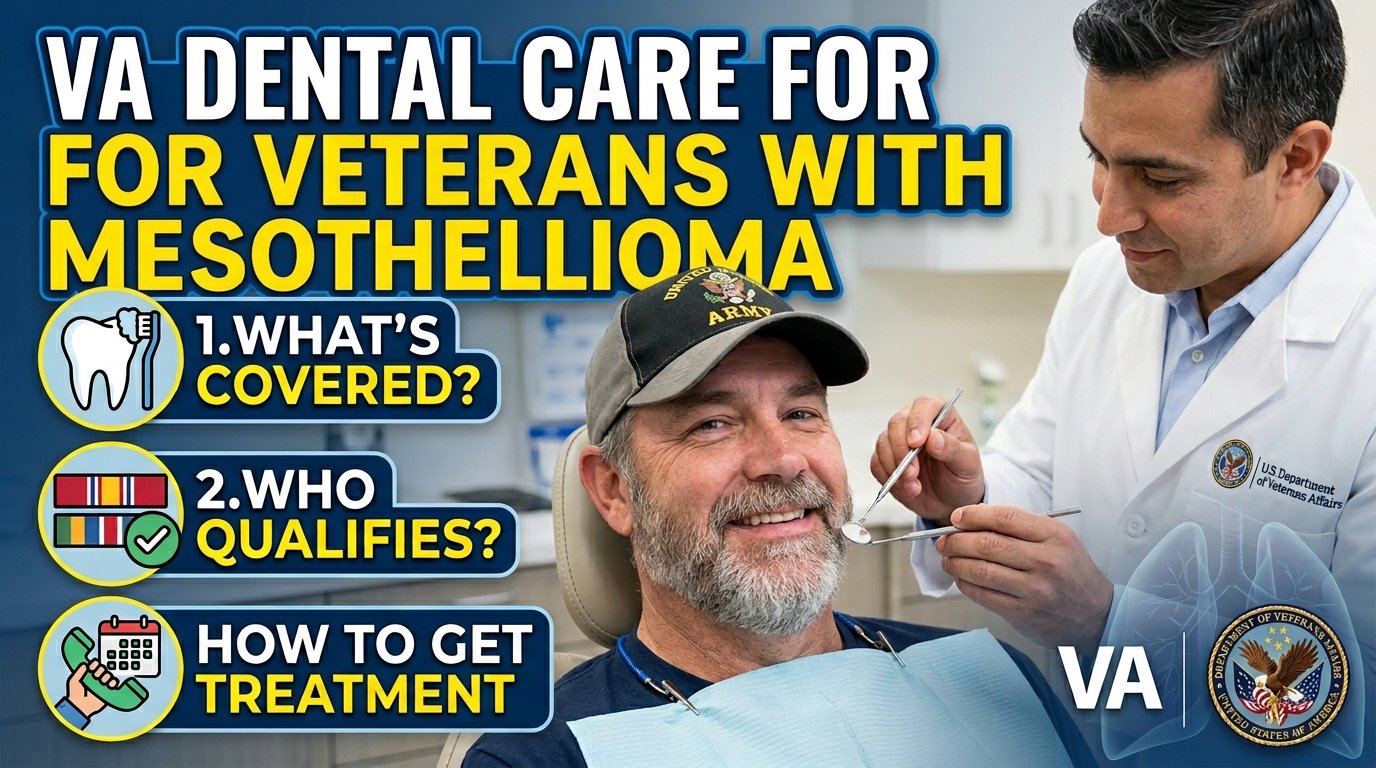
Here is what you need to know. The VA does provide dental care for some veterans. But the rules are different from medical care. Not every veteran qualifies for VA dental benefits. However, veterans with a 100 percent service-connected disability (like mesothelioma) are in the highest priority group for VA dental care.
This guide will walk you through everything you need to know about VA dental care for veterans with mesothelioma. You will learn who qualifies, what services are covered, how to enroll, and how to get emergency dental treatment.
No complicated government language. No confusion. Just clear, honest information to help you get the dental care you need.
Part 1: Why Dental Care Matters for Mesothelioma Patients
The Connection Between Oral Health and Cancer Treatment
If you are undergoing treatment for mesothelioma, your dental health matters more than ever.
Chemotherapy and dental health: Chemotherapy can cause mouth sores, dry mouth, and increased risk of infection. Existing dental problems can become much worse during chemo.
Immunotherapy and dental health: Some immunotherapy drugs can cause inflammation of the mouth and gums.
Pain and nutrition: Tooth pain can make it hard to eat. Good nutrition is essential during cancer treatment. Dental problems should be addressed before they interfere with your ability to eat.
Infection risk: A dental infection during chemotherapy can be dangerous. Your immune system may be weakened. An infection that would be minor for a healthy person can become serious for a cancer patient.
Before starting treatment: Ideally, you should have a dental exam before starting chemotherapy or immunotherapy. Address any cavities, gum disease, or other issues in advance.
Part 2: Do You Qualify for VA Dental Care?
VA dental care is not automatic. Unlike medical care, which is available to all enrolled veterans, dental care has stricter eligibility requirements.
Priority Groups for VA Dental Care
The VA classifies veterans into eight classes for dental care. Class I has the highest priority. Class VIII has the lowest.
Class I (Highest Priority): Veterans with a 100 percent service-connected disability. This includes veterans with mesothelioma.
Class II: Veterans who have a service-connected dental condition (not just any condition – a dental condition specifically caused by service).
Class III: Former prisoners of war.
Class IV: Veterans with a service-connected disability rated at 10 percent or higher who are receiving VA care for that disability and have a dental condition related to that disability.
Class V: Veterans who are participating in a VA vocational rehabilitation program.
Class VI: Veterans who are receiving VA care for a service-connected disability and have been homeless for more than 60 days.
Class VII: Veterans who have been rated at 100 percent for less than 180 days (transitional coverage).
Class VIII (Lowest Priority): All other veterans (limited to once-per-year exam and cleaning if space and resources are available).
For Mesothelioma Veterans: You Are Class I
Because you have a 100 percent service-connected disability (mesothelioma), you are in Class I . This means you are eligible for comprehensive dental care through the VA. There is no waiting list. There is no limitation on services.
What Class I includes:
- Comprehensive dental exams
- Cleanings and preventive care
- Fillings and restorations
- Root canals and endodontic treatment
- Extractions and oral surgery
- Crowns and bridges (prosthodontics)
- Dentures (full and partial)
- Periodontal (gum disease) treatment
- Dental implants (in some cases, may require approval)
Part 3: What Dental Services Are Covered for Class I Veterans?
For veterans with a 100 percent service-connected disability, the VA provides comprehensive dental care. Here is what is typically covered.
Preventive Care (100% Covered)
- Annual comprehensive exam: A complete evaluation of your teeth and gums
- Cleanings (prophylaxis): Usually every 6 months (more often if needed)
- X-rays: Bitewing, panoramic, and periapical X-rays as needed
- Fluoride treatment: For patients at high risk for cavities
- Oral cancer screening: Included in your annual exam
Restorative Care (100% Covered)
- Fillings: Composite (tooth-colored) or amalgam (silver) fillings
- Crowns: For teeth that are too damaged for fillings
- Inlays and onlays: For larger cavities that do not require full crowns
- Root canals (endodontic therapy): To save infected teeth
- Extractions: Removal of teeth that cannot be saved
Prosthodontic Care (100% Covered)
- Full dentures: For patients missing all teeth on upper or lower arch
- Partial dentures: For patients missing some teeth
- Implant-supported dentures: In some cases (may require approval)
- Bridgework: For replacing missing teeth
Periodontal (Gum) Care (100% Covered)
- Deep cleaning (scaling and root planing): For gum disease
- Periodontal maintenance: Ongoing care after gum disease treatment
- Gum surgery: For advanced gum disease (may require referral to periodontist)
Oral Surgery (100% Covered)
- Wisdom tooth extraction
- Removal of impacted teeth
- Biopsy of oral lesions
- Pre-prosthetic surgery (bone smoothing, ridge reduction)
Emergency Dental Care (100% Covered)
- Emergency exams
- Pain management
- Temporary fillings
- Extractions for pain relief
Part 4: What Is NOT Covered by VA Dental Care?
Even for Class I veterans, some dental services may not be covered.
Generally Not Covered
- Cosmetic dentistry: Teeth whitening, veneers (unless medically necessary)
- Orthodontics: Braces for adults (unless medically necessary for jaw surgery)
- Dental implants for cosmetic purposes: May be covered for functional reasons with approval
- Private dental lab fees: If you go outside the VA system
What “Medically Necessary” Means
The VA defines medically necessary as treatment that is needed to:
- Prevent serious dental disease
- Treat existing dental disease
- Restore oral function (chewing, speaking)
- Relieve pain
- Address conditions that affect your overall health
Cosmetic improvements are generally not covered.
Part 5: How to Enroll in VA Dental Care
Step One: Enroll in VA Health Care (If You Haven’t Already)
You must be enrolled in VA health care to receive VA dental care. If you are not already enrolled, complete VA Form 10-10EZ.
Apply online: VA.gov
Apply by mail: Contact your local VA medical center
Apply in person: At your local VA medical center
Step Two: Get Your VA Health Care ID Card
Once enrolled, you will receive a VA health care ID card. Bring this card to all dental appointments.
Step Three: Request a Dental Appointment
Call your local VA medical center. Ask for the dental clinic. Tell them you are a Class I veteran (100 percent service-connected disability). Schedule an initial exam.
If your local VA does not have a dental clinic: Ask about the VA Dental Community Care Program (see Part 7).
Step Four: Attend Your Initial Exam
The dentist will perform a comprehensive exam. They will take X-rays. They will create a treatment plan. You will discuss any urgent needs.
Part 6: VA Dental Care for Veterans Who Are Not 100% Disabled
If you have mesothelioma and are receiving treatment but do not yet have a 100 percent rating, you may still qualify for some dental care.
What You May Qualify For
- Once-per-year dental exam and cleaning (if space and resources are available at your local VA)
- Emergency dental care for pain or infection
- Dental care related to your service-connected condition (if your dental problems are caused by your mesothelioma treatment – e.g., jaw problems from radiation)
How to Get Emergency Dental Care
If you have a dental emergency (severe pain, swelling, bleeding, broken tooth), call your local VA dental clinic. They will see you even if you are not a Class I veteran.
Getting a Higher Rating
If your mesothelioma is active and you are undergoing treatment, you should have a 100 percent rating. If you do not, file for an increased rating. Work with a VSO or VA-accredited attorney.
Part 7: VA Dental Community Care Program
If your local VA medical center does not have a dental clinic, or if the wait time is too long, you may be eligible for the VA Dental Community Care Program. This is similar to the VCCP for medical care.
How It Works
- You receive dental care from a local, non-VA dentist
- The VA pays the dentist directly
- You pay nothing out of pocket (same as VA dental clinic)
Eligibility for Dental Community Care
You qualify if:
- You are a Class I veteran (100 percent service-connected), AND
- Your local VA cannot provide care within 30 days, OR
- You live more than 40 miles from the nearest VA dental clinic, OR
- The VA does not have a dental clinic in your area
How to Access Dental Community Care
Step One: Call your local VA dental clinic.
Step Two: Ask if you qualify for Dental Community Care.
Step Three: The VA will provide a referral to a local dentist.
Step Four: Schedule your appointment with the community dentist.
Part 8: Dental Care While Traveling for Mesothelioma Treatment
If you are traveling to a specialized mesothelioma center (like MD Anderson or Mayo Clinic) for treatment, you may be away from home for weeks or months. You may need dental care while you are away.
What to Do
- Call the VA dental clinic at your travel destination. Explain that you are a Class I veteran who is temporarily in the area for mesothelioma treatment.
- Ask for an appointment. They should accommodate you.
- If they cannot see you, ask about Community Care in that area.
Emergency Dental Care While Traveling
If you have a dental emergency while traveling:
- Go to a local emergency room or urgent care for pain relief.
- Call the VA Beneficiary Travel office within 72 hours.
- They may reimburse you for emergency dental care.
Part 9: Dental Care for Surviving Spouses and Dependents
The VA does not provide dental care for surviving spouses or dependents of veterans who died from mesothelioma. However, there are other options.
CHAMPVA Dental Coverage
If you have CHAMPVA as a surviving spouse, CHAMPVA does not cover routine dental care. It only covers dental care that is:
- Emergency dental care (from an accident)
- Dental care related to a covered medical condition (e.g., jaw surgery for cancer)
For routine dental care (cleanings, fillings, crowns), you will need separate dental insurance or pay out of pocket.
TRICARE Dental (For Some Dependents)
Some surviving spouses and dependents may be eligible for TRICARE dental benefits if the veteran was retired from active duty. Contact TRICARE for details.
Frequently Asked Questions
Do I need a referral from my primary care doctor to see a VA dentist?
No. You can schedule directly with the VA dental clinic.
How often can I get my teeth cleaned?
Most Class I veterans receive cleanings every 6 months. If you have gum disease or other conditions, you may be scheduled more often.
Does the VA cover dental implants?
Sometimes. Implants may be covered if they are medically necessary for functional reasons (e.g., you cannot eat or speak without them). Cosmetic implants are not covered.
Can I see my own dentist and have the VA pay?
Only if you are approved for the VA Dental Community Care Program. You cannot choose any dentist – the VA must refer you.
What if I need a root canal?
Root canals are covered for Class I veterans and for veterans with service-connected dental conditions.
What if I am homeless?
Homeless veterans (Class VI) are eligible for comprehensive dental care, including cleanings, fillings, extractions, and dentures.
Resources
- VA Dental Care Information: www.va.gov/dental/
- Find Your Local VA Dental Clinic: www.va.gov/find-locations/
- VA Dental Community Care: Ask your local VA dental clinic
- VA Form 10-10EZ (Health Care Enrollment): www.va.gov/health-care/how-to-apply/
- Veterans Crisis Line (for dental emergencies that cause severe pain): 988 (press 1)
Final Thoughts: Do Not Neglect Your Teeth
When you are fighting mesothelioma, dental care may not be at the top of your priority list. But your oral health affects your overall health. Infections can spread. Pain can interfere with your ability to eat and sleep.
You have earned comprehensive dental care through the VA. As a Class I veteran (100 percent service-connected disability), you are eligible for cleanings, fillings, root canals, crowns, dentures, and more. All at no cost to you.
Do not wait for a dental emergency. Schedule your annual exam today. Get your teeth cleaned. Address any problems before they become serious.
You served your country. You earned this benefit. Use it.
Disclaimer: This article provides general information about VA dental care for veterans with mesothelioma. It does not constitute medical advice, dental advice, or official VA guidance. VA benefits rules change. Dental eligibility and covered services are subject to change. Every veteran’s situation is different. Always consult with your local VA dental clinic and a qualified dentist about your specific dental needs. If you have been diagnosed with mesothelioma, speak with a doctor immediately and contact a VA-accredited claims agent or an attorney to understand your benefits, including dental care.