Advertisement

VA Appeals for Mesothelioma Claims: What to Do When Your Claim Is Denied

A Denial Is Not the End

You filed your VA claim for mesothelioma. You gathered all your medical records. You completed VA Form 21-526EZ. You went to your C&P exam. You waited months.

And then the letter came.

“Your claim for service connection for mesothelioma is denied.”

Your heart sinks. You feel angry. You feel hopeless. You think, “What was the point of all that effort if they were just going to say no?”

Here is the truth. A denial is not the end. Many VA claims are denied the first time. Sometimes it is because of missing paperwork. Sometimes it is because the VA made a mistake. Sometimes it is because the C&P exam did not capture your symptoms correctly.

You have the right to appeal. The VA has a clear appeals process. And with mesothelioma being a presumptive condition under the PACT Act, most denials can be overturned.

This guide will walk you through everything you need to know about appealing a VA claim denial for mesothelioma. You will learn why claims get denied, the three ways to appeal, which option is fastest, how to gather new evidence, and how to win your appeal.

No complicated government language. No confusion. Just clear, honest information to help you get the benefits you deserve.


Part 1: Why VA Mesothelioma Claims Get Denied

Understanding why your claim was denied is the first step to winning your appeal. The VA’s denial letter will explain the reason. Common reasons include:

Missing or Incomplete Medical Records

The VA needs proof of your mesothelioma diagnosis. If you did not submit your biopsy report, imaging results, or pathology report, your claim may be denied.

Solution: Submit your complete medical records. Ask your doctor for copies.

No Proof of Asbestos Exposure

Even though the PACT Act makes mesothelioma presumptive for many veterans, the VA still needs to know where and when you served. If your DD214 is missing or incomplete, the VA may deny your claim.

Solution: Submit your DD214. If you do not have it, request it from the National Archives. Provide a personal statement describing your service and asbestos exposure.

The VA Says Your Mesothelioma Is Not Service-Connected

This should not happen for veterans who served in qualifying locations under the PACT Act. But sometimes the VA makes mistakes. They may not apply the PACT Act correctly.

Solution: File a Supplemental Claim. Cite the PACT Act. Provide evidence of your qualifying service location or job.

The C&P Exam Did Not Document Your Symptoms Properly

Sometimes the C&P examiner rushes. They do not ask enough questions. They do not document how severe your symptoms are. They write a report that does not reflect your true condition.

Solution: Request a copy of your C&P exam report. If it is inaccurate, write a statement correcting the errors. Ask for a new C&P exam.

You Missed Your C&P Exam

If you did not attend your scheduled C&P exam and did not have a good reason, the VA may deny your claim.

Solution: Contact the VA immediately. Explain why you missed the exam. Reschedule. Provide documentation (like a doctor’s note) if you were sick.

The VA Says You Are Not Eligible for PACT Act Benefits

Some veterans are not covered by the PACT Act presumptive conditions. This includes veterans who served only during peacetime or in non-qualifying locations.

Solution: You may still be eligible based on direct evidence of asbestos exposure. Provide witness statements, ship records, or other evidence showing you were exposed during service.


Part 2: Your Three Appeal Options

The VA offers three ways to appeal a denied claim. Each has different timelines, different rules, and different levels of complexity.

Comparison of Appeal Options

FeatureSupplemental ClaimHigher-Level ReviewBoard Appeal
Best forNew evidence availableVA made a legal mistakeComplex cases, no new evidence
Timeline4-6 months4-6 months1-5 years
Can you submit new evidence?YesNoYes (under certain conditions)
Hearing with a judge?NoNoYes (optional)
Success rateHigh (with good evidence)ModerateModerate
ComplexityLowLowHigh

Part 3: Option One – Supplemental Claim (Fastest and Most Common)

What Is a Supplemental Claim?

Supplemental Claim is an appeal that allows you to submit new evidence that was not part of your original claim. This is the most common type of appeal for mesothelioma claims. It is also the fastest.

When to Use a Supplemental Claim

Use a Supplemental Claim if:

  • You have new medical records showing your mesothelioma diagnosis
  • You have a new doctor’s statement linking your mesothelioma to service
  • You have new evidence of your asbestos exposure (witness statements, ship records)
  • You have a corrected DD214
  • You have a new C&P exam report

How to File a Supplemental Claim

Step One: Complete VA Form 20-0995 (Decision Review Request: Supplemental Claim).

Step Two: List the new evidence you are submitting. Be specific.

Step Three: Attach copies of your new evidence.

Step Four: Submit to the VA online, by mail, or with a VSO.

Deadline: You have one year from the date of your denial letter to file a Supplemental Claim. If you miss the deadline, you lose your right to that effective date. You can still file, but your back pay will start later.

What Happens After You File?

The VA will review your new evidence. They may schedule a new C&P exam. They will issue a new Rating Decision. Most Supplemental Claims are processed in 4-6 months.

Example: Winning a Supplemental Claim

Original claim denied because: No proof of asbestos exposure.

New evidence submitted: A personal statement from the veteran describing his service as a boiler tender on a Navy ship from 1972-1975. A statement from a fellow sailor confirming the ship had asbestos insulation. Navy records showing the ship was built in 1943 and contained asbestos.

Result: Supplemental Claim approved. Veteran receives 100 percent rating and back pay.


Part 4: Option Two – Higher-Level Review

What Is a Higher-Level Review?

Higher-Level Review is an appeal where a senior VA reviewer looks at your claim again. You cannot submit new evidence. The reviewer only looks at the evidence that was already in your file.

When to Use a Higher-Level Review

Use a Higher-Level Review if:

  • You believe the VA made a legal mistake (they misapplied the law)
  • You believe the VA ignored evidence that was already in your file
  • You have no new evidence to submit

How to File a Higher-Level Review

Step One: Complete VA Form 20-0996 (Decision Review Request: Higher-Level Review).

Step Two: Check the box for “informal conference” if you want to explain your case to the reviewer over the phone.

Step Three: Submit to the VA online, by mail, or with a VSO.

Deadline: You have one year from the date of your denial letter.

What Happens After You File?

A senior VA reviewer will examine your file. They may call you for an informal conference if you requested one. They will issue a new Rating Decision. Most Higher-Level Reviews are processed in 4-6 months.

Example: Winning a Higher-Level Review

Original claim denied because: The VA said the veteran’s mesothelioma was not service-connected.

Evidence in file: The veteran served on a Navy ship built in 1942. The PACT Act makes mesothelioma presumptive for Navy veterans who served on ships built before 1983.

VA mistake: The VA did not apply the PACT Act correctly.

Higher-Level Review result: The senior reviewer corrected the mistake. Claim approved.


Part 5: Option Three – Board of Veterans’ Appeals

What Is a Board Appeal?

Board of Veterans’ Appeals (BVA) appeal goes to a judge at the VA’s Board of Veterans’ Appeals in Washington, DC. This is the most formal and slowest option. It can take 1 to 5 years.

When to Use a Board Appeal

Use a Board Appeal if:

  • Your Supplemental Claim and Higher-Level Review were both denied
  • You have a complex case that requires a judge’s interpretation of the law
  • You want a hearing with a judge
  • You have no other options left

Three Types of Board Appeals

Direct Review (fastest, but no new evidence): The judge reviews only the evidence already in your file. No hearing. Timeline: 1-2 years.

Evidence Submission (medium, you can submit new evidence): You can submit new evidence. No hearing. Timeline: 2-3 years.

Hearing (slowest, but you can present your case): You request a hearing with a judge (in person, by video, or by phone). You can submit new evidence. Timeline: 3-5 years.

How to File a Board Appeal

Step One: Complete VA Form 10182 (Decision Review Request: Board Appeal (Notice of Disagreement)).

Step Two: Choose your hearing preference (direct review, evidence submission, or hearing).

Step Three: Submit to the VA.

Deadline: You have one year from the date of your denial letter.

What Happens After You File?

You will wait. And wait. And wait. The Board has a huge backlog. While you wait, you can submit additional evidence and attend your hearing (if requested). Eventually, a judge will issue a decision.

Example: Winning a Board Appeal

Original claim denied because: The VA said the veteran did not have a qualifying service location for PACT Act presumptive status.

Evidence in file: The veteran served in the Navy from 1985-1989 on a ship built in 1979. The ship contained asbestos. The veteran later developed mesothelioma.

Legal argument: The PACT Act covers veterans who served on ships with asbestos, regardless of their service dates.

Board result: The judge agreed with the veteran. Claim approved.


Part 6: Which Appeal Option Is Right for You?

Decision Tree

Do you have new evidence that was not in your original claim?

  • YES → File a Supplemental Claim (fastest, best chance)
  • NO → Continue below

Do you believe the VA made a legal mistake (like misapplying the PACT Act)?

  • YES → File a Higher-Level Review
  • NO → Continue below

Has your Supplemental Claim and Higher-Level Review both been denied?

  • YES → File a Board Appeal
  • NO → Start with Supplemental Claim

Pro Tip for Mesothelioma Veterans

For mesothelioma claims, the Supplemental Claim is usually the best option. Most denials happen because of missing evidence. Submit that missing evidence (medical records, DD214, witness statements, PACT Act citation) and your claim will likely be approved.


Part 7: Gathering New Evidence for Your Appeal

The most important part of any appeal (especially a Supplemental Claim) is your new evidence. Here is what you can submit.

Medical Evidence

  • Biopsy report confirming mesothelioma
  • Imaging results (CT, MRI, PET scans)
  • Pathology report
  • Treatment records (surgery, chemotherapy, radiation, immunotherapy)
  • Doctor’s statement linking your mesothelioma to asbestos exposure
  • Doctor’s statement that you cannot work

Service Evidence

  • DD214 (military discharge papers)
  • Ship records showing asbestos was present
  • Unit records showing your duty locations
  • Personnel records showing your job duties

Lay Evidence (Witness Statements)

  • Your own personal statement describing your service and asbestos exposure
  • Statements from fellow service members who remember working with asbestos
  • Statements from family members who remember you coming home from work with asbestos dust on your clothes

PACT Act Evidence

  • Proof of your service in a qualifying location (Vietnam, Persian Gulf, Afghanistan, etc.)
  • Proof of your service on a Navy ship built before 1983
  • Proof of your service in a high-risk occupation (boiler tender, machinist’s mate, pipefitter, etc.)

Part 8: The Veteran’s Personal Statement

Your personal statement is one of the most powerful pieces of evidence you can submit. Write it in your own words. Be honest. Be specific.

What to Include

  • When and where you served (dates, ship names, base names)
  • Your job duties (be specific – “I was a boiler tender. I worked in the boiler room every day.”)
  • What asbestos products you worked with (insulation, gaskets, packing, pipe covering)
  • How you were exposed (cutting, sanding, removing, repairing)
  • Your mesothelioma diagnosis (when, where, by whom)
  • How mesothelioma affects your life (symptoms, treatment, inability to work)

Example Personal Statement

“I served in the United States Navy from January 1970 to January 1974. I was stationed aboard the USS Kitty Hawk, an aircraft carrier. My job was Machinist’s Mate. I worked in the engine room every day. The pipes and boilers were covered with white insulation that I later learned was asbestos. When we did maintenance, we had to cut into that insulation. White dust would fill the air. No one told us to wear masks. No one told us it was dangerous.

I was diagnosed with pleural mesothelioma in March 2024. I have had chemotherapy. I am tired all the time. I cannot work. I cannot climb stairs without stopping to catch my breath. My wife helps me dress and bathe.

I believe my mesothelioma was caused by the asbestos I was exposed to during my Navy service.”


Part 9: Getting Help with Your Appeal

You do not have to do this alone.

Veterans Service Officers (VSOs)

VSOs from organizations like the American Legion, VFW, DAV, and state VA departments can help with your appeal for free. They know the forms. They know the process. They can submit your appeal for you.

Find a VSO: www.va.gov/ogc/apps/accreditation/

VA-Accredited Attorneys

If your case is complex or you have been denied multiple times, you may want to hire a VA-accredited attorney. They can represent you before the VA and the Board of Veterans’ Appeals.

Important: Attorney fees are capped by law. They can only charge if you win. They are usually paid out of your back pay.


Frequently Asked Questions

How long does an appeal take?
Supplemental Claim: 4-6 months. Higher-Level Review: 4-6 months. Board Appeal: 1-5 years.

Do I get back pay if I win my appeal?
Yes. If your appeal is approved, you receive back pay to the date of your original claim (or the date you became disabled, whichever is later).

Can I file more than one appeal?
Yes. If your Supplemental Claim is denied, you can then file a Higher-Level Review. If that is denied, you can file a Board Appeal.

Do I need a lawyer for my appeal?
Not for a Supplemental Claim or Higher-Level Review. A VSO can help for free. For a Board Appeal, a lawyer can be helpful.

What if I miss the one-year deadline?
You can still file an appeal, but you lose the right to back pay from your original claim date. Your back pay will only go back to the date you file the appeal. File as soon as possible.

How do I check the status of my appeal?
Log into VA.gov. Go to your claim status page. You can also call 1-800-827-1000.


Final Thoughts: Do Not Give Up

A denial letter is discouraging. It feels personal. It feels like the VA does not believe you.

But a denial is not a rejection of you. It is often just a paperwork problem. Missing evidence. A missed deadline. A C&P examiner who did not listen.

You have mesothelioma. You served your country. You deserve these benefits. Do not let a denial stop you.

File an appeal. Get new evidence. Get a VSO to help you. Fight for what you deserve.

You have already fought harder battles. You can win this one too.


Disclaimer: This article provides general information about appealing VA claim denials for veterans with mesothelioma. It does not constitute legal advice or official VA guidance. VA benefits rules change. Every veteran’s situation is different. Always consult with a qualified Veterans Service Officer, VA-accredited attorney, or the VA directly about your specific situation. If you have been diagnosed with mesothelioma, speak with a doctor immediately and contact a VA-accredited claims agent or an attorney to help with your appeal.

The VA C&P Exam for Mesothelioma: What to Expect, How to Prepare, and How to Get the Rating You Deserve

The Exam That Decides Your Future

You have filed your VA claim for mesothelioma. You have gathered your medical records. You have completed VA Form 21-526EZ. You have submitted everything. Now you get a letter from the VA.

They want you to come in for a Compensation and Pension (C&P) exam.

Your heart sinks. Another appointment. More poking and prodding. More questions. You are tired of doctors. You are tired of exams. You just want your benefits.

Take a deep breath. The C&P exam is not like other medical exams. It is not treatment. It is not diagnostic. It is simply the VA’s way of gathering information to decide your disability rating.

For mesothelioma, the C&P exam is usually straightforward. Mesothelioma is a presumptive condition under the PACT Act. The VA knows it is serious. The exam is often brief. But how you handle it can affect your rating and your monthly payment.

This guide will walk you through everything you need to know about the VA C&P exam for mesothelioma. You will learn what the exam is, what the doctor will ask, how to prepare, what to say (and what NOT to say), and how to get the 100 percent rating you deserve.

No complicated government language. No confusion. Just clear, honest information to help you get through this exam and get your benefits.


Part 1: What Is a VA C&P Exam?

The Simple Explanation

Compensation and Pension (C&P) exam is a medical exam performed by a VA doctor or a VA-contracted doctor. Its purpose is NOT to treat you. Its purpose is to gather evidence for your disability claim.

The doctor will:

  • Review your medical records
  • Ask you questions about your symptoms
  • Perform a basic physical examination
  • Write a report for the VA rating specialist

The rating specialist uses this report, along with your medical records and other evidence, to decide:

  • Whether your condition is service-connected (connected to your military service)
  • What your disability rating should be (0 percent to 100 percent)

For Mesothelioma, the C&P Exam Is Usually Simple

Here is the good news. Under the PACT Act, mesothelioma is a presumptive condition for many veterans. The VA does not need to prove service connection. That part is already done.

The C&P exam for mesothelioma is mainly about confirming:

  • You have mesothelioma (the diagnosis)
  • How severe your symptoms are
  • How the disease affects your daily life and ability to work

Because mesothelioma is a terminal cancer, the VA almost always rates it at 100 percent. The C&P exam is often brief. But you still need to take it seriously.


Part 2: Who Needs a C&P Exam?

Not every veteran who files a claim needs a C&P exam. The VA schedules an exam when:

  • Your medical records do not have enough information to decide your claim, OR
  • Your medical records are outdated, OR
  • The VA wants a second opinion from their own doctor

For mesothelioma, you will almost certainly need a C&P exam. The VA wants its own doctor to confirm the diagnosis and document your symptoms.

What If You Are Too Sick to Attend?

If you are too sick to travel to a VA facility, you can request a telehealth C&P exam (by video) or a home-based C&P exam (a doctor comes to you). Call the VA’s C&P scheduling office and explain your situation. They will work with you.


Part 3: How to Prepare for Your C&P Exam

Step One: Gather Your Documents

Bring these items to your exam:

  • Your VA claim number (if you have it)
  • A list of your current medications
  • A list of your doctors and their contact information
  • Copies of recent medical records (especially your mesothelioma biopsy report and imaging results)
  • A notebook to write down notes

Step Two: Write Down Your Symptoms

Before the exam, write down:

  • All your symptoms (even ones that seem minor)
  • When each symptom started
  • How often you have each symptom
  • How severe each symptom is (on a scale of 1 to 10)
  • How each symptom affects your daily life

Example:

  • Shortness of breath – started 6 months ago – happens every day – severity 7/10 – cannot climb stairs, cannot walk more than one block, need to stop to catch my breath
  • Fatigue – started at the same time as shortness of breath – happens every day – severity 8/10 – sleep 12 hours a day, still tired, cannot work, need help with cooking and cleaning
  • Chest pain – started 3 months ago – happens several times a day – severity 6/10 – feels like a sharp stabbing pain under my ribs, worse when I breathe deeply

Step Three: Write Down How Your Life Has Changed

The VA wants to know how mesothelioma affects your daily life. Write down:

  • Can you work? If not, why not?
  • Can you do household chores? (cooking, cleaning, laundry)
  • Can you drive? Can you shop for groceries?
  • Can you bathe and dress yourself? Do you need help?
  • Can you climb stairs? How many steps before you need to rest?
  • Can you walk? How far?
  • Do you need to rest during the day? How often? For how long?
  • How has your social life changed? Do you see friends? Do you go to family events?

Step Four: Bring Someone with You

You can bring a family member or friend to your C&P exam. They can:

  • Help you remember what the doctor said
  • Take notes
  • Provide emotional support
  • Add information if you forget something

Pro tip: Your spouse or caregiver can be very helpful. They see how mesothelioma affects you at home. They can describe symptoms you might not notice yourself.


Part 4: What to Expect During the C&P Exam

Before the Exam

You will check in at the VA facility or contracted clinic. Bring your ID and VA ID card (if you have one). Arrive 15-30 minutes early.

The Doctor’s Questions

The doctor will ask you about:

Your mesothelioma diagnosis:

  • When were you diagnosed?
  • How was it diagnosed (biopsy, imaging)?
  • What type of mesothelioma do you have (pleural, peritoneal)?
  • What cell type (epithelioid, sarcomatoid, biphasic)?

Your symptoms:

  • Do you have shortness of breath? How bad? How often?
  • Do you have chest pain or abdominal pain? How bad? How often?
  • Do you have a cough? Is it dry or wet? Do you cough up blood?
  • Do you have fatigue? How bad? How often?
  • Have you lost weight? How much?
  • Do you have nausea or vomiting? (for peritoneal mesothelioma)
  • Do you have swelling in your abdomen? (for peritoneal mesothelioma)

Your treatments:

  • Have you had surgery? What type?
  • Have you had chemotherapy? What drugs? How many cycles?
  • Have you had radiation? Where?
  • Have you had immunotherapy? What drugs?
  • What are your current treatments? What is your treatment schedule?

How mesothelioma affects your daily life:

  • Can you work? What was your last job? Why did you stop?
  • Can you do household chores?
  • Can you bathe and dress yourself? Do you need help?
  • Can you walk? How far?
  • Can you climb stairs?

Pro tip: Do not minimize your symptoms. Do not say “I am fine” or “It is not that bad.” Be honest. Be complete. Describe your worst days, not your best days.

The Physical Examination

The doctor will perform a basic physical exam. For mesothelioma, this usually includes:

  • Listening to your lungs with a stethoscope
  • Checking for fluid in your lungs or abdomen
  • Checking for lumps or swelling
  • Checking your breathing
  • Checking your oxygen levels (with a pulse oximeter on your finger)

The exam is usually brief. It is not painful.

The Doctor’s Report

After the exam, the doctor writes a report called a Disability Benefits Questionnaire (DBQ) . The DBQ includes:

  • Your diagnosis
  • Your symptoms
  • The results of the physical exam
  • The doctor’s opinion on how your condition affects your daily life and ability to work

The VA rating specialist uses this DBQ to decide your rating.


Part 5: What to Say (And What NOT to Say)

Do Say This

Be honest. Tell the doctor exactly how you feel. If you have bad days, describe them. If you need help with daily activities, say so.

Be specific. “I get short of breath” is vague. “I get short of breath after walking one block and need to rest for five minutes” is specific.

Describe your worst day. The VA wants to know how your condition affects you on your worst days, not your best days. If you have good days and bad days, describe the bad days.

Use “I” statements. “I cannot climb stairs without stopping to catch my breath.” “I need my wife to help me get dressed.”

Talk about your limitations. Tell the doctor what you cannot do now that you used to be able to do.

Do NOT Say This

Do not say “I am fine.” You are not fine. You have mesothelioma. Do not pretend to be okay.

Do not downplay your symptoms. Do not say “It is not that bad” or “I do not want to complain.” The VA cannot help you if you do not tell them how bad it is.

Do not exaggerate. Be honest. Do not lie. The doctor can tell. Exaggerating can hurt your credibility.

Do not talk about non-service-connected issues. The C&P exam is about your mesothelioma. If you have other health problems not related to your service, do not focus on them.

Do not guess. If you do not know the answer to a question, say “I do not know.” Do not make up an answer.


Part 6: Common C&P Exam Mistakes to Avoid

Mistake 1: Dressing Up

Do not dress up for your C&P exam. Dress how you dress on a normal bad day. If you usually wear sweatpants and a loose shirt because of abdominal swelling, wear sweatpants and a loose shirt. The doctor needs to see the real you.

Mistake 2: Shaving or Grooming

If you have lost hair from chemotherapy, do not wear a wig. If you are too weak to shave, do not shave. The doctor needs to see the real you.

Mistake 3: Downplaying Your Symptoms to Be “Polite”

Many veterans are raised to be tough. They say “I am fine” when they are not. They do not want to complain. They do not want to be a burden.

Stop that. Right now.

The C&P exam is not the time to be polite. It is the time to be honest. If you downplay your symptoms, the VA will give you a lower rating. You will get less money. You will not get the benefits you deserve.

Mistake 4: Focusing on Good Days

The VA wants to know about your typical daily functioning. If your symptoms come and go, describe the bad days. Do not say “Sometimes I feel okay” and leave it at that. Say “On my bad days, which happen about 3 days a week, I cannot get out of bed.”

Mistake 5: Going Alone When You Need Help

If you have memory problems, confusion, or difficulty communicating, bring someone with you. Your spouse or caregiver can help the doctor understand your condition.


Part 7: What Happens After the C&P Exam?

The Doctor Submits the DBQ

The doctor will write the DBQ and submit it to the VA. You do not need to do anything.

The VA Rating Specialist Reviews Your File

The rating specialist will review:

  • Your medical records
  • Your C&P exam DBQ
  • Your service records
  • Your personal statements
  • Any other evidence you submitted

The VA Issues a Rating Decision

The VA will send you a letter called a Rating Decision. It will tell you:

  • Whether your claim was approved
  • Your disability rating (should be 100 percent for mesothelioma)
  • Your monthly payment amount
  • The effective date (when your benefits start)

For mesothelioma, you should receive a 100 percent rating. If you do not, appeal.


Part 8: What If the C&P Exam Goes Wrong?

Your Exam Was Rushed or Incomplete

Sometimes C&P examiners are rushed. They do not ask all the questions. They do not listen carefully. They write a report that does not accurately reflect your condition.

What to do: Write a statement describing what happened. Send it to the VA. Request a new C&P exam.

The Doctor’s Report Is Inaccurate

You have the right to request a copy of your C&P exam DBQ. Ask the VA for a copy. If the report is inaccurate, write a statement correcting the errors. Send it to the VA.

Your Claim Was Denied

If your claim is denied, you can appeal. Common reasons for denial include:

  • The C&P exam did not document your symptoms properly
  • The VA says your condition is not service-connected (unlikely with PACT Act)
  • You missed the exam

What to do: Contact a Veterans Service Officer. They can help you appeal.


Frequently Asked Questions

How long does a C&P exam take for mesothelioma?
Usually 30-60 minutes. Sometimes less.

Do I need to bring my medical records?
Yes. Bring copies of your recent medical records, especially your biopsy report and imaging results.

Can I record the C&P exam?
No. Most VA facilities do not allow recording. However, you can bring someone to take notes for you.

What if I cannot travel to the C&P exam?
Request a telehealth exam (by video) or a home-based exam. Call the VA’s C&P scheduling office.

How soon after the C&P exam will I get my rating?
Usually 2-4 months. Sometimes longer.

What if I miss my C&P exam?
Call the VA immediately. Explain why you missed it. Reschedule. If you miss without a good reason, your claim may be denied.


Final Thoughts: This Exam Is Your Chance to Tell Your Story

The C&P exam can feel intimidating. But it is not a test you can fail. It is simply your chance to tell the VA doctor what you are going through.

Be honest. Be specific. Do not downplay your symptoms. Describe your worst days. Bring someone with you if you need help.

You have mesothelioma. You served your country. You deserve the 100 percent rating. The C&P exam is the final step. Do it right. Get the benefits you earned.


Disclaimer: This article provides general information about the VA C&P exam for veterans with mesothelioma. It does not constitute legal advice or official VA guidance. VA benefits rules change. Every veteran’s situation is different. Always consult with a qualified Veterans Service Officer, VA-accredited attorney, or the VA directly about your specific situation. If you have been diagnosed with mesothelioma, speak with a doctor immediately and contact a VA-accredited claims agent or an attorney to help with your claim and C&P exam preparation.

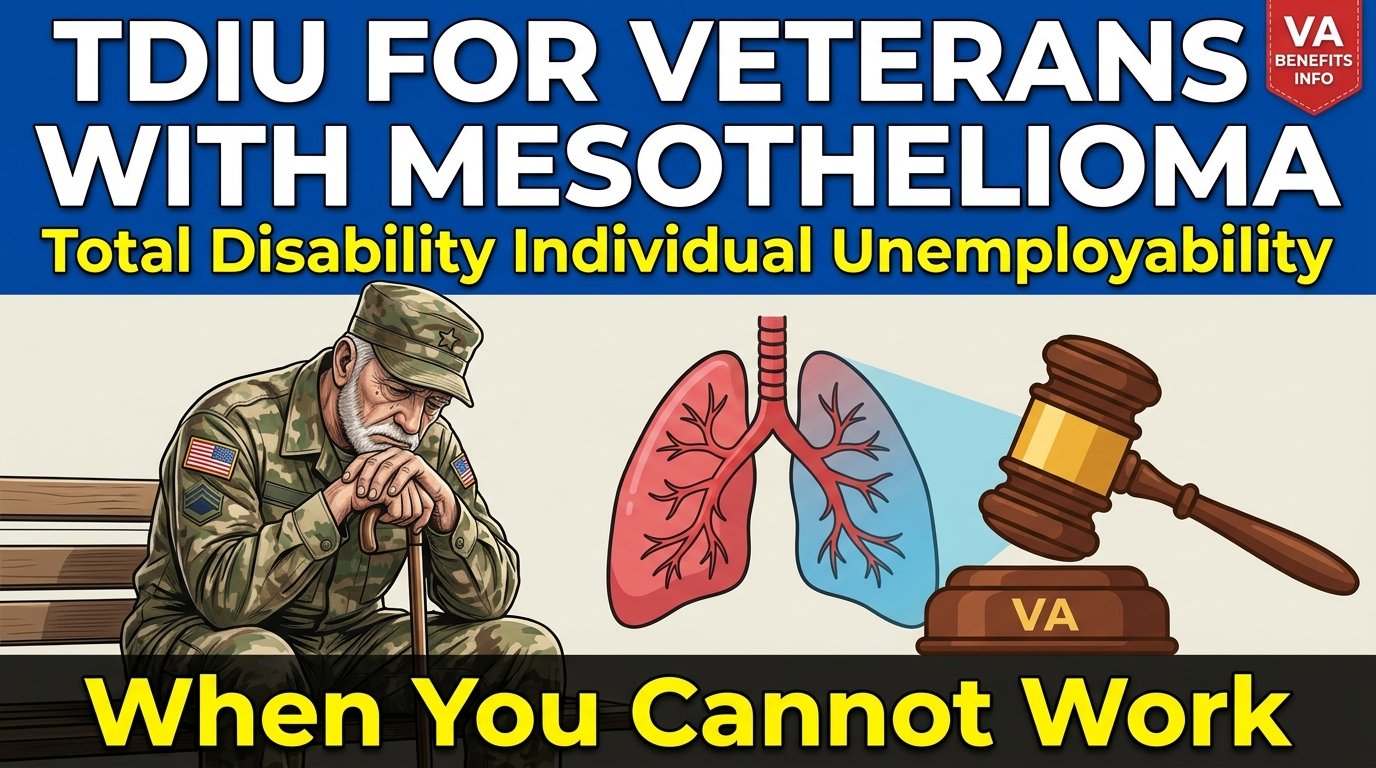
TDIU for Veterans with Mesothelioma: Total Disability Individual Unemployability When You Cannot Work

When 100 Percent Is Not Enough

You have mesothelioma. You cannot work. The fatigue is overwhelming. The shortness of breath makes it impossible to do physical labor. The pain makes it hard to concentrate. Your doctor says you cannot work. You know you cannot work.

You applied for VA disability compensation. You received a rating. But it was not 100 percent. Maybe you received 60 percent. Maybe 80 percent. The VA says you are not fully disabled. But you know you cannot hold down a job.

What do you do?

There is a VA benefit designed exactly for this situation. It is called Total Disability Individual Unemployability (TDIU) . TDIU pays you at the 100 percent disability rate even if your combined disability rating is less than 100 percent. All you need to prove is that you cannot work because of your service-connected conditions.

For veterans with mesothelioma who are still working through treatment or who are in the early stages of the disease, TDIU can be a critical benefit.

This guide will walk you through everything you need to know about TDIU. You will learn who qualifies, how much money you can receive, how to apply, and how to prove you cannot work. No complicated government language. No confusion. Just clear, honest information to help you get the benefits you deserve.


Part 1: What Is TDIU?

The Simple Explanation

Total Disability Individual Unemployability (TDIU) is a VA benefit that pays you at the 100 percent disability compensation rate when:

  • Your combined VA disability rating is less than 100 percent, BUT
  • You cannot work because of your service-connected conditions

In other words, TDIU says: “We do not rate your disabilities as 100 percent on paper. But we recognize that you cannot work because of them. So we will pay you as if you are 100 percent disabled.”

For veterans with mesothelioma, TDIU can be a lifesaver. Mesothelioma is almost always rated at 100 percent, but there are cases where the rating is lower (especially in early stages or certain cell types). TDIU fills the gap.

Why TDIU Exists

The VA disability rating system is based on a schedule that assigns percentage points to specific symptoms. But that schedule does not always capture the full impact of a condition on your ability to work.

You might have a 60 percent rating for mesothelioma based on your current symptoms. But the fatigue, the treatment schedule, and the emotional toll make it impossible to hold a job. TDIU recognizes that reality.


Part 2: Do You Qualify for TDIU?

Basic Eligibility Requirements

To qualify for TDIU, you must meet two requirements.

Requirement 1: You have at least one service-connected disability rated at 60 percent or higher.

OR

You have two or more service-connected disabilities with a combined rating of 70 percent or higher, with at least one disability rated at 40 percent or higher.

For mesothelioma patients, this is usually easy to meet. Mesothelioma is typically rated at 100 percent. But even if you are in the early stages and have a lower rating, you likely meet this requirement.

Requirement 2: You cannot work because of your service-connected conditions.

This is the key requirement. You must prove that:

  • You are not currently working (or you are working in a sheltered/protected environment)
  • Your inability to work is caused by your service-connected conditions, not by other factors (like age or a bad economy)

What counts as “unable to work”? The VA defines this as being unable to secure or follow substantially gainful employment. “Substantially gainful employment” means a job that pays above the federal poverty threshold (approximately $15,000 per year).

What does NOT count as unable to work?

  • Odd jobs or hobby income
  • Working in a family business where you are not genuinely employable elsewhere
  • Sheltered employment (jobs designed for people with disabilities)
  • Working a few hours a week

Special Rules for Mesothelioma

Mesothelioma is a terminal cancer. The VA treats terminal conditions differently. If you have a terminal diagnosis, you do not need to prove that you cannot work. The VA will presume you are unemployable.

Proof required: A doctor’s statement that your mesothelioma is terminal or that your prognosis is less than six months.

Even if your mesothelioma is not yet terminal, a doctor’s statement that you cannot work due to your symptoms (fatigue, pain, shortness of breath, treatment schedule) is usually enough.


Part 3: How Much Money Can You Get?

TDIU Pays at the 100 Percent Rate

If approved for TDIU, you receive the same monthly payment as a veteran with a 100 percent disability rating.

2026 VA Disability Rates for 100% Rating (TDIU same as 100%)

Family StatusMonthly Payment (2026)Annual Payment
Veteran alone$3,938.58$47,262.96
Veteran with spouse$4,158.17$49,898.04
Veteran with spouse and one child$4,318.99$51,827.88
Veteran with spouse and two children$4,479.81$53,757.72

Plus Aid and Attendance (if needed): Add approximately $1,973 per month

TDIU vs. 100% Schedular Rating

Feature100% SchedularTDIU
Based onYour symptoms meeting the rating scheduleYour inability to work
Can you work?Possibly (if sheltered or marginal employment)No (cannot hold substantially gainful employment)
Payment amountSameSame
Additional benefits (CHAMPVA, education, etc.)YesYes

Important: TDIU has work restrictions that a 100 percent schedular rating does not. If you receive TDIU, you cannot earn more than the federal poverty threshold (about $15,000 per year) from work. If you receive a 100 percent schedular rating, you can work without restriction (if you are able).


Part 4: How to Apply for TDIU

Step One: Complete VA Form 21-8940

VA Form 21-8940 is the “Veteran’s Application for Increased Compensation Based on Unemployability.” It is the main application for TDIU.

The form asks for:

  • Your personal information
  • Your VA disability ratings
  • Your employment history from the last 5 years
  • The dates you last worked
  • The reason you stopped working
  • Your average monthly earnings

Where to get the form:

  • Download from VA.gov
  • Pick up from your local VA regional office
  • Ask a Veterans Service Officer for a copy

Step Two: Complete VA Form 21-4192

VA Form 21-4192 is the “Request for Employment Information in Connection with Claim for Disability Benefits.” This form goes to your last employer.

What the form asks for:

  • Your job title and duties
  • Your dates of employment
  • Your earnings
  • The reason your employment ended

Important: Many employers do not respond to this form. If they do not, do not worry. The VA will still process your claim. Just tell the VA you requested the form but did not receive a response.

Step Three: Get a Doctor’s Statement

The most important evidence for TDIU is a doctor’s statement that you cannot work because of your service-connected condition.

Ask your oncologist or primary care doctor to write:

“To whom it may concern: [Veteran’s name] has been diagnosed with mesothelioma, a service-connected cancer. Due to [list specific symptoms: fatigue, pain, shortness of breath, treatment schedule], the veteran is unable to secure or follow substantially gainful employment. This condition is permanent and is expected to continue for the rest of the veteran’s life.”

Step Four: Submit Your Application

Submit your completed VA Form 21-8940, VA Form 21-4192 (if available), and your doctor’s statement.

Submit online: VA.gov
Submit by mail: VA Evidence Intake Center, PO Box 4444, Janesville, WI 53547-4444
Submit with help: A Veterans Service Officer can submit for you


Part 5: What Evidence Does the VA Need?

The VA will look at three types of evidence.

Medical Evidence

  • Your mesothelioma diagnosis (biopsy report, imaging results)
  • Treatment records (surgery, chemotherapy, radiation, immunotherapy)
  • Doctor’s notes describing your symptoms and functional limitations
  • A doctor’s statement that you cannot work

Employment Evidence

  • Your employment history (jobs held in the last 5 years)
  • Earnings records (pay stubs, tax returns)
  • VA Form 21-4192 from your last employer
  • A personal statement describing why you cannot work

Personal Statement

Write a letter to the VA in your own words. Describe:

  • Your typical day (how much time in bed, how much activity you can handle)
  • How mesothelioma affects your ability to work (fatigue, pain, treatment schedule, mental fog)
  • The last job you tried to do and why you could not continue

Example:

“I was diagnosed with mesothelioma in November 2024. I have undergone chemotherapy every three weeks since then. For the week after each treatment, I am bedridden with fatigue and nausea. I cannot concentrate. I cannot drive. I have missed all of my shifts. My employer let me go because I could not reliably show up. I am currently in treatment. My doctor says I cannot work now and does not expect me to be able to work in the future.”


Part 6: What If You Are Working a Little Bit?

Marginal Employment

You can still qualify for TDIU if you are working in “marginal employment.” Marginal employment means:

  • Your earnings are below the federal poverty threshold (about $15,000 per year), OR
  • Your job is in a sheltered or protected environment (like a family business that would not hire someone else to do your job)

Example: You work 10 hours a week at your son’s bookstore, earning $5,000 per year. This is marginal employment. You can still qualify for TDIU.

Protected Work Environment

If you are working in a job that is specifically designed for people with disabilities, or if your employer makes special accommodations for you that they would not make for another employee, this is a “protected work environment.” It does not disqualify you from TDIU.

Example: Your family owns a farm. You do light work for a few hours a week. Your family would not hire someone else to do your job. This is protected employment. You can still qualify for TDIU.


Part 7: TDIU vs. Other VA Benefits

TDIU vs. 100% Schedular Rating (Comparison)

FeatureTDIU100% Schedular
Work allowedOnly marginal employmentAny employment (if able)
Income limit~$15,000/yearNone
Payment amountSameSame
EligibilityMust prove unemployabilityBased on symptom schedule

Can You Receive Both TDIU and Aid and Attendance?

Yes. TDIU and Aid and Attendance are separate benefits. You can receive both.

  • TDIU pays you at the 100 percent rate because you cannot work
  • Aid and Attendance adds extra money because you need help with daily activities

If you qualify for both, your monthly payment could exceed $5,900.

Can You Receive TDIU and Social Security Disability (SSDI)?

Yes. VA benefits and Social Security are separate programs. You can receive both. However, the VA will look at your SSDI approval as evidence that you cannot work.


Part 8: What If Your TDIU Claim Is Denied?

Denials are common. Do not give up.

Common Reasons for Denial

  • The VA says your condition does not prevent you from working
  • The VA says you do not have a qualifying disability rating (60% or 70/40%)
  • Your doctor’s statement was not specific enough
  • You are working above the poverty threshold

How to Appeal

Option 1: Supplemental Claim (fastest)
If you have new evidence (a more detailed doctor’s letter), file a supplemental claim.

Option 2: Higher-Level Review
If you believe the VA made a legal mistake, request a higher-level review.

Option 3: Board of Veterans’ Appeals
If still denied, appeal to the Board of Veterans’ Appeals.

Get help. A Veterans Service Officer or VA-accredited attorney can help with your appeal.


Frequently Asked Questions

Can I get TDIU if I am already receiving 100 percent disability?
No. TDIU is only for veterans who are rated below 100 percent but cannot work. If you already have a 100 percent rating, you do not need TDIU.

Can I work while receiving TDIU?
Yes, but only in marginal employment (earning less than about $15,000 per year). If you earn more than that, the VA may reduce or terminate your TDIU.

Does the VA automatically consider TDIU?
Sometimes. When you file a claim for an increased rating, the VA is supposed to consider TDIU if your evidence shows you are unemployable. But it is safer to apply specifically for TDIU.

How long does a TDIU claim take?
Most TDIU claims are processed in 4-6 months. If you have a terminal diagnosis, request expedited processing.

What if I am retired?
Retirement does not automatically disqualify you from TDIU. You must prove you cannot work because of your service-connected condition, not because you chose to retire.

What if I was fired from my job?
Being fired does not disqualify you. What matters is why you were fired. If you were fired because you could not perform your job due to mesothelioma, that supports your TDIU claim.


Final Thoughts: You Deserve the 100 Percent Rate

Mesothelioma is a devastating disease. Even in its early stages, it can make it impossible to work. The fatigue, the pain, the treatment schedule, the mental fog – all of these add up to a profound inability to hold a job.

The VA disability rating system does not always capture this reality. You might have a 60 percent or 80 percent rating on paper, but in real life, you cannot work. TDIU exists to bridge that gap.

Do not settle for less than you deserve. If you cannot work because of mesothelioma, apply for TDIU. Get the 100 percent payment rate. Get the benefits you earned.

You served. You sacrificed. Now it is time for the VA to serve you.


Disclaimer: This article provides general information about Total Disability Individual Unemployability (TDIU) for veterans with mesothelioma. It does not constitute legal advice or official VA guidance. VA benefits rules change. Every veteran’s situation is different. Always consult with a qualified Veterans Service Officer, VA-accredited attorney, or the VA directly about your specific situation. If you have been diagnosed with mesothelioma, speak with a doctor immediately and contact a VA-accredited claims agent or an attorney to understand your benefits, including TDIU.

Veterans Community Care Program for Mesothelioma: How to Get Treatment at Local Hospitals When the VA Cannot Provide It

When the Nearest VA Hospital Is Too Far Away

You have been diagnosed with mesothelioma. You need specialized treatment. Surgery. Chemotherapy. Immunotherapy. Maybe even HIPEC for peritoneal mesothelioma.

You live in a small town in Montana. Or rural Texas. Or upstate New York. The nearest VA hospital that treats mesothelioma is 300 miles away. You are too sick to drive that far. You cannot afford to stay in a hotel for weeks. Your family cannot take that much time off work.

What do you do?

The answer is the Veterans Community Care Program (VCCP) . This program allows you to receive care from non-VA doctors and hospitals in your local community. The VA pays the bill. You get treatment close to home.

This guide will walk you through everything you need to know about the VCCP for mesothelioma. You will learn who qualifies, what services are covered, how to apply, and how to get the care you need without traveling across the country.

No complicated government language. No confusion. Just clear, honest information to help you get the treatment you deserve.


Part 1: What Is the Veterans Community Care Program?

The Simple Explanation

The Veterans Community Care Program (VCCP) is a VA program that pays for veterans to receive health care from non-VA providers in their local communities. It is sometimes called “Choice Program” or “Mission Act” care.

The program exists because the VA cannot provide every type of care at every location. Some VA hospitals do not have mesothelioma specialists. Some do not offer the advanced surgeries or treatments you need. Some are simply too far away.

Under VCCP, you can see a local doctor, go to a local hospital, or receive treatment at a local cancer center. The VA pays the bill. You do not pay anything out of pocket for covered services.

Why This Matters for Mesothelioma Patients

Mesothelioma is a rare cancer. Only specialized cancer centers have experience treating it. Many VA hospitals have never treated a single case of mesothelioma.

Under VCCP, you can get treatment at renowned mesothelioma centers like:

  • MD Anderson Cancer Center (Houston, Texas)
  • Brigham and Women’s Hospital (Boston, Massachusetts)
  • Memorial Sloan Kettering Cancer Center (New York, New York)
  • Mayo Clinic (Rochester, Minnesota)
  • UCLA Medical Center (Los Angeles, California)

Or you can get treatment from a local cancer center close to your home. The choice is yours.


Part 2: Do You Qualify for VCCP?

You qualify for VCCP if you meet any of the following criteria.

Criterion 1: You Need a Service Not Available at Your Local VA

This is the most common reason mesothelioma patients use VCCP. Your local VA hospital does not have:

  • A thoracic surgeon who performs pleurectomy or extrapleural pneumonectomy
  • A surgical oncologist who performs HIPEC for peritoneal mesothelioma
  • An oncologist experienced with mesothelioma chemotherapy or immunotherapy
  • A radiation oncologist experienced with mesothelioma radiation

How to prove it: Your VA doctor must certify that the service you need is not available at your local VA.

Criterion 2: You Live Too Far from a VA Facility

You qualify for VCCP if:

  • You live more than 40 miles driving distance from the nearest VA medical facility that can provide the service you need, OR
  • You live more than 40 miles from any VA medical facility (for primary care or mental health)

Example: You live 80 miles from the nearest VA hospital. You qualify for VCCP for all your care.

Criterion 3: The VA Cannot Schedule You in a Timely Manner

You qualify for VCCP if the VA cannot schedule your appointment within:

  • 20 days for primary care or mental health
  • 28 days for specialty care (like oncology)
  • 30 days for inpatient hospital admissions

Example: You need to see a mesothelioma specialist. The VA says the earliest appointment is 60 days away. You qualify for VCCP.

Criterion 4: You Live in a State Without a Full-Service VA Medical Facility

Veterans living in Alaska, Hawaii, New Hampshire, and certain rural areas qualify for VCCP for most services.

Criterion 5: There Is a “Grandfathered” Agreement

Some VA facilities have longstanding agreements with local non-VA providers. This is less common, but it applies in some areas.


Part 3: What Services Are Covered Under VCCP?

For veterans with mesothelioma, the following services are covered under VCCP.

Inpatient Hospital Care

  • Surgery (including pleurectomy, extrapleural pneumonectomy, cytoreductive surgery)
  • HIPEC (Heated Intraperitoneal Chemotherapy)
  • Hospital stays for complications or symptom management
  • Intensive care unit (ICU) stays

Outpatient Care

  • Oncology consultations
  • Chemotherapy infusions
  • Immunotherapy infusions
  • Radiation therapy
  • Follow-up appointments
  • Physical therapy and rehabilitation

Emergency Care

  • Local emergency room visits
  • Ambulance transportation
  • Urgent care center visits

Diagnostic Services

  • CT scans, MRIs, PET scans
  • Biopsies
  • Blood tests and laboratory work
  • Pulmonary function tests

Prescription Medications

  • Chemotherapy drugs
  • Immunotherapy drugs
  • Pain medications
  • Anti-nausea medications
  • Other prescriptions related to your mesothelioma treatment

Mental Health Services

  • Counseling and therapy
  • Support groups
  • Psychiatric care

Palliative Care

  • Pain management
  • Symptom management
  • Hospice care (if needed)

Part 4: How to Apply for VCCP

Step One: Talk to Your VA Primary Care Provider

VCCP is not something you apply for on your own. Your VA doctor must refer you. Start by making an appointment with your VA primary care provider.

Tell them: “I have been diagnosed with mesothelioma. I need specialized treatment that is not available at this VA. I would like to be referred to community care.”

Step Two: Your VA Doctor Submits a Referral

Your VA doctor will submit a referral through the VA’s Community Care system. The referral will include:

  • Your diagnosis (mesothelioma)
  • The specific service you need (surgery, chemotherapy, etc.)
  • Why the local VA cannot provide that service
  • Your preferred non-VA provider (if you have one)

Step Three: The VA Approves or Denies the Referral

The VA’s Community Care office will review your referral. They will check:

  • Does the service meet VCCP criteria?
  • Is the non-VA provider qualified?
  • Is the non-VA provider’s cost reasonable?

Processing time: 7-14 days for routine referrals. Expedited for urgent care.

Step Four: You Schedule Your Appointment

Once your referral is approved, you will receive an authorization letter. The letter will include:

  • The approved service (e.g., “oncology consultation”)
  • The number of authorized visits
  • The expiration date (usually 6-12 months)

Call the non-VA provider. Schedule your appointment. Tell them you are a VA Community Care patient. Give them your authorization number.

Step Five: The VA Pays the Bill

The non-VA provider bills the VA directly. You do not pay anything out of pocket for covered services. Your VA copays still apply (the same as if you received care at the VA).


Part 5: Choosing a Non-VA Provider

Can You Choose Any Doctor or Hospital?

Yes and no.

You can choose any Medicare-certified provider who is willing to accept VA Community Care patients. However, the VA may limit your choices if:

  • The provider charges significantly more than other local providers
  • The provider has a history of poor quality or patient complaints
  • The provider is not accepting new patients

Finding a Mesothelioma Specialist Under VCCP

The best mesothelioma treatment centers in the country all accept VA Community Care patients. These include:

  • MD Anderson Cancer Center (Houston, Texas)
  • Brigham and Women’s Hospital (Boston, Massachusetts)
  • Memorial Sloan Kettering Cancer Center (New York, New York)
  • Mayo Clinic (Rochester, Minnesota)
  • UCLA Medical Center (Los Angeles, California)
  • University of Texas Southwestern (Dallas, Texas)
  • University of Chicago Medicine (Chicago, Illinois)

If you want to be treated at one of these centers, tell your VA doctor. They can include your preference in the referral.

What If Your Preferred Provider Is Not in the VA’s Network?

The VA has a large network of community providers. But not every doctor or hospital is in the network.

If your preferred provider is not in the network, you can ask them to join. The provider must:

  • Be Medicare-certified
  • Agree to the VA’s billing and quality requirements
  • Complete a short application

Many mesothelioma specialists are willing to do this. Ask their billing office.


Part 6: What If Your VCCP Referral Is Denied?

Denials happen. Do not give up.

Common Reasons for Denial

  • The VA believes the service is available at your local VA
  • Your referral did not include enough medical justification
  • The provider you chose is not in the VA’s network
  • Your VA doctor did not submit the referral correctly

How to Appeal

Step One: Ask your VA doctor to resubmit the referral with more detailed justification.

Step Two: If that does not work, request a Clinical Review through the VA’s Community Care office. A senior doctor will review your case.

Step Three: If still denied, request a Patient Advocate from the VA. Every VA facility has a Patient Advocate whose job is to help veterans navigate the system.

Step Four: Contact your local Veterans Service Officer (VSO) . They can help you appeal.

Step Five: As a last resort, contact your Congressional representative . They can make inquiries on your behalf.


Part 7: Travel and Lodging for VCCP Appointments

Even with VCCP, you may need to travel to a specialized mesothelioma center. The VA can help with travel costs.

Beneficiary Travel Program

The VA’s Beneficiary Travel Program reimburses veterans for travel to VA-authorized care. This includes VCCP appointments at non-VA facilities.

What is covered:

  • Mileage (at the federal rate, currently around $0.22 per mile)
  • Tolls
  • Parking fees
  • In some cases, airfare, lodging, and meals

How to apply: File VA Form 10-3542 after your appointment. Keep your receipts.

Pre-Approval for Long-Distance Travel

If you need to travel more than 100 miles for treatment, you can request pre-approval. The VA may provide:

  • Airfare or train tickets
  • Hotel lodging
  • Meal allowances

Talk to the VA’s Beneficiary Travel office before you travel.


Part 8: Combining VCCP with Other VA Benefits

VCCP and VA Disability Compensation

You can receive VCCP care and VA disability compensation at the same time. They are separate benefits. One does not affect the other.

VCCP and Aid and Attendance

If you receive Aid and Attendance, you can still use VCCP. The VA will pay for your transportation to appointments, including ambulance or non-emergency medical transport if needed.

VCCP and DIC for Surviving Spouses

If your loved one passed away from mesothelioma before receiving VCCP care, surviving spouses may be eligible for CHAMPVA (Civilian Health and Medical Program of the Department of Veterans Affairs). CHAMPVA is similar to VCCP but for survivors.


Frequently Asked Questions

How long does it take to get a VCCP referral approved?
Routine referrals: 7-14 days. Urgent referrals: 2-3 days. Emergency care does not require pre-approval.

Can I go to the emergency room at my local hospital under VCCP?
Yes. If you have a medical emergency, go to the nearest emergency room. Tell them you are a VA patient. The VA will pay for emergency care under VCCP. Notify the VA within 72 hours.

What if my local VA hospital says they can treat my mesothelioma but I want to go to a specialist?
You have the right to a second opinion. If your VA doctor says they can treat you, you can still request a VCCP referral for a second opinion at a specialist center.

Does VCCP cover experimental treatments or clinical trials?
Sometimes. If the clinical trial is approved by the VA and the treatment is medically necessary, VCCP may cover it. Talk to your VA doctor.

What if my non-VA provider bills me directly?
Do not pay the bill. Call the VA’s Community Care office. They will contact the provider and arrange payment. If you already paid, you can file for reimbursement.

Can I use VCCP for hospice care?
Yes. If your local VA does not offer hospice care, you can receive hospice care at a local non-VA facility under VCCP.


Final Thoughts: You Deserve Care Close to Home

You served your country. You have mesothelioma. You need specialized treatment. You should not have to drive 300 miles or spend weeks away from your family to get it.

The Veterans Community Care Program exists for exactly this situation. It allows you to receive care from local doctors and hospitals when the VA cannot provide it. It pays for treatment at the best mesothelioma centers in the country. It covers travel and lodging when you need to go farther from home.

Do not let distance or inconvenience prevent you from getting the care you need. Talk to your VA doctor about VCCP today. Get the referral. Get the treatment. Get better.

You earned this.


Disclaimer: This article provides general information about the Veterans Community Care Program (VCCP) for veterans with mesothelioma. It does not constitute legal advice or official VA guidance. VA benefits rules change. Every veteran’s situation is different. Always consult with qualified medical professionals and VA staff about your specific care needs. If you have been diagnosed with mesothelioma, speak with a doctor immediately and contact your local VA to understand your treatment options, including VCCP.

Navy Ship Asbestos Exposure: A Complete Guide to the Vessels, High-Risk Jobs, and VA Benefits for Navy Veterans with Mesothelioma

The Silent Danger Beneath the Deck

You served your country at sea. You stood watch in the engine room, the boiler room, or the navigation room. You slept in cramped berthing areas. You ate in the mess hall. You did your job without complaint.

What you did not know was that the ship you served on was filled with asbestos. It was in the insulation wrapped around the pipes. It was in the gaskets sealing the valves. It was in the boiler room walls. It was in the floor tiles and the ceiling panels. It was everywhere.

The Navy used asbestos on ships for decades. From the 1930s until the early 1980s, asbestos was seen as a miracle material. It was cheap. It was heat-resistant. It was fireproof. On a ship, fire is the greatest danger. Asbestos was supposed to protect you.

Instead, it put microscopic fibers into the air you breathed every day. Those fibers settled in your lungs. Decades later, they caused mesothelioma.

If you are a Navy veteran who served on a ship built before 1983, you were almost certainly exposed to asbestos. The VA now recognizes this. Under the PACT Act, mesothelioma is a presumptive condition for Navy veterans. You do not need to prove which ship or which job. The VA presumes your service caused your cancer.

This guide will walk you through everything you need to know about Navy ship asbestos exposure. You will learn which ships and jobs had the highest risk, why the Navy used so much asbestos, what symptoms to watch for, and how to get the VA benefits you deserve.


Part 1: Why the Navy Used So Much Asbestos

The “Miracle Mineral”

Asbestos is a group of naturally occurring minerals. They form into long, thin fibers. These fibers are incredibly strong. They are resistant to heat, fire, and chemicals. They do not conduct electricity.

For the Navy, asbestos was perfect. Ships face constant fire risk. A fire at sea can be a death sentence. Asbestos was used to fireproof nearly every part of the ship.

From the 1930s until the early 1980s, the Navy required asbestos in shipbuilding. It was used in:

  • Insulation: Wrapped around pipes, boilers, and turbines
  • Gaskets and packing: Sealing valves, pumps, and hatches
  • Fireproofing: Coating walls, ceilings, and bulkheads
  • Flooring and ceiling tiles: Throughout the ship
  • Electrical wiring: Insulation on cables
  • Brake pads and clutches: On ship vehicles and equipment

Thousands of tons of asbestos were on a single aircraft carrier. Every sailor aboard was exposed.

The Hidden Danger

The danger was not the asbestos itself. The danger came when asbestos was disturbed. When workers cut, sanded, removed, or repaired asbestos-containing materials, microscopic fibers floated into the air.

You could not see them. You could not smell them. You did not know you were breathing them in.

Those fibers got stuck in your lungs. Your body could not break them down or get rid of them. They sat there for years, causing inflammation and scarring. Twenty, thirty, forty, or fifty years later, that damage turned into mesothelioma.


Part 2: Which Navy Ships Had Asbestos?

Almost every ship built before 1983 contained asbestos. The older the ship, the more asbestos it had. The list includes:

Aircraft Carriers

Aircraft carriers were floating cities. They had thousands of compartments, miles of pipes, and massive engines. All of it was insulated with asbestos.

  • Essex-class (built 1942-1950)
  • Midway-class (built 1943-1947)
  • Forrestal-class (built 1952-1959)
  • Kitty Hawk-class (built 1956-1968)
  • Enterprise-class (built 1960-1961) – the first nuclear-powered carrier, still used asbestos extensively
  • Nimitz-class (built 1968-2009) – early ships in this class contained asbestos; later ships did not

Highest risk jobs on aircraft carriers: Boiler tenders, machinist’s mates, pipefitters, electrician’s mates, insulators, and anyone working in the engine room or boiler room.

Battleships

Battleships were the pride of the Navy. They were also filled with asbestos. The massive boilers and engines required extensive insulation.

  • Iowa-class (built 1942-1944) – including the USS Iowa, USS New Jersey, USS Missouri, USS Wisconsin
  • South Dakota-class (built 1939-1942)
  • North Carolina-class (built 1937-1941)

Cruisers

Cruisers served as escorts for aircraft carriers and battleships. They had the same asbestos issues as larger ships.

  • Baltimore-class (built 1941-1945)
  • Cleveland-class (built 1940-1946)
  • Des Moines-class (built 1945-1949)
  • Boston-class (built 1952-1955)

Destroyers

Destroyers were smaller, faster ships. They were cramped. Asbestos was everywhere.

  • Fletcher-class (built 1941-1945)
  • Allen M. Sumner-class (built 1943-1945)
  • Gearing-class (built 1944-1946)
  • Forrest Sherman-class (built 1953-1959)
  • Spruance-class (built 1972-1983)

Frigates

Frigates were similar to destroyers but focused on anti-submarine warfare.

  • Knox-class (built 1965-1974)
  • Oliver Hazard Perry-class (built 1975-2004)

Submarines

Submarines were cramped, enclosed spaces. Asbestos fibers had nowhere to go. Submariners breathed recirculated air filled with asbestos fibers.

  • Gato-class (built 1940-1944)
  • Balao-class (built 1942-1946)
  • Los Angeles-class (built 1972-1996) – early ships contained asbestos
  • George Washington-class (built 1959-1961) – the first ballistic missile submarines

Amphibious Assault Ships

These ships carried Marines and landing craft. They were built with the same asbestos materials as other vessels.

  • Iwo Jima-class (built 1960-1970)
  • Tarawa-class (built 1973-1980)

Auxiliary Ships

Auxiliary ships provided fuel, supplies, repairs, and other support. They were often older and had significant asbestos.

  • Tankers (AO, AOR, AOE classes)
  • Supply ships (AF, AFS, AKE classes)
  • Repair ships (AR, ARL classes)
  • Tenders (AD, AS, AVT classes)

Part 3: High-Risk Navy Jobs for Asbestos Exposure

Every sailor on a ship built before 1983 was exposed to asbestos. But some jobs had much higher exposure than others.

Boiler Tenders (BT)

Boiler tenders worked directly with boilers that were insulated with asbestos. They worked in boiler rooms where asbestos fibers were constantly in the air. They repaired and maintained boilers, disturbing the asbestos insulation.

Risk level: Extremely high

Machinist’s Mates (MM)

Machinist’s mates worked on engines, pumps, and other machinery. They replaced gaskets and packing materials that contained asbestos. They worked in confined spaces where asbestos fibers accumulated.

Risk level: Extremely high

Pipefitters (PF) and Pipefitter Mates

Pipefitters worked on pipes throughout the ship. The pipes were insulated with asbestos. When they cut, removed, or repaired pipes, they released asbestos fibers into the air. They also worked with asbestos gaskets and packing.

Risk level: Extremely high

Electrician’s Mates (EM)

Electrician’s mates worked with electrical wiring that was insulated with asbestos. They cut and stripped wires, releasing asbestos fibers. They also worked in confined spaces where asbestos exposure was high.

Risk level: High

Enginemen (EN)

Enginemen operated and maintained engines, boilers, and auxiliary equipment. They were surrounded by asbestos every single day.

Risk level: High

Hull Maintenance Technicians (HT)

Hull maintenance technicians repaired and maintained the ship’s structure. They worked with asbestos-containing materials used in bulkheads, decks, and other structural components.

Risk level: High

Gunner’s Mates (GM)

Gunner’s mates worked with weapons systems. Older weapons systems used asbestos-containing components. They were also exposed to asbestos in their workspaces.

Risk level: Moderate to High

Insulators

Insulators were responsible for installing and repairing insulation throughout the ship. Much of that insulation contained asbestos. This job had probably the highest asbestos exposure of all.

Risk level: Extremely high

Shipyard Workers (Civilian and Military)

Shipyard workers built, repaired, and maintained ships. They worked with asbestos every day. Welders, pipefitters, electricians, insulators, carpenters, and laborers were all exposed. Even office workers and storekeepers in shipyards were exposed to asbestos fibers in the air.

Risk level: Extremely high

Damage Controlmen (DC)

Damage controlmen responded to emergencies on the ship, including fires. When fires damaged asbestos-containing materials, they were exposed to high levels of asbestos fibers.

Risk level: High


Part 4: What If You Were Not in a High-Risk Job?

Many Navy veterans assume they were not exposed because their job was not on the “high-risk” list. This is not true.

Asbestos was everywhere on Navy ships. If you breathed the air on a ship built before 1983, you were exposed. It does not matter if you were a cook, a storekeeper, a radioman, or a yeoman. Asbestos fibers circulated through the ventilation system. They settled in berthing areas, mess halls, and offices.

Every sailor on a ship built before 1983 was exposed to asbestos. The VA recognizes this. Under the PACT Act, Navy service on a ship built before 1983 is enough to qualify for presumptive status.


Part 5: What If You Never Served on a Ship?

Many Navy veterans were exposed to asbestos even if they never set foot on a ship.

Shipyard Workers

You worked in Navy shipyards building, repairing, or maintaining ships. The shipyards themselves were filled with asbestos. Dry docks, workshops, and offices all contained asbestos materials.

Shore-Based Personnel

You worked on naval bases, barracks, offices, and other facilities that contained asbestos in insulation, flooring, ceiling tiles, and wall panels. Asbestos was used in military construction for decades.

Aviation Personnel

You worked on Navy aircraft that contained asbestos in brake pads, gaskets, and insulation. Even if you never went to sea, you were exposed.

If you served in the Navy in any capacity before the 1980s, you were exposed to asbestos.Period.


Part 6: Symptoms of Mesothelioma – What to Watch For

Mesothelioma takes 20 to 50 years to develop after asbestos exposure. Many Navy veterans are being diagnosed now, decades after their service.

Common Symptoms of Pleural Mesothelioma (Lung Lining)

  • Shortness of breath that gets worse over time
  • Pain in your chest or under your ribcage
  • A dry cough that will not go away
  • Coughing up blood
  • Trouble swallowing
  • Hoarseness in your voice
  • Swelling in your face or arms
  • Unexplained weight loss
  • Extreme fatigue
  • Night sweats or fever

Common Symptoms of Peritoneal Mesothelioma (Abdominal Lining)

  • Pain or swelling in your abdomen
  • Nausea and vomiting
  • Loss of appetite
  • Unexplained weight loss
  • Diarrhea or constipation
  • Swelling in your legs
  • Extreme fatigue

If you have any of these symptoms and you served on a Navy ship, see a doctor immediately. Tell the doctor about your asbestos exposure.


Part 7: VA Benefits for Navy Veterans with Mesothelioma

You Are Presumptive Under the PACT Act

The PACT Act of 2022 made mesothelioma a presumptive condition for Navy veterans who served on ships built before 1983 or in shipyards. This means:

  • You do not need to prove a direct connection between your service and your mesothelioma
  • The VA presumes your mesothelioma was caused by your service
  • Your claim should be approved

How to Apply

Step One: Gather your DD214 and medical records showing your mesothelioma diagnosis.

Step Two: Complete VA Form 21-526EZ (Application for Disability Compensation).

Step Three: In the exposure section, write: “I was exposed to asbestos during my Navy service aboard [ship name/years]. Asbestos was used throughout the ship. I have been diagnosed with mesothelioma.”

Step Four: Submit your application online at VA.gov, by mail, or with the help of a Veterans Service Officer.

How Much Will You Receive?

Mesothelioma is rated at 100 percent disability. For 2026, a single Navy veteran with a 100 percent rating receives approximately 3,938permonth∗∗.WithAidandAttendance(ifyouneedhelpwithdailyactivities),youcanreceiveapproximately∗∗3,938permonth∗∗.WithAidandAttendance(ifyouneedhelpwithdailyactivities),youcanreceiveapproximately∗∗5,912 per month.


Frequently Asked Questions

Do I need to know which ship I served on?
No. Under the PACT Act, you do not need to provide specific ship names. General service dates and locations are enough.

What if I served on a ship built after 1983?
Ships built after 1983 used less asbestos, but some still contained it. You may still be eligible. Talk to a VSO.

What if I only served on a ship for a short time?
Even short-term exposure can cause mesothelioma. The length of exposure does not matter. File your claim.

Can I receive VA benefits and also sue asbestos companies?
Yes. VA benefits come from the government. Lawsuits and trust fund claims come from private companies. They are completely separate.

How long does a VA claim take for Navy veterans?
Most claims are processed in 3-6 months. With a terminal diagnosis, you can request expedited processing.

What if my claim was denied before the PACT Act?
You can reapply. File a Supplemental Claim citing the PACT Act. Your claim should be approved under the new rules.


Final Thoughts: You Served. Now It Is Time to Be Served.

You stood in the engine room, the boiler room, or the navigation room. You did your job without complaint. You did not know that the asbestos around you was slowly killing you.

That was not your fault. The Navy knew asbestos was dangerous. The companies that made asbestos products knew. They hid the truth. They kept using it anyway.

Now you have mesothelioma. You are facing surgery, chemotherapy, radiation, or immunotherapy. You are worried about your family. You are worried about your finances.

But here is the truth. The VA has benefits for Navy veterans like you. Monthly tax-free payments. Free health care. Help for your family.

These benefits are not charity. You earned them. You served. Now it is time for your country to serve you.

Do not wait. File your VA claim today. Get a Veterans Service Officer to help you. The process is free. The money is there. You deserve it.


Disclaimer: This article provides general information about Navy ship asbestos exposure and VA benefits for Navy veterans with mesothelioma. It does not constitute legal advice or official VA guidance. VA benefits rules change. Every veteran’s situation is different. Always consult with a qualified Veterans Service Officer, VA-accredited attorney, or the VA directly about your specific situation. If you are a Navy veteran with symptoms of mesothelioma, see a doctor immediately. If you have been diagnosed with mesothelioma, contact a VA-accredited claims agent or an attorney to understand your benefits.

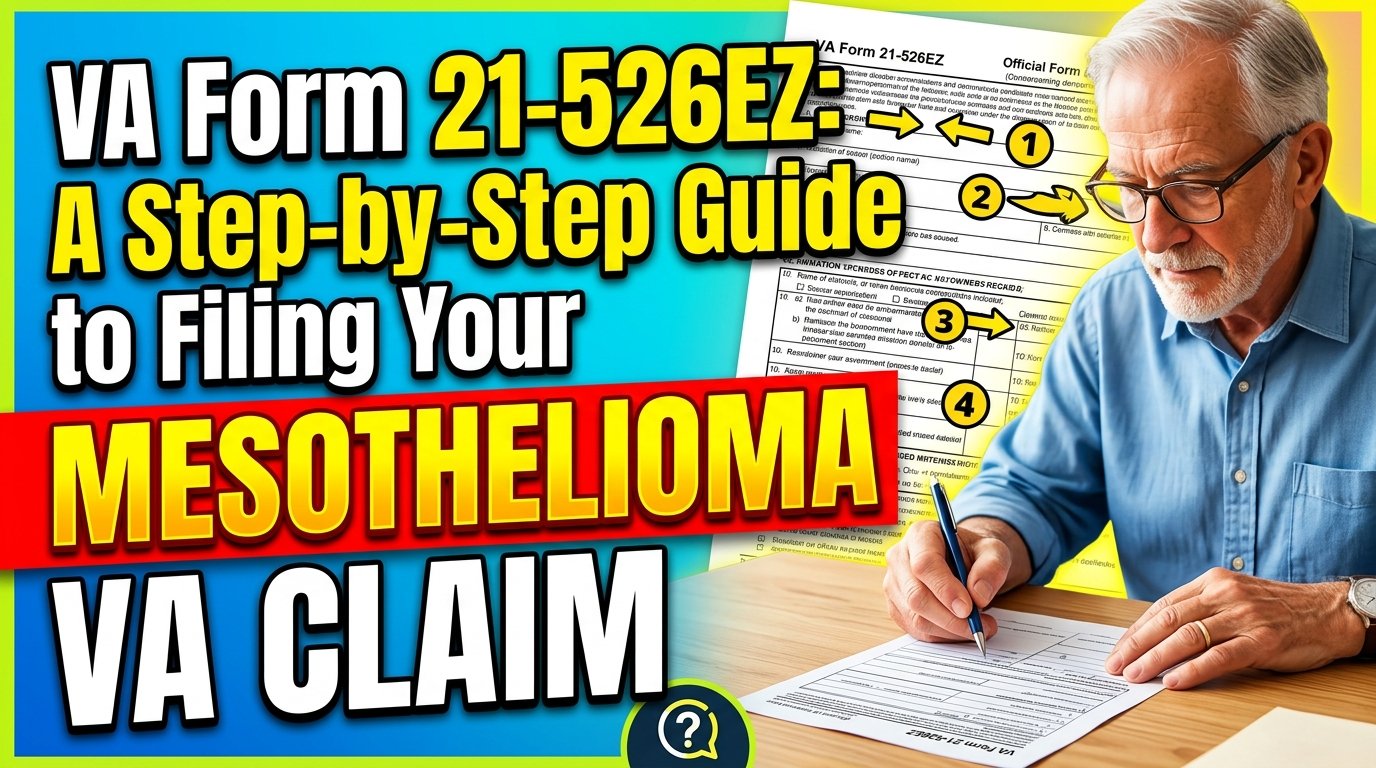
VA Form 21-526EZ: A Step-by-Step Guide to Filing Your Mesothelioma VA Claim

The Form That Unlocks Your Benefits

You have served your country. You have been diagnosed with mesothelioma. You have heard that the VA offers benefits for veterans with asbestos-related cancers. You know you deserve help.

But now you are staring at a government form. It is eleven pages long. It asks for dates, locations, and details you half-remember from forty years ago. You are sick. You are tired. You do not have the energy for paperwork.

Take a deep breath. You can do this.

VA Form 21-526EZ is the application for VA disability compensation. Despite its intimidating name, the “EZ” actually stands for “Easy.” The form was designed to be simpler than older VA forms. And with the PACT Act making mesothelioma a presumptive condition, your claim is easier than ever to file.

This guide will walk you through VA Form 21-526EZ line by line, page by page. You will learn what information you need, how to answer each question, and how to submit your application. No complicated government language. No confusion. Just clear, honest instructions to help you get the benefits you earned.


Part 1: Before You Start – What You Will Need

Before you open the form, gather these documents. Having them ready will make the process much faster.

Personal Information

  • Your full legal name (as it appears on your DD214)
  • Your Social Security number
  • Your VA file number (if you have one – it is on your VA ID card)
  • Your date and place of birth

Military Service Information

  • Your DD214 (Certificate of Release or Discharge from Active Duty)
  • Your branch of service (Navy, Army, Air Force, Marines, Coast Guard)
  • Your dates of active duty service (start and end)
  • Your service number (if you have one – older veterans may have this instead of an SSN)
  • Your highest rank achieved

Medical Information

  • Your mesothelioma diagnosis (from your doctor)
  • The date you were diagnosed
  • The name and address of the hospital or clinic where you were diagnosed
  • Your doctor’s name and contact information

Exposure Information (for asbestos claims)

  • Where you think you were exposed to asbestos (ship name, base name, job duties)
  • The approximate dates of exposure (even a range like “1972-1975” is fine)
  • A brief description of your job duties that involved asbestos

Do not worry if you do not have exact dates or ship names. Under the PACT Act, mesothelioma is presumptive for many veterans. You do not need perfect records.


Part 2: Understanding VA Form 21-526EZ

What Is This Form?

VA Form 21-526EZ is the Application for Disability Compensation and Related Compensation Benefits. It is the main form you use to apply for VA disability benefits.

You use this form whether you are applying for:

  • A new disability (like mesothelioma)
  • An increased rating for an existing disability
  • Secondary conditions caused by a service-connected disability

For mesothelioma, you are filing a new disability claim.

Where to Get the Form

Pro tip: The online application is the fastest method. It walks you through the same questions as Form 21-526EZ, but you do not have to print or mail anything. If you are comfortable using a computer, use the online portal.


Part 3: Line-by-Line Guide to VA Form 21-526EZ

Let us walk through the form page by page.

Page 1: Veteran Identification

Section I: Veteran’s Information

  • Item 1A: Your full name (Last, First, Middle Initial)
  • Item 1B: Your Social Security number
  • Item 1C: Your VA file number (if known – leave blank if not)
  • Item 1D: Your date of birth
  • Item 1E: Your place of birth (city and state)
  • Item 1F: Your gender (Male/Female)
  • Item 1G: Your current mailing address
  • Item 1H: Your email address (optional but helpful)
  • Item 1I: Your phone number

Item 2: Service Information

  • Item 2A: Your branch of service (check Navy, Army, Air Force, Marines, or Coast Guard)
  • Item 2B: Your service number (if you served before the 1970s and have one)
  • Item 2C: Your highest rank achieved
  • Item 2D: Date entered active duty (MM/DD/YYYY)
  • Item 2E: Date released from active duty (MM/DD/YYYY)

Item 3: Have you applied for VA disability benefits before? (Check Yes or No)

  • If Yes, provide the date and the VA regional office where you applied

Item 4: Are you receiving any VA disability benefits now? (Check Yes or No)

Item 5: Are you on active duty now? (Check Yes or No)

Page 2: Dependent Information

This section is important because your payment amount increases if you have dependents.

Section II: Dependency Information

  • Item 6A: Are you married? (Yes/No)
  • Item 6B: If Yes, provide spouse’s full name, date of birth, and Social Security number
  • Item 7: Do you have any unmarried children under 18? (Yes/No)
  • If Yes, list each child’s full name, date of birth, and Social Security number
  • Item 8: Do you have any unmarried children between 18 and 23 who are attending school? (Yes/No)
  • If Yes, list each child’s name, school name, and expected graduation date
  • Item 9: Do you have any other dependents (like a disabled parent)? (Yes/No)

Page 3: Disability Information (The Most Important Page)

Section III: Disability Information

Item 10A: List the disabilities you are claiming.

For mesothelioma, write exactly:

“Mesothelioma (asbestos-related cancer) – presumptive condition under PACT Act”

Item 10B: Date of diagnosis.

Write the date your doctor first told you that you have mesothelioma.

Item 10C: How does this disability affect your ability to work?

Be honest. Write something like:

“I have been diagnosed with mesothelioma, a terminal cancer. I am undergoing treatment including [chemotherapy/surgery/immunotherapy]. I am unable to work due to fatigue, shortness of breath, pain, and frequent medical appointments.”

Item 10D: Where did you receive treatment?

List the name and address of the hospital, clinic, or doctor who diagnosed and treated you.

Page 4: Exposure Information (For Asbestos Claims)

Section IV: Exposure Information

Item 11A: Were you exposed to environmental hazards during your military service? (Check Yes)

  • Item 11B: Describe the exposure.

Write something like:

“I was exposed to asbestos during my service in the United States Navy. I served aboard the [ship name] from [year] to [year]. My job duties included [brief job description]. Asbestos was used throughout the ship for insulation, gaskets, pipe covering, and other materials.”

Example if you do not remember ship details:

“I was exposed to asbestos during my service in the Navy from [year] to [year]. I served on active duty and was stationed on ships and in shipyards where asbestos was widely used. I handled and was around asbestos-containing materials including insulation, gaskets, and pipe covering.”

Item 11C: What conditions do you believe are related to this exposure?

Write:

“Mesothelioma, which is known to be caused by asbestos exposure.”

Page 5: Employment Information

Section V: Employment Information

  • Item 12A: Are you currently employed? (Yes/No)
  • Item 12B: If No, provide the date you last worked
  • Item 12C: Your last employer’s name and address
  • Item 12D: Your job title
  • Item 12E: Average monthly earnings from that job

Why this matters: The VA uses this information to determine if you are eligible for unemployability benefits (TDIU) if your mesothelioma prevents you from working.

Page 6-11: Remaining Sections

The rest of the form asks for:

  • Banking information (for direct deposit of your monthly payments)
  • Authorization to release information (sign this – it allows the VA to get your medical records)
  • Payment authorization
  • Your signature and date

Sign and date the form. Unsigned forms will be returned to you, delaying your claim.


Part 4: The PACT Act Addendum

What Is the PACT Act Addendum?

The VA created a special PACT Act Addendum (VA Form 21-526EZ – PACT Act) for veterans filing claims under the new law. This addendum is short – just one page.

What the addendum asks:

  • Did you serve in the Vietnam theater of operations? (Yes/No/Dates)
  • Did you serve in the Persian Gulf or Afghanistan? (Yes/No/Dates)
  • Did you serve on a Navy ship or in a Navy shipyard? (Yes/No/Dates)
  • Do you have a presumptive condition listed under the PACT Act? (Check Mesothelioma)

Pro tip: Always include the PACT Act Addendum with your Form 21-526EZ. It flags your claim for expedited processing under the new presumptive rules.


Part 5: Submitting Your Claim

Option 1: Online (Fastest)

Go to VA.gov. Create a login (or use your existing DS Logon, ID.me, or Login.gov account). Follow the prompts to file a disability claim online.

The online system walks you through the exact same questions as Form 21-526EZ. You can upload your medical records and DD214 directly. This is the fastest method.

Processing time: 3-4 months on average

Option 2: By Mail

Mail your completed Form 21-526EZ, PACT Act Addendum, and all supporting documents to:

Department of Veterans Affairs
Claims Intake Center
PO Box 4444
Janesville, WI 53547-4444

Pro tip: Send your package by certified mail with return receipt requested. This proves the VA received your application.

Processing time: 4-6 months on average

Option 3: In Person

Take your completed forms and documents to your nearest VA regional office. A VA representative will help you submit them.

Processing time: 4-6 months on average

Option 4: With a VSO (Best Option)

Veterans Service Officer (VSO) from organizations like the American Legion, VFW, or DAV can help you fill out and submit your forms for free. They know the system. They can avoid common mistakes. This is the best option if you feel overwhelmed.

Find a VSO: Visit www.va.gov/ogc/apps/accreditation/


Part 6: What Happens After You Submit

Step One: VA Acknowledgment

The VA will send you a letter (or email) acknowledging receipt of your claim. This letter includes your claim number and the date your claim was received.

Step Two: Evidence Gathering

The VA will gather your service records, medical records, and any other evidence you submitted. They may contact you for additional information.

What you can do: If you have additional medical records, send them to the VA as soon as possible. You do not need to wait for them to ask.

Step Three: C&P Exam

The VA will schedule a Compensation and Pension (C&P) exam with a VA doctor. This exam is free. The doctor will review your medical records and examine you. They will write a report about your condition.

For mesothelioma: The C&P exam is usually brief. The doctor will confirm your diagnosis and document your symptoms. They will also note that mesothelioma is a 100 percent disabling condition.

Step Four: VA Rating Decision

The VA will issue a Rating Decision. This letter will tell you:

  • Whether your claim was approved or denied
  • Your disability rating (100 percent for mesothelioma)
  • Your monthly payment amount
  • The effective date (when your benefits start)

Step Five: You Start Receiving Payments

If your claim is approved, your monthly payments will begin within 30 days. You will also receive back pay from the effective date.


Part 7: Common Mistakes to Avoid

Mistake 1: Not Mentioning the PACT Act

Under the PACT Act, mesothelioma is presumptive. But you need to tell the VA you are claiming it under the PACT Act. Check the box. Mention it in your exposure statement. Include the PACT Act Addendum.

Mistake 2: Leaving Sections Blank

If a question does not apply to you, write “N/A” (not applicable). Do not leave it blank. The VA may return your form as incomplete.

Mistake 3: Forgetting Your Signature

An unsigned form is invalid. Sign and date the last page. If you are filing online, you will sign electronically.

Mistake 4: Sending Original Documents

Never send original documents. The VA will not return them. Send copies. Keep your originals in a safe place.

Mistake 5: Applying Alone When You Need Help

There is no shame in asking for help. A Veterans Service Officer can help you for free. Use them.


Frequently Asked Questions

How long does it take to fill out VA Form 21-526EZ?
About 30 minutes if you have your documents ready. 1-2 hours if you need to gather information.

Do I need a lawyer to fill out this form?
No. A lawyer is not required. A VSO can help for free. You can also fill it out yourself.

What if I do not remember my ship name or exact dates?
Do your best. Use ranges like “1972-1975.” Under the PACT Act, exact proof is not required for mesothelioma claims.

Can I file online instead of using the paper form?
Yes. The online application at VA.gov is faster and easier. It asks the same questions.

What if I make a mistake on the form?
Do not worry. The VA will contact you if they need clarification. You can also submit a corrected form.

How do I check the status of my claim?
Go to VA.gov and log into your account. You can see your claim status online. You can also call 1-800-827-1000.


Final Thoughts: You Can Do This

VA Form 21-526EZ looks intimidating. Eleven pages. Small print. Government language. But it is not as hard as it looks. You have already done harder things. You served your country. You faced a mesothelioma diagnosis. You have fought through treatment.

You can fill out one form.

Take it one page at a time. Gather your documents. Answer each question honestly. If you get stuck, call a VSO. They are there to help you.

The benefits you are applying for can change your life. Monthly tax-free payments. Free health care. Peace of mind for you and your family.

Do not wait. Fill out the form today. You earned this.


Disclaimer: This article provides general information about VA Form 21-526EZ and the VA disability claim process for veterans with mesothelioma. It does not constitute legal advice or official VA guidance. VA benefits rules change. Every veteran’s situation is different. Always consult with a qualified Veterans Service Officer, VA-accredited attorney, or the VA directly about your specific situation. If you have been diagnosed with mesothelioma, speak with a doctor immediately and contact a VA-accredited claims agent or an attorney to help with your claim.

The PACT Act and Mesothelioma: How the 2022 Law Changed Everything for Veterans Exposed to Asbestos

The Letter That Finally Arrived

For decades, veterans who served on Navy ships, in shipyards, or on military bases were told something frustrating. “You have cancer. But we cannot prove it came from your service. Your claim is denied.”

The companies that made asbestos products knew the danger. The military knew asbestos was everywhere. But the burden of proof fell on the veteran. You had to prove that the mesothelioma you were diagnosed with thirty years after your service came from the asbestos you breathed on that ship.

That was almost impossible. Records were lost. Witnesses had died. Memories faded. Thousands of veterans were denied benefits they deserved.

Then came the PACT Act.

On August 10, 2022, President Biden signed the Honoring our Promise to Address Comprehensive Toxics (PACT) Act into law. It was the largest expansion of VA benefits in decades. And it changed everything for veterans with mesothelioma.

This guide will walk you through everything you need to know about the PACT Act and how it affects veterans with mesothelioma. You will learn what the law does, why it matters, which veterans qualify, what new benefits are available, and how to apply.

No complicated government language. No confusion. Just clear, honest information to help you get the benefits you earned.


Part 1: What Is the PACT Act?

The Simple Explanation

The PACT Act is a law that expands VA health care and benefits for veterans exposed to toxic substances during their military service. “Toxic substances” includes asbestos, burn pits, Agent Orange, radiation, and other environmental hazards.

Before the PACT Act, a veteran had to prove that their illness was directly caused by their military service. This was often impossible. Asbestos-related diseases like mesothelioma take 20 to 50 years to develop. Records are lost. Memory fades.

The PACT Act changed this by creating presumptive conditions. A presumptive condition means the VA automatically assumes your illness was caused by your service if you served in certain locations or job roles. You do not have to prove the connection. The burden of proof shifts from you to the VA.

Why the PACT Act Was Needed

Here is the problem the PACT Act solved.

Before 2022, a Navy veteran who served on a ship filled with asbestos had to provide evidence that they were exposed to asbestos during their service. But what evidence? The Navy did not keep records of which sailor was in which engine room on which day. Companies destroyed records of which ships had asbestos. Witnesses died.

As a result, many legitimate claims were denied. The VA said, “We believe you were exposed, but you cannot prove it.” That was wrong. That was unjust. The PACT Act fixed it.


Part 2: How the PACT Act Helps Veterans with Mesothelioma

Mesothelioma Is Now a Presumptive Condition

The most important change for mesothelioma veterans is this. Mesothelioma is now a presumptive condition for veterans who served in specific locations and time periods.

This means if you served in any of the following locations, the VA presumes your mesothelioma was caused by your military service. You do not need to prove a connection. You do not need to find old records. You do not need to track down witnesses.

Where you must have served:

  • The Persian Gulf, Afghanistan, or Djibouti from August 2, 1990 to present
  • The Vietnam War from January 9, 1962 to May 7, 1975 (including service on inland waterways and offshore waters)
  • The Korean Demilitarized Zone from September 1, 1967 to August 31, 1971
  • Any active duty military service where you were exposed to asbestos through your job duties (includes all Navy ship service before 1983)

It Also Covers Other Asbestos-Related Cancers

The PACT Act also made several other cancers presumptive for veterans with toxic exposure. These include:

  • Lung cancer
  • Gastrointestinal cancers (stomach, colon, esophageal)
  • Laryngeal cancer
  • Pharyngeal cancer
  • Urinary tract cancers (kidney, bladder)

If you are a veteran with any of these cancers and you served in a qualifying location or job, the VA presumes your cancer came from your service. This is a massive expansion of benefits.

The 20+ New Presumptive Conditions

The PACT Act added more than 20 new presumptive conditions for veterans exposed to toxic substances. These include:

  • Asthma (moderate or severe)
  • Chronic bronchitis
  • Chronic obstructive pulmonary disease (COPD)
  • Chronic sinusitis
  • Chronic rhinitis
  • Constrictive bronchiolitis
  • Emphysema
  • Granulomatous disease
  • Interstitial lung disease
  • Pleuritis
  • Pulmonary fibrosis
  • Sarcoidosis

And cancers including:

  • Brain cancer
  • Gastrointestinal cancer (multiple types)
  • Head and neck cancer
  • Kidney cancer
  • Lymphoma (Hodgkin’s and non-Hodgkin’s)
  • Melanoma
  • Pancreatic cancer
  • Reproductive cancer
  • Respiratory cancer (lung, bronchus, larynx, pharynx)
  • Urinary tract cancer (bladder, ureter, urethra)

Part 3: Which Veterans Qualify Under the PACT Act?

Gulf War and Post-9/11 Veterans

If you served in any of the following locations, you qualify for presumptive conditions under the PACT Act:

  • Southwest Asia theater of operations (Iraq, Kuwait, Saudi Arabia, Bahrain, Qatar, United Arab Emirates, Oman, Gulf of Aden, Gulf of Oman, Persian Gulf, Arabian Sea, Red Sea)
  • Afghanistan (any service)
  • Djibouti (any service)
  • Uzbekistan (any service)
  • Syria (any service)

Time period: August 2, 1990 to present

What this means for mesothelioma: While mesothelioma is rare in Gulf War veterans (the latency period is still developing), this coverage is critical for other asbestos-related cancers.

Vietnam War Veterans

If you served in Vietnam between January 9, 1962 and May 7, 1975, you qualify for presumptive conditions under the PACT Act.

This includes:

  • Service on inland waterways (brown water veterans)
  • Service on offshore waters (blue water veterans)
  • Service on the ground in Vietnam

Mesothelioma connection: Vietnam era is when most Navy veterans were exposed to asbestos on ships. This coverage is critical.

Navy Veterans (The Most Important Group)

Here is the most important section for mesothelioma veterans.

Even if you did not serve in Vietnam or the Gulf, you qualify for PACT Act benefits if you served on a Navy ship built before 1983 or worked in a Navy shipyard.

The VA now presumes that any sailor who served on a ship built before 1983 was exposed to asbestos. You do not need to prove which ship. You do not need to prove which job. The VA takes your word for it.

Which Navy ships are covered? All of them. Aircraft carriers, battleships, cruisers, destroyers, frigates, submarines, amphibious assault ships, and auxiliary ships built before 1983.

Which Navy jobs are covered? All of them. Even if you were a cook or a clerk, you were exposed. Asbestos was everywhere.


Part 4: What Benefits Does the PACT Act Provide?

VA Disability Compensation

The most important benefit is monthly, tax-free disability compensation. Mesothelioma is rated at 100 percent. A 100 percent rating pays approximately 3,938permonth∗∗(2026rate,alone)to∗∗3,938permonth∗∗(2026rate,alone)to∗∗5,912 per month with Aid and Attendance.

Under the PACT Act, you do not need to prove service connection. You simply need to prove:

  • You served in a qualifying location or job
  • You have mesothelioma

That is it. Your claim should be approved.

VA Health Care

Under the PACT Act, veterans with presumptive conditions are eligible for free VA health care for their condition. This includes:

  • Doctor visits and specialist consultations
  • Hospital stays
  • Surgery
  • Chemotherapy
  • Radiation therapy
  • Immunotherapy
  • HIPEC for peritoneal mesothelioma
  • Palliative care
  • Prescription medications
  • Mental health counseling

Toxic Exposure Screening

The PACT Act requires the VA to offer toxic exposure screening to every veteran enrolled in VA health care. This is a simple questionnaire that asks about your service locations and potential exposures.

Based on your answers, the VA will recommend specific health care services and connect you with benefits counselors.

Veterans Community Care Program (VCCP)

If you live far from a VA hospital or the VA cannot provide the specialized mesothelioma treatment you need, you may be eligible for the VCCP. This program pays for you to receive care from non-VA doctors and hospitals in your community.

The PACT Act expanded VCCP eligibility for veterans with presumptive conditions.


Part 5: How to Apply for PACT Act Benefits

Step One: Determine If You Qualify

Review the qualifying locations and time periods above. If you served in any of them, you likely qualify.

For mesothelioma specifically: If you served on a Navy ship built before 1983 or in a Navy shipyard, you qualify.

Step Two: Gather Your Evidence

You will need:

  • Your DD214 (military discharge papers)
  • Your mesothelioma diagnosis (biopsy report, imaging results)
  • Any records showing your service locations (ship names, base names, dates)

Important: Under the PACT Act, you do NOT need to prove a direct connection between your service and your mesothelioma. So do not stress about finding old records of asbestos exposure.

Step Three: Complete VA Form 21-526EZ

VA Form 21-526EZ is the application for disability compensation.

On the form, be sure to check the box for “PACT Act presumptive condition.” This flags your claim for expedited processing.

Step Four: Submit Your Application

Submit online at VA.gov, by mail, or in person at a VA regional office.

Step Five: Wait for the VA’s Decision

Processing times have improved under the PACT Act. The VA has hired more claims processors and created a dedicated PACT Act claims team.

  • Simple claims: 3-4 months
  • Complex claims: 6-8 months

Pro tip: If you have a terminal diagnosis, request expedited processing.


Part 6: Backdated Benefits (Retroactive Payments)

The PACT Act Backdate Rule

One of the most important features of the PACT Act is that benefits can be backdated to August 10, 2022 – the day the law was signed.

This means if you file your claim today, and it is approved, you may receive retroactive payments going back to August 2022. That is potentially three years of back payments.

Example: If you are approved for 100 percent disability (3,938permonth)andyourclaimisapprovedin2026,youcouldreceivebackpayofapproximately3,938permonth)andyourclaimisapprovedin2026,youcouldreceivebackpayofapproximately3,938 x 40 months = $157,520 (plus additional for Aid and Attendance if applicable).

This is a massive benefit. Do not wait to file. Every month you delay is a month of back pay you might lose.


Part 7: What If You Were Previously Denied?

The PACT Act Gives You a Second Chance

If you applied for VA benefits for mesothelioma before the PACT Act and were denied because you could not prove service connection, you can reapply.

Under the PACT Act, your mesothelioma is now presumptive. You do not need to find new evidence. You simply need to file a new claim citing the PACT Act.

How to Reapply

  • File a Supplemental Claim (VA Form 20-0995)
  • Check the box for “PACT Act presumptive condition”
  • Submit the same evidence you submitted before (your DD214 and medical records)

The VA will review your claim under the new rules. Your claim should be approved.


Part 8: Common Mistakes to Avoid

Mistake 1: Assuming You Do Not Qualify

Many veterans think, “I did not serve in Vietnam or the Gulf, so the PACT Act does not apply to me.” Wrong.

If you served on a Navy ship before 1983, you qualify. If you worked in a shipyard, you qualify. Do not assume.

Mistake 2: Not Mentioning the PACT Act on Your Application

When you fill out VA Form 21-526EZ, there is a specific section for PACT Act claims. Check that box. If you do not, your claim may be processed under the old rules, which could lead to a denial.

Mistake 3: Waiting Too Long to Apply

The PACT Act backdate only goes to August 10, 2022. Every month you wait, you lose potential back pay. Apply today.

Mistake 4: Applying Alone When You Need Help

There is no shame in asking for help. A Veterans Service Officer (VSO) can help you with your application for free. They know the forms. They know the process. Use them.


Frequently Asked Questions

Does the PACT Act cover mesothelioma from Navy service?
Yes. If you served on a Navy ship built before 1983 or in a Navy shipyard, mesothelioma is presumptive under the PACT Act.

Do I have to prove I was exposed to asbestos?
No. Under the PACT Act, if you served in a qualifying location or job, the VA presumes you were exposed. You do not need to provide proof.

Can I receive PACT Act benefits and also sue asbestos companies?
Yes. PACT Act benefits come from the VA. Lawsuits and trust fund claims come from private companies. They are completely separate. Neither affects the other.

What if I already have a VA rating for mesothelioma?
You do not need to do anything. You are already covered. However, if you are not already receiving Aid and Attendance, consider applying for that separately.

What if I was denied before the PACT Act?
You can reapply. File a Supplemental Claim. Cite the PACT Act. Your claim should be approved.

How long does a PACT Act claim take?
Most claims are processed in 3-6 months. Some take longer. If you have a terminal diagnosis, request expedited processing.


Final Thoughts: The PACT Act Is a Gift

The PACT Act is not perfect. No law is. But it is the most significant expansion of VA benefits in generations. For veterans with mesothelioma, it is a gift. It removes the impossible burden of proving that your cancer came from your service. It says, “We believe you. You served. You sacrificed. You deserve these benefits.”

If you are a veteran with mesothelioma and you have not yet applied for VA benefits, apply today. Use the PACT Act. Get the compensation and health care you earned.

If you are a surviving spouse of a veteran who died from mesothelioma, you may be eligible for DIC under the PACT Act. The same presumptive rules apply.

Do not wait. Do not assume you do not qualify. Apply. You have nothing to lose and everything to gain.


Disclaimer: This article provides general information about the PACT Act and VA benefits for veterans with mesothelioma. It does not constitute legal advice or official VA guidance. VA benefits rules change. Every veteran’s situation is different. Always consult with a qualified Veterans Service Officer, VA-accredited attorney, or the VA directly about your specific situation. If you have been diagnosed with mesothelioma, speak with a doctor immediately and contact a VA-accredited claims agent or an attorney to understand your benefits under the PACT Act.

VA DIC for Surviving Spouses: A Complete Guide to Dependency and Indemnity Compensation After a Mesothelioma Death

The Letter No One Wants to Open

You have already been through so much. You watched your spouse fight mesothelioma with courage you never knew was possible. You sat beside them through the chemotherapy, the surgeries, the sleepless nights, and the endless appointments. You held their hand at the end.

And now they are gone.

The grief is overwhelming. But life does not stop. The bills keep coming. The mortgage is due. The car payment is due. You are suddenly trying to manage everything alone.

Here is something you need to know. The VA has a benefit for surviving spouses of veterans who died from service-connected conditions like mesothelioma. It is called Dependency and Indemnity Compensation (DIC) . It is a monthly, tax-free payment designed to help you replace the income you lost when your spouse passed away. And it can be thousands of dollars per month.

This guide will walk you through everything you need to know about VA DIC for surviving spouses. You will learn who qualifies, how much money you can receive each month, how to apply, what documents you need, and what to do if your claim is denied.

No complicated government language. No confusion. Just clear, honest information to help you get the benefits you deserve after your loss.


Part 1: What Is VA Dependency and Indemnity Compensation (DIC)?

The Simple Explanation

Dependency and Indemnity Compensation (DIC) is a monthly, tax-free payment from the Department of Veterans Affairs to the surviving spouse, children, or parents of a veteran who died from a service-connected condition.

Mesothelioma is almost always considered a service-connected condition for veterans who were exposed to asbestos during their military service. This means surviving spouses of these veterans are almost always eligible for DIC.

DIC is not the same as life insurance. It is not the same as VA pension. It is a separate benefit designed specifically for survivors of veterans who died from service-related causes.

DIC vs. VA Survivors Pension

Many people confuse these two benefits. They are different.

FeatureDICVA Survivors Pension
Who qualifies?Surviving spouse of veteran who died from service-connected conditionSurviving spouse of wartime veteran with low income
Income limit?NoYes (needs-based)
Payment amountHigher ($1,600+/month)Lower (up to ~$1,100/month)
Available to mesothelioma survivors?Yes (almost always)Possibly (depends on income)

If your spouse died from mesothelioma, apply for DIC first. It pays more and does not have income limits.


Part 2: Do You Qualify for DIC as a Surviving Spouse?

Basic Eligibility Requirements

To qualify for DIC as a surviving spouse, you must meet all of the following requirements.

Requirement 1: You were legally married to the veteran.

  • You must have been married to the veteran for at least one year, or
  • You had a child with the veteran, or
  • You married the veteran within 15 years of their discharge (for certain cases)

Requirement 2: The veteran died from a service-connected condition.

For mesothelioma, this is almost automatic if the veteran had a VA disability rating for mesothelioma or if the VA determines their mesothelioma was caused by service-related asbestos exposure.

Requirement 3: You are not currently remarried.

  • If you remarry after age 55, you can still receive DIC (this is a recent change, thanks to the PACT Act)
  • If you remarry before age 55, you generally lose DIC benefits

The PACT Act of 2022 made a significant change. Surviving spouses who remarry after age 55 can now keep their DIC benefits. Before this law, remarriage at any age cut off benefits.

Special Circumstances That Also Qualify

Even if the veteran did not have a VA disability rating before death, you may still qualify if:

  • The veteran was receiving VA disability compensation for a service-connected condition (mesothelioma) at the time of death, or
  • The veteran was rated at 100 percent disabled for at least eight years before death, or
  • The veteran died from a condition that the VA later determines was service-connected (this is common with mesothelioma)

What If the VA Never Rated the Veteran’s Mesothelioma?

Many veterans are diagnosed with mesothelioma late in life. Some die before their VA claim is approved. You can still file for DIC.

You will need to prove that the veteran’s mesothelioma was caused by service-related asbestos exposure. This means providing:

  • Medical records showing the mesothelioma diagnosis
  • Evidence of the veteran’s asbestos exposure during military service
  • A doctor’s opinion connecting the exposure to the disease

A VA-accredited attorney or Veterans Service Officer can help you with this.


Part 3: How Much Money Can You Receive?

2026 DIC Rates for Surviving Spouses

The rates below are effective December 1, 2025 through November 30, 2026. They include the annual Cost-of-Living Adjustment (COLA).

SituationMonthly Payment (2026)Annual Payment
Basic DIC (surviving spouse alone)$1,653.07$19,836.84

DIC for surviving spouse with additional benefits:

BenefitMonthly AdditionTotal (with basic DIC)
Basic DIC alone$1,653.07
+ Aid and Attendance (spouse needs help with daily activities)+$409.53$2,062.60
+ Housebound (spouse cannot leave home without help)+$191.85$1,844.92
+ 8-Year Provision (veteran rated 100% for 8+ years before death)+$351.02$2,004.09
+ Transitional Benefit (if you have children under 18)+$350.55 (first 2 years after death)$2,003.62

DIC for Surviving Spouse with Dependent Children

If you have children under 18 (or under 23 if still in school), you receive additional amounts.

Family StatusMonthly Payment (2026)
Surviving spouse with 1 child$2,159.37
Surviving spouse with 2 children$2,328.01
Surviving spouse with 3 children$2,496.65
Each additional child+$168.64

The 8-Year Provision Explained

The 8-Year Provision adds approximately $351 per month to your DIC payment if:

  • The veteran had a 100 percent VA disability rating (which applies to mesothelioma), and
  • The veteran held that 100 percent rating for at least eight continuous years before death

Because mesothelioma is rated at 100 percent, many surviving spouses qualify for this additional payment.

Aid and Attendance for Surviving Spouses

If you, as the surviving spouse, need help with daily activities (bathing, dressing, eating, using the bathroom), you can receive Aid and Attendance on top of your DIC.

The Aid and Attendance addition for surviving spouses is $409.53 per month (2026 rate) .


Part 4: How to Apply for DIC as a Surviving Spouse

Step One: Gather Your Documents

You will need the following documents before you start your application.

Personal Documents:

  • Your Social Security number
  • Your marriage certificate (proving you were legally married)
  • Your divorce decrees (if you were previously married)
  • Your current bank account information (for direct deposit)

Veteran’s Documents:

  • The veteran’s death certificate (showing mesothelioma as cause or contributing cause)
  • The veteran’s DD214 (military discharge papers)
  • The veteran’s VA disability rating decision letter (if available)
  • The veteran’s medical records showing mesothelioma diagnosis

Children’s Documents (if applicable):

  • Birth certificates for dependent children
  • School enrollment records for children over 18

Do not worry if you do not have all of these. A Veterans Service Officer can help you find what you need.

Step Two: Complete VA Form 21P-534EZ

VA Form 21P-534EZ is the “Application for Dependency and Indemnity Compensation (DIC), Death Pension, and Accrued Benefits by a Surviving Spouse or Child.” It is the main application form for DIC.

The form asks for:

  • Your personal information
  • The veteran’s military service history
  • The veteran’s medical conditions (mesothelioma)
  • Information about your marriage and any children
  • Your income and assets

Where to get the form:

Step Three: Submit Your Application

You can submit your application in three ways.

Online (fastest): Go to VA.gov. Create a login. Fill out the forms online. Upload your documents. Submit.

By mail: Mail your completed form and documents to:

Department of Veterans Affairs
Evidence Intake Center
PO Box 4444
Janesville, WI 53547-4444

In person: Go to your nearest VA regional office. Bring your documents. A VA representative will help you.

Step Four: Wait for the VA’s Decision

The VA will review your application. They may request additional information or documents. Processing times vary.

  • Simple, well-documented claims: 3-6 months
  • Complex claims (no prior VA rating): 6-12 months
  • Claims with expedited processing (terminal illness of spouse): faster

Pro tip: If you are struggling financially while you wait, you can request Accrued Benefits – a one-time payment covering the time between the veteran’s death and approval of your claim.


Part 5: What If Your Claim Is Denied?

Denials happen. Do not give up.

Common Reasons for Denial

  • The VA could not find evidence of service-connected asbestos exposure
  • The veteran’s death certificate does not list mesothelioma as a cause
  • Missing marriage certificate or other documents
  • The VA determined the veteran’s mesothelioma was not service-connected

How to Appeal

Option 1: Supplemental Claim (fastest)
If you have new evidence (more detailed medical records, witness statements, a doctor’s opinion), file a supplemental claim.

Option 2: Higher-Level Review
If you believe the VA made a legal mistake, request a higher-level review.

Option 3: Board of Veterans’ Appeals
If you are still denied, appeal to the Board of Veterans’ Appeals.

Get help. A Veterans Service Officer or VA-accredited attorney can help with your appeal. Their services are free or low-cost.


Part 6: Additional Benefits for Surviving Spouses

DIC is not the only benefit available to surviving spouses of veterans who died from mesothelioma.

ChampVA Health Insurance

ChampVA is a health insurance program for surviving spouses and dependent children of veterans who are permanently and totally disabled or who died from a service-connected condition.

What ChampVA covers:

  • Doctor visits
  • Hospital stays
  • Prescription medications
  • Mental health counseling
  • Medical equipment

Wait: ChampVA coverage begins on the date of the veteran’s death. You have a limited time to apply (usually within one year).

VA Home Loan Guaranty (Surviving Spouse)

Surviving spouses may be eligible for VA home loan benefits. This can help you:

  • Buy a home with no down payment
  • Refinance an existing mortgage
  • Get lower interest rates

VA Burial Benefits

The VA provides burial benefits for veterans and their spouses.

What is covered:

  • Burial in a VA national cemetery (free)
  • A headstone or grave marker (free)
  • A burial flag (free)
  • Presidential Memorial Certificate (free)
  • Reimbursement of burial expenses (up to $2,000)

Survivors Pension (if you do not qualify for DIC)

If you do not qualify for DIC, you may qualify for VA Survivors Pension. This is a needs-based benefit for low-income surviving spouses of wartime veterans.

2026 Survivors Pension rate: Approximately $1,100 per month (depending on income and dependents).


Part 7: Special PACT Act Changes for Surviving Spouses

The Honoring our PACT Act of 2022 made several important changes for surviving spouses.

Change 1: Remarriage After Age 55

Before the PACT Act, remarrying at any age cut off a surviving spouse’s DIC benefits. Now, if you remarry after age 55, you can keep your DIC benefits.

Change 2: Expanded Presumptive Conditions

The PACT Act added more than 20 new presumptive conditions for toxic exposure, including several cancers. While mesothelioma was already covered, these changes make it easier for surviving spouses to prove service connection.

Change 3: Easier Access to ChampVA

The PACT Act streamlined the ChampVA application process for surviving spouses of veterans who died from toxic exposure-related conditions.


Frequently Asked Questions

How long does a DIC claim take?
Processing times vary. Simple claims: 3-6 months. Complex claims: 6-12 months.

Do I need a lawyer to file for DIC?
No. You can file on your own. A Veterans Service Officer can help for free. For complex cases or appeals, a VA-accredited attorney can be helpful.

Can I receive DIC and Social Security survivor benefits at the same time?
Yes. DIC and Social Security are separate programs. You can receive both.

What if the veteran died before their VA claim was approved?
You can still file for DIC. You will need to prove the veteran’s mesothelioma was service-connected. A lawyer or VSO can help.

What if I was divorced from the veteran before they died?
Generally, divorced surviving spouses are not eligible for DIC unless they have a child with the veteran and were married for at least one year. There are exceptions. Talk to a VSO.

What if the veteran died from mesothelioma but never went to the VA?
You can still file. You will need to provide medical records and evidence of service-related asbestos exposure.


Final Thoughts: You Are Not Alone

Losing a spouse to mesothelioma is devastating. The grief does not go away. But the VA benefits exist to help you through this difficult time.

DIC gives you a monthly, tax-free payment that can help pay the mortgage, put food on the table, and keep the lights on. ChampVA gives you health insurance. Burial benefits help you honor your loved one.

You do not have to navigate this alone. There are Veterans Service Officers, VA-accredited attorneys, and support groups ready to help you. Take the first step today. Apply for DIC. You earned these benefits because of your spouse’s service and sacrifice.


Disclaimer: This article provides general information about VA Dependency and Indemnity Compensation (DIC) for surviving spouses of veterans with mesothelioma. It does not constitute legal advice or official VA guidance. VA benefits rules change. Every situation is different. Always consult with a qualified Veterans Service Officer, VA-accredited attorney, or the VA directly about your specific situation. If you are the surviving spouse of a veteran who died from mesothelioma, contact a VA-accredited claims agent or an attorney to understand your benefits.

Aid and Attendance for Veterans with Mesothelioma: A Complete Guide to VA Form 21-2680, Monthly Payment Rates, and How to Qualify

When You Can No Longer Care for Yourself

Mesothelioma is a relentless disease. It does not just attack your body. It steals your independence. The shortness of breath makes it hard to walk to the bathroom. The fatigue makes it impossible to cook your own meals. The pain makes it difficult to bathe or dress yourself.

You were always the strong one. The one who took care of everyone else. Now you need help. Asking for help is hard. But here is the truth. The VA has a benefit designed specifically for veterans like you. It is called Aid and Attendance.

Aid and Attendance is not charity. It is not welfare. It is a benefit you earned through your service. It adds hundreds of dollars to your monthly VA disability payment. For veterans with mesothelioma, who typically have a 100 percent disability rating, Aid and Attendance can push your monthly payment over $5,000 per month.

This guide will walk you through everything you need to know. You will learn what Aid and Attendance is, who qualifies, how much money you can get, how to fill out VA Form 21-2680, and how to apply.

No complicated government language. No confusion. Just clear, honest information to help you get the care you need and the benefits you deserve.


Part 1: What Is Aid and Attendance?

The Simple Explanation

Aid and Attendance (A&A) is an additional monthly payment from the VA for veterans who need help with everyday activities. It is not a separate benefit. It is an add-on to an existing VA benefit. You can receive A&A on top of:

  • VA Disability Compensation (for service-connected conditions like mesothelioma)
  • VA Pension (for low-income wartime veterans)

Because mesothelioma is rated at 100 percent disability, most veterans with mesothelioma apply for A&A on top of their disability compensation.

What Kind of Help Qualifies?

The VA pays Aid and Attendance to veterans who need help with activities of daily living (ADLs). These include:

  • Bathing (getting in and out of the tub or shower, washing yourself)
  • Dressing (putting on clothes, buttoning buttons, tying shoes)
  • Grooming (brushing hair, shaving, brushing teeth)
  • Eating (preparing food, feeding yourself)
  • Using the bathroom (getting on and off the toilet, cleaning yourself)
  • Transferring (getting in and out of bed or a chair)

You do not need to need help with all of these. You only need to need help with some of them. The key question is: Can you live independently without regular assistance from another person?

Aid and Attendance vs. Housebound Benefits

Many veterans confuse these two benefits. They are different.

FeatureAid and AttendanceHousebound
Who qualifies?Veterans who need help with daily activitiesVeterans who cannot leave their home without assistance
Disability requirementA single 100% disability or combined 60%+A single 100% disability or combined 60%+
Payment amountHigher (adds ~$1,973/month to 100% rate)Lower (adds ~$197/month to 100% rate)
Typical vet with mesotheliomaYes — most qualifyYes — but A&A pays more

Important: You cannot receive both Aid and Attendance and Housebound at the same time. You can only receive one. For most veterans with mesothelioma, Aid and Attendance is the better choice because it pays more.


Part 2: Do You Qualify for Aid and Attendance?

Basic Eligibility Requirements

To qualify for Aid and Attendance, you must meet three requirements.

Requirement 1: You already receive a VA pension or disability compensation.

For veterans with mesothelioma, you likely already have a 100 percent disability rating. You are already receiving VA disability compensation. This makes you eligible to apply for A&A.

Requirement 2: You have a single disability rated at 100 percent OR a combined rating of at least 60 percent.

Mesothelioma is rated at 100 percent. You meet this requirement automatically.

Requirement 3: You need the regular aid and attendance of another person.

This is the key requirement. Your doctor must certify that you need help with activities of daily living.

Medical Criteria (What Your Doctor Must Certify)

The VA uses specific medical criteria to determine if you qualify for Aid and Attendance. Your doctor must certify at least one of the following:

  • You are blind or nearly blind (5/200 visual acuity or less in both eyes)
  • You are a patient in a nursing home because of mental or physical incapacity
  • You need help from another person to perform personal functions required in everyday living (bathing, dressing, eating, toileting, transferring)
  • You are bedridden (cannot get out of bed without help)
  • You need to be protected from yourself or others due to confusion, disorientation, or memory loss

For most veterans with mesothelioma, the qualifying condition is the third one: you need help with personal functions required in everyday living.

Special Considerations for Mesothelioma Patients

Mesothelioma causes specific symptoms that make you a good candidate for Aid and Attendance.

Shortness of breath: You cannot walk to the bathroom without stopping to catch your breath. You cannot stand long enough to take a shower. You need help.

Fatigue: You are exhausted all the time. You do not have the energy to cook, clean, or dress yourself. You need help.

Pain: The chest pain or abdominal pain makes it hard to move. You cannot lift your arms to put on a shirt. You cannot bend to tie your shoes. You need help.

Weakness: You have lost muscle mass. You are weak. You cannot get out of bed or out of a chair without someone helping you. You need help.

Cognitive changes: The stress of the disease, the medications, and the treatments can cause confusion or memory problems. You may need someone to remind you to take your medications or to keep you safe.

If any of these sound like you, you likely qualify for Aid and Attendance.


Part 3: How Much Money Can You Get?

Aid and Attendance Payment Rates (2026)

The rates below are effective December 1, 2025 through November 30, 2026. They include the annual Cost-of-Living Adjustment (COLA).

For veterans receiving VA Disability Compensation (100% rating):

Benefit LevelMonthly Payment (2026)Annual Payment
100% disability alone$3,938.58$47,262.96
100% disability + Aid and Attendance$5,912.10$70,945.20
Difference with A&A+$1,973.52+$23,682.24

Example: If you are a single veteran with no dependents and you qualify for Aid and Attendance, your monthly VA payment will increase from approximately 3,938toapproximately3,938toapproximately5,912. That is an extra 1,973permonth∗∗or∗∗1,973permonth∗∗or∗∗23,682 per year.

For veterans receiving VA Pension (wartime veterans with low income):

Family StatusMaximum Annual Pension Rate (MAPR) 2026+ Aid and Attendance
No dependents$16,964.78$28,378.54
With spouse or one child$22,215.85$33,634.83

Aid and Attendance Plus Special Monthly Compensation (SMC)

If you already receive Special Monthly Compensation (SMC) for other conditions, Aid and Attendance may increase your SMC level.

SMC LevelMonthly Payment (2026)Qualifying Condition
SMC-K$141.89Loss of use of a creative organ
SMC-L$406.51Need for Aid and Attendance (daily living)
SMC-R1$4,739.25Need for regular Aid and Attendance at the highest level

Most veterans with mesothelioma who qualify for Aid and Attendance will receive SMC-L or higher.


Part 4: VA Form 21-2680 – The Application

What Is VA Form 21-2680?

VA Form 21-2680 is the “Examination for Housebound Status or Permanent Need for Regular Aid and Attendance.” It is the application form you need to file to receive Aid and Attendance benefits.

The form is divided into two main parts. The veteran fills out part one. The doctor fills out part two.

How to Fill Out VA Form 21-2680 (Step by Step)

Section 1: Veteran Information (You fill this out)

  • Your full name, VA file number, and Social Security number
  • Your date of birth and place of birth
  • Your current address and phone number
  • Your service number and branch of service
  • Your dates of active duty service

Section 2: Claim for Aid and Attendance or Housebound (You fill this out)

Check the box that says: “I claim permanent need for regular Aid and Attendance (A&A).”

Do not check the Housebound box unless your doctor specifically recommends it (A&A pays more).

Section 3: Statement of Veteran (You fill this out)

This is your chance to tell the VA in your own words why you need help. Be honest. Be specific. Do not be shy.

Write something like:

“I have been diagnosed with mesothelioma, a terminal cancer caused by asbestos exposure during my Navy service. The disease causes severe shortness of breath, fatigue, and pain. I cannot bathe myself without assistance because I get too winded standing in the shower. I cannot dress myself without help because lifting my arms causes chest pain. I cannot prepare my own meals because I am too exhausted to stand at the stove. My spouse helps me with all of these activities every day.”

Section 4: Physician’s Statement (Your doctor fills this out)

Your doctor must complete this section. It asks:

  • Your diagnosis (mesothelioma, confirmed by biopsy)
  • Your current health status and symptoms
  • Whether you need help with bathing, dressing, eating, toileting, or transferring
  • Whether you are bedridden or require nursing home care
  • Whether you are blind or have severe visual impairment

Pro tip: Make an appointment with your doctor specifically to complete this form. Bring the form with you. Do not just drop it off. Sit with your doctor and go through each question together.

Section 5: Signature and Certification

You sign and date the form. Your doctor signs and dates the form.

Where to Get VA Form 21-2680

Where to Submit VA Form 21-2680

Mail the completed form to your nearest VA regional office. You can also submit it in person or upload it through VA.gov if you have an online account.


Part 5: How to Apply for Aid and Attendance (Step by Step)

Step One: Determine If You Qualify

Review the medical criteria above. If you need help with daily activities, you likely qualify.

Step Two: Gather Your Evidence

You will need:

  • Your VA disability rating decision letter (showing 100 percent rating)
  • Medical records showing your mesothelioma diagnosis
  • A completed VA Form 21-2680 with your doctor’s statement

Step Three: Complete VA Form 21-2680

Fill out your part. Have your doctor fill out their part.

Step Four: Submit Your Application

Mail or upload the form to the VA. Keep a copy for your records.

Step Five: Wait for the VA’s Decision

The VA will review your application. They may schedule a C&P exam to confirm your need for Aid and Attendance. Processing times vary. Some veterans receive a decision in 2-3 months. Others wait 6 months or longer.

Pro tip: If you have a terminal diagnosis, request expedited processing. Include a letter from your doctor stating that your condition is terminal.

Step Six: Receive Your Decision

The VA will send you a letter telling you whether your application was approved. If approved, your monthly payment will increase. You will also receive back pay to the date you applied.


Part 6: What If Your Application Is Denied?

Do not panic. Many Aid and Attendance applications are denied the first time for simple reasons.

Common Reasons for Denial

  • Doctor’s statement was not specific enough (vague language)
  • Missing medical records
  • Form filled out incorrectly
  • VA determined you do not need help based on their C&P exam

How to Appeal

Option 1: Supplemental Claim (fastest)
If you have new evidence (a more detailed doctor’s letter), file a supplemental claim. The VA will review your case again.

Option 2: Higher-Level Review
If you believe the VA made a legal mistake, request a higher-level review.

Option 3: Board of Veterans’ Appeals
If you are still denied, appeal to the Board of Veterans’ Appeals.

Get help. A Veterans Service Officer (VSO) or VA-accredited attorney can help with your appeal. Their services are free or low-cost.


Part 7: Housebound Benefits (The Alternative)

If you do not qualify for Aid and Attendance, you may qualify for Housebound benefits. Housebound is for veterans who cannot leave their home without assistance.

Housebound Criteria

  • You have a single disability rated at 100 percent, and
  • You cannot leave your home without assistance, and
  • Your condition is likely to continue for life

Housebound Payment Rate (2026)

Benefit LevelMonthly Payment (2026)
100% disability alone$3,938.58
100% disability + Housebound$4,135.58
Difference with Housebound+$197.00

Housebound pays significantly less than Aid and Attendance (197vs.197vs.1,973). If you qualify for Aid and Attendance, apply for that instead.


Frequently Asked Questions

Can I receive Aid and Attendance if I am already in a nursing home?
Yes. Nursing home residents often qualify for Aid and Attendance. The VA pays the nursing home directly in some cases.

Can I receive Aid and Attendance if my spouse is my caregiver?
Yes. The VA does not require you to hire a professional caregiver. Your spouse, adult child, or other family member can provide the care. The VA does not pay your family member directly. The extra payment goes to you.

Does Aid and Attendance affect my other VA benefits?
No. Aid and Attendance is an additional payment. It does not reduce your disability compensation or pension.

Do I need to reapply for Aid and Attendance every year?
No. Once approved, Aid and Attendance is permanent. You do not need to reapply unless your condition improves.

What if I am a surviving spouse applying for DIC?
Surviving spouses can also receive Aid and Attendance on top of DIC. The form is different (VA Form 21-2680 is still used). The payment for surviving spouses is approximately $409 per month (2026 rate).


Final Thoughts: You Deserve This Benefit

Asking for help is hard. You are a veteran. You are proud. You have spent your life taking care of others. Now you need help bathing, dressing, and getting out of bed. It feels like a loss of dignity.

But here is the truth. Accepting help is not a sign of weakness. It is a sign of wisdom. The Aid and Attendance benefit exists because the VA understands that veterans with serious disabilities need help. There is no shame in accepting it.

You earned this benefit. You served. You sacrificed. Now it is time for the VA to serve you.

Do not wait. Download VA Form 21-2680 today. Make an appointment with your doctor. Fill out the form. Submit your application. The money is there. You deserve it.


Disclaimer: This article provides general information about VA Aid and Attendance benefits for veterans with mesothelioma. It does not constitute legal advice or official VA guidance. VA benefits rules change. Every veteran’s situation is different. Always consult with a qualified Veterans Service Officer, VA-accredited attorney, or the VA directly about your specific situation. If you have been diagnosed with mesothelioma, speak with a doctor immediately and contact a VA-accredited claims agent or an attorney to understand your benefits.

2026 VA Disability for Mesothelioma: Monthly Rates, PACT Act Presumptive Status, and How to File Your Claim

A Letter to Our Veterans

If you are reading this, you or someone you love has probably been through something no human should have to endure. You served your country. You stood in the shipyards, on the decks of Navy vessels, or in the engine rooms of ships built between the 1930s and 1980s. You did your job without complaint. You did not know that the insulation on the pipes, the gaskets on the engines, and the lining of the boiler rooms were slowly putting microscopic asbestos fibers into your lungs.

Now, decades later, you have mesothelioma. The anger, the confusion, and the fear are all valid.

But here is something you need to know. The United States Department of Veterans Affairs (VA) recognizes mesothelioma as a service-connected condition for veterans exposed to asbestos during their military service. This is not a favor. This is not charity. This is a benefit you earned with your blood, sweat, and years of service.

This guide will walk you through everything you need to know about VA disability for mesothelioma in 2026. You will learn how much money you can get each month, how the PACT Act changed everything for veterans, which military jobs put you at the highest risk, and exactly how to file your claim step by step.

No complicated government language. No hidden tricks. Just clear, honest information to help you get what you deserve.


Part 1: Why the VA Considers Mesothelioma a “Presumptive Condition”

Before 2022, veterans had to prove that their asbestos exposure happened specifically during their military service. This was often difficult. Records were lost. Witnesses had passed away. Memories faded.

The Honoring our PACT Act of 2022 changed everything.

Under the PACT Act, mesothelioma is now classified as a presumptive condition for veterans who served in specific locations and time periods. This means the VA assumes your mesothelioma was caused by your military service. You do not have to prove the connection. The burden of proof shifts from you to the VA.

Which Veterans Qualify for Presumptive Status?

You qualify for presumptive status if you served in any of the following locations and later developed mesothelioma:

  • The Persian Gulf, Afghanistan, or Djibouti (August 2, 1990 to present)
  • Vietnam War (January 9, 1962 to May 7, 1975) — including service on inland waterways and offshore waters
  • The Korean Demilitarized Zone (September 1, 1967 to August 31, 1971)
  • Any active duty military service where you were exposed to asbestos through your job duties

Most importantly for mesothelioma: If you served on a Navy ship, in a Navy shipyard, or in any military occupation listed on the VA’s “high-risk for asbestos exposure” list, the VA will presume your mesothelioma is service-connected. You do not need to prove anything else.

The High-Risk Occupations List

The VA maintains a list of military occupations that are considered high-risk for asbestos exposure. If you held any of these jobs, your claim is almost automatically approved.

  • Boiler Tender
  • Machinist’s Mate
  • Pipefitter
  • Electrician’s Mate
  • Engineman
  • Gunner’s Mate
  • Hull Maintenance Technician
  • Insulator
  • Shipyard worker (any capacity)
  • Construction worker (military construction battalions)
  • Any sailor who served on a ship built before 1983

Even if your specific job is not on this list, you can still qualify. Asbestos was everywhere on older ships and bases. Talk to a VA-accredited claims agent about your specific situation.


Part 2: 2026 VA Disability Rates for Mesothelioma

Now let us talk about money. This is what most veterans want to know first. How much will I get?

Mesothelioma is universally rated by the VA as a 100 percent disabling condition. This is the highest possible rating. You cannot get a higher rating than 100 percent.

2026 VA Disability Monthly Rates (100% Rating)

The rates below are effective December 1, 2025 through November 30, 2026. They include the annual Cost-of-Living Adjustment (COLA) based on inflation.

Family StatusMonthly PaymentAnnual Payment
Veteran alone (no dependents)$3,938.58$47,262.96
Veteran with one parent (no spouse)$4,014.17$48,170.04
Veteran with spouse (no children)$4,158.17$49,898.04
Veteran with spouse and one child under 18$4,318.99$51,827.88
Veteran with spouse and two children under 18$4,479.81$53,757.72
Veteran with one child under 18 (no spouse)$4,082.15$48,985.80
Veteran with two children under 18 (no spouse)$4,243.67$50,924.04

Additional amounts:

  • Each additional child under 18: $106.14 per month
  • Each child between 18-23 in school: $344.23 per month
  • Spouse receiving Aid and Attendance: Add $195.92 per month

Special Monthly Compensation (SMC)

Some veterans with mesothelioma qualify for Special Monthly Compensation on top of the 100 percent rate. This is for veterans who:

  • Need the regular aid and attendance of another person (can no longer dress, bathe, or feed themselves independently)
  • Are housebound (cannot leave their home without assistance)
  • Have lost the use of one or more limbs

For mesothelioma patients, the most common SMC is Aid and Attendance. If you qualify, you receive an additional payment of approximately $1,973.52 per month on top of your 100 percent rate.

SMC Rate Table (2026)

SMC LevelMonthly Payment (2026)Typical Qualifying Condition
SMC-R1$4,739.25Aid and Attendance (daily living assistance needed)
SMC-S$4,027.90Housebound (cannot leave home unassisted)
SMC-K$141.89Loss of use of a creative organ (varies)

Part 3: The Navy Asbestos Exposure Problem

If you served in the United States Navy, your risk of mesothelioma is significantly higher than veterans from other branches. This is not speculation. This is documented fact recognized by the VA and the Department of Defense.

Why Navy Vets Are at Higher Risk

From the 1930s until the early 1980s, the Navy used asbestos in nearly every part of its ships. Why? Asbestos was cheap, heat-resistant, and fireproof. On a ship, fire is the greatest danger. Asbestos was seen as a miracle material.

But that “miracle” came with a deadly price.

Asbestos was used in:

  • Boiler rooms and engine rooms (insulation on pipes and boilers)
  • Navigation rooms and sleeping quarters (wall panels and ceiling tiles)
  • Galleys and mess halls (floor tiles and countertops)
  • Pump rooms and valve systems (gaskets and packing materials)
  • Electrical wiring insulation
  • Brake pads and clutches on ship vehicles

Every time a worker cut, repaired, or removed these materials, microscopic asbestos fibers filled the air. You breathed them in. You did not know it. No one warned you.

Which Ships Had Asbestos?

Almost every ship built before 1983 contained asbestos. This includes:

  • Aircraft carriers (Essex-class, Midway-class, Forrestal-class, Kitty Hawk-class, Enterprise-class, Nimitz-class)
  • Battleships (Iowa-class, South Dakota-class, North Carolina-class)
  • Cruisers (Baltimore-class, Cleveland-class, Des Moines-class, Boston-class)
  • Destroyers (Fletcher-class, Allen M. Sumner-class, Gearing-class, Forrest Sherman-class)
  • Frigates (Knox-class, Oliver Hazard Perry-class)
  • Submarines (Gato-class, Balao-class, Los Angeles-class, George Washington-class)
  • Amphibious assault ships (Iwo Jima-class, Tarawa-class)
  • Auxiliary ships (tankers, supply ships, repair ships, tenders)

If you served on any ship built before 1983, the VA presumes you were exposed to asbestos.

What If You Never Served on a Ship?

Many Navy veterans were exposed to asbestos even if they never set foot on a ship.

  • Shipyard workers: You worked in Navy shipyards building, repairing, or maintaining ships. The shipyards themselves were filled with asbestos.
  • Shore-based personnel: You worked on naval bases, barracks, offices, and other facilities that contained asbestos in insulation, flooring, ceiling tiles, and wall panels.
  • Aviation personnel: You worked on Navy aircraft that contained asbestos in brake pads, gaskets, and insulation.

If you served in the Navy, you were exposed. Period.


Part 4: How to File Your VA Claim for Mesothelioma

Filing a VA claim for mesothelioma is easier than filing for other conditions because of the presumptive status. But you still need to follow the steps carefully.

Step One: Gather Your Evidence

You will need three types of evidence.

1. Military Service Records

  • Your DD214 (Certificate of Release or Discharge from Active Duty)
  • Any ship or unit records showing where you served
  • If you do not have your DD214, request it from the National Archives online

2. Medical Records

  • Your mesothelioma diagnosis from a qualified doctor
  • Pathology report (biopsy results showing mesothelioma)
  • Imaging scan results (CT, MRI, PET)
  • Treatment records (surgery, chemotherapy, radiation, immunotherapy)

3. Asbestos Exposure History

  • A written statement from you describing your exposure (dates, locations, specific jobs)
  • Witness statements from fellow service members (if available)
  • Ship records showing asbestos was present (your lawyer or VSO can help find these)

Do not worry if you do not have all of this. A Veterans Service Officer (VSO) or VA-accredited claims agent can help you find what you need.

Step Two: Complete VA Form 21-526EZ

VA Form 21-526EZ is the application for disability compensation. It is available online, by mail, or in person at a VA regional office.

The form asks for:

  • Your personal information (name, address, service number)
  • Your military service history
  • Your medical conditions (list mesothelioma)
  • Your exposure history (asbestos exposure during service)

Pro tip: When listing your medical condition, write “Mesothelioma (presumptive condition under PACT Act).” This flags your claim for expedited processing.

Step Three: Submit Your Claim

You can submit your claim in three ways.

Online (fastest): Go to VA.gov. Create a login (or use your existing one). Fill out the forms online. Upload your evidence. Submit.

By mail: Print VA Form 21-526EZ. Fill it out. Mail it with copies of your evidence to:

Department of Veterans Affairs
Claims Intake Center
PO Box 4444
Janesville, WI 53547-4444

In person: Go to your nearest VA regional office. Bring your documents. A VA representative will help you.

Step Four: VA Processing and C&P Exam

Once you submit your claim, the VA will review it. They may schedule a Compensation and Pension (C&P) exam. This is a free medical exam to confirm your diagnosis and assess your disability level.

For mesothelioma, the C&P exam is usually a standard physical exam plus a review of your medical records. The doctor will confirm you have mesothelioma and cannot work.

Important: Because mesothelioma is presumptive under the PACT Act, the VA does not need to prove a connection between your service and your disease. Your claim should be approved faster.

Step Five: Receive Your Decision

The VA will send you a letter in the mail. This is called a Rating Decision. It will tell you:

  • Whether your claim was approved
  • Your disability rating (should be 100 percent for mesothelioma)
  • Your monthly payment amount
  • The effective date (when your benefits start)

If your claim is approved: You will receive back pay from the effective date. Your monthly payments will start within 30 days.

If your claim is denied: Do not give up. Many claims are denied the first time due to missing paperwork. You can appeal. Contact a Veterans Service Officer or VA-accredited attorney for help.


Part 5: What If Your Claim Is Denied?

Denials happen. Do not take it personally. The VA has strict rules, and sometimes paperwork gets lost or incomplete.

Why Denials Happen for Mesothelioma Claims

  • Missing DD214 or other service records
  • Medical records not received
  • Exposure evidence not strong enough
  • Administrative errors (wrong dates, missing signatures)

How to Appeal

The VA has three appeal options.

1. Supplemental Claim (fastest)
If you have new evidence you did not submit before, you can file a supplemental claim. The VA will review your case again with the new evidence.

2. Higher-Level Review
If you believe the VA made a legal mistake, you can request a higher-level review. A senior VA reviewer looks at your case again without new evidence.

3. Board of Veterans’ Appeals
If you are still denied, you can appeal to the Board of Veterans’ Appeals. This is a formal process. You can request a hearing with a judge.

Do not go through this alone. A Veterans Service Officer or VA-accredited attorney can help with every level of appeal.


Part 6: Additional Benefits You May Qualify For

VA disability compensation is not the only benefit available to veterans with mesothelioma.

VA Health Care

Veterans with service-connected mesothelioma are eligible for free health care at VA hospitals and clinics. This includes:

  • Doctor visits and specialist consultations
  • Hospital stays
  • Surgery
  • Chemotherapy
  • Radiation therapy
  • Immunotherapy
  • HIPEC for peritoneal mesothelioma
  • Palliative care and pain management
  • Prescription medications
  • Mental health counseling
  • Home health care
  • Hospice care

Veterans Community Care Program (VCCP)

If you live far from a VA hospital or the VA cannot provide the specialized mesothelioma treatment you need, you may be eligible for the VCCP. This program pays for you to receive care from non-VA doctors and hospitals in your community.

VA Pension

If your income is below a certain threshold, you may qualify for VA Pension in addition to disability compensation. Pension is a needs-based benefit for wartime veterans.

Aid and Attendance

As mentioned above, if you need help with daily activities (bathing, dressing, eating, using the bathroom), you qualify for Aid and Attendance. This adds hundreds of dollars per month to your disability or pension payment.

Dependency and Indemnity Compensation (DIC)

If you eventually pass away from mesothelioma, your surviving spouse may be eligible for DIC. This is a monthly, tax-free payment of approximately $1,653 per month (2026 rate) plus additional amounts for dependent children.


Frequently Asked Questions

How long does a VA claim take for mesothelioma?
Processing times vary. Some claims are approved in 3-4 months. Others take 6-12 months. Because mesothelioma is a presumptive condition under the PACT Act, your claim should process faster. If you have a terminal diagnosis, request expedited processing.

Do I need a lawyer to file a VA claim for mesothelioma?
No. You can file on your own. But for complex cases or if your claim is denied, a VA-accredited attorney or claims agent can be very helpful. Their fees are capped by law and paid only if you win.

Can I receive VA benefits and also sue asbestos companies?
Yes. VA benefits come from the government. Lawsuits and trust fund claims come from private companies. They are completely separate. One does not affect the other.

What if I was exposed to asbestos in the Navy and also in civilian jobs?
That is fine. Your lawyer will pursue all sources of compensation. Your VA claim only cares about your military exposure. Your lawsuit cares about all exposure.

What if my mesothelioma was diagnosed after I already had a VA disability rating?
File a new claim for an increased rating. You will need to submit your new medical records showing the mesothelioma diagnosis.


Final Thoughts: You Earned These Benefits

You served your country. You put on the uniform. You stood ready to give your life. You did not know that the greatest threat to your health would come not from enemy fire, but from the asbestos hidden in the ships where you served.

That was not your fault. The companies that made and sold asbestos products knew the danger. They hid the truth. They kept selling asbestos to the Navy for decades.

Now you have mesothelioma. You are facing surgery, chemotherapy, radiation, or immunotherapy. You are worried about your family. You are worried about your finances.

But here is the truth. The VA has benefits for people like you. Monthly tax-free payments. Free health care. Help for your family after you are gone.

These benefits are not charity. You earned them. You served. Now it is time for your country to serve you.

Do not wait. File your VA claim today. Get a Veterans Service Officer to help you. The process is free. The money is there. You deserve it.


Disclaimer: This article provides general information about VA benefits for veterans with mesothelioma. It does not constitute legal advice or official VA guidance. VA benefits rules change. Every veteran’s situation is different. Always consult with a qualified Veterans Service Officer, VA-accredited attorney, or the VA directly about your specific situation. If you have been diagnosed with mesothelioma, speak with a doctor immediately and contact a VA-accredited claims agent or an attorney to understand your benefits.