Advertisement

VA Benefits for Adult Children of Veterans with Mesothelioma: Dependency, Education, and Survivor Benefits

The Forgotten Dependents

Your parent served in the military. They were exposed to asbestos. Decades later, they were diagnosed with mesothelioma. You watched them fight. You helped them through treatment. You held their hand at the end.

Now they are gone. And you are left with grief, memories, and questions. Do you qualify for any VA benefits? Can you get help with college? Is there any financial assistance for adult children?

The answers are complicated. The VA’s benefits for adult children are more limited than for spouses. But there are programs that can help – with education, health care, and in some cases, monthly compensation.

This guide will walk you through everything you need to know about VA benefits for adult children of veterans who died from mesothelioma. You will learn about Chapter 35 education benefits, CHAMPVA health insurance, DIC for children, and other programs.

No complicated government language. No confusion. Just clear, honest information to help you navigate the benefits you may be eligible for.


Part 1: Overview of VA Benefits for Adult Children

The VA offers several benefits to surviving children of veterans who died from service-connected conditions like mesothelioma.

BenefitWhat It ProvidesEligibility
Chapter 35 (DEA)Monthly payments for college or job trainingAges 18-26 (some exceptions)
CHAMPVAHealth insurance coverageUnder 18 (or 18-23 if in school)
DIC for ChildrenMonthly compensation for disabled childrenAny age (if disabled before 18)
Burial benefitsHeadstone, flag, presidential certificateAll children (as next of kin)
Accrued benefitsBack pay owed to the veteranAll children (if no spouse)

Important: For adult children (age 18 and over), the most important benefit is Chapter 35 (DEA)education benefits. CHAMPVA generally ends at age 18 (or 23 if in school). DIC for children is only for children who became disabled before age 18.


Part 2: Chapter 35 – Survivors’ and Dependents’ Educational Assistance (DEA)

What Is Chapter 35?

Chapter 35 of the VA benefits code is also called Survivors’ and Dependents’ Educational Assistance (DEA) . It provides monthly payments to the surviving children (and spouses) of veterans who:

  • Died from a service-connected condition (mesothelioma qualifies), OR
  • Are permanently and totally disabled from a service-connected condition

For adult children of mesothelioma veterans, Chapter 35 is the most valuable benefit.

Who Is Eligible for Chapter 35?

You are eligible if:

  • Your parent served in the military, AND
  • Your parent died from a service-connected condition (mesothelioma), AND
  • You are the biological child, adopted child, or stepchild of the veteran, AND
  • You are between the ages of 18 and 26 (some exceptions apply)

Age Exceptions

  • You can start using Chapter 35 benefits at age 18 (or younger if you have graduated high school)
  • You can use benefits until age 26
  • If you are in the military, you can have benefits paused and resume later
  • In rare cases, extensions beyond age 26 are available for certain circumstances

What Education Programs Are Covered?

  • College or university (undergraduate and graduate degrees)
  • Vocational and technical training (trade schools, certificate programs)
  • Apprenticeships and on-the-job training
  • Correspondence courses
  • Flight training (with certain restrictions)
  • High school equivalency (GED) preparation

How Much Does Chapter 35 Pay?

The monthly payment depends on your enrollment status and type of training.

2026 Monthly Payment Rates (Estimated):

Enrollment StatusMonthly Payment
Full-time (12+ credit hours)$1,488.00
Three-quarter time (9-11 credit hours)$1,116.00
Half-time (6-8 credit hours)$744.00
Less than half-time (1-5 credit hours)Tuition and fees only (no monthly payment)

Apprenticeship/OJT rates: Vary based on length of training, starting at 75% of full-time rate and decreasing over time.

How Long Can You Use Chapter 35?

You have 45 months of full-time benefits. This is equivalent to about 4 years of college.

How to Apply for Chapter 35

Step One: Gather your documents.

  • Your birth certificate (proving you are the veteran’s child)
  • Your parent’s death certificate (showing mesothelioma as cause of death)
  • Your parent’s DD214
  • Your parent’s VA rating decision (if available)

Step Two: Complete VA Form 22-5490 (Application for Survivors’ and Dependents’ Educational Assistance).

Step Three: Submit online at VA.gov, by mail, or with help from a VSO.

Step Four: Once approved, you will receive a Certificate of Eligibility (COE). Bring this to your school’s financial aid office.

Important Tips

  • Apply early: Processing can take 2-3 months.
  • Coordinate with other aid: Chapter 35 can be used with other financial aid (Pell Grants, scholarships, student loans).
  • It is not retroactive: You do not get paid for semesters before you apply.

Part 3: CHAMPVA Health Insurance for Children

What Is CHAMPVA?

CHAMPVA (Civilian Health and Medical Program of the Department of Veterans Affairs) is a health insurance program for dependents of veterans who are permanently and totally disabled or who died from a service-connected condition.

Who Is Eligible for CHAMPVA as a Child?

You are eligible if:

  • Your parent died from a service-connected condition (mesothelioma), AND
  • You are the biological child, adopted child, or stepchild of the veteran, AND
  • You are under 18 years old, OR
  • You are between 18 and 23 and attending school full-time, OR
  • You became permanently disabled before age 18

What Does CHAMPVA Cover?

  • Doctor visits and specialist consultations
  • Hospital stays
  • Emergency room care
  • Prescription medications
  • Mental health care
  • Physical therapy
  • Durable medical equipment
  • Well-child visits and immunizations

What Does CHAMPVA Cost?

  • Annual deductible: 50perperson,50perperson,100 per family
  • Cost-share: 25% of covered services (after deductible)
  • Out-of-pocket maximum: $3,000 per year

When CHAMPVA Ends for Children

  • Age 18: Coverage ends unless you are still in high school (then coverage continues until graduation)
  • Age 23: Coverage ends for full-time students
  • No age limit: For children who were permanently disabled before age 18

How to Apply for CHAMPVA

Complete VA Form 10-7959c (Application for CHAMPVA Benefits). Submit by mail to the VA CHAMPVA Center in Denver, Colorado.


Part 4: DIC for Children (Dependency and Indemnity Compensation)

What Is DIC for Children?

Dependency and Indemnity Compensation (DIC) is a monthly, tax-free payment to surviving family members of veterans who died from service-connected conditions. For children, DIC is generally only available to children who are permanently disabled.

Who Is Eligible for DIC as a Child?

You are eligible for DIC if:

  • Your parent died from a service-connected condition (mesothelioma), AND
  • You are the biological child, adopted child, or stepchild of the veteran, AND
  • You are a minor (under 18), OR
  • You are between 18 and 23 and in school, OR
  • You are any age and became permanently disabled before age 18

How Much Does DIC Pay for Children?

SituationMonthly Payment (2026)
One child (no surviving spouse)600600−800 (estimated)
Two children (no surviving spouse)800800−1,000 (estimated)
Additional children+150150−200 per child

Note: If there is a surviving spouse, the payment goes to the spouse, not the children. Children may receive additional amounts added to the spouse’s DIC.

DIC for Adult Children with Disabilities

If you became permanently disabled before age 18, you can receive DIC for your entire life. You must provide:

  • Medical records documenting your disability
  • Evidence that the disability began before age 18
  • Evidence that you are unable to support yourself

Part 5: Accrued Benefits (Back Pay)

What Are Accrued Benefits?

When a veteran dies while a VA claim is pending, or if they die after filing a claim but before receiving payment, the money owed to them becomes accrued benefits. This money can be paid to surviving family members.

Who Qualifies for Accrued Benefits?

  • The surviving spouse (first priority)
  • Surviving children (if no spouse)
  • Surviving parents (if no spouse or children)

How to Claim Accrued Benefits

Complete VA Form 21P-601 (Application for Accrued Benefits). Submit it to the VA. You will need the veteran’s death certificate and claim information.


Part 6: VA Burial Benefits for Adult Children

As the surviving child of a veteran, you may be responsible for arranging your parent’s burial. The VA offers burial benefits that can help.

Burial Benefits Available

  • Reimbursement of burial expenses: Up to $2,000 for service-connected death (mesothelioma qualifies)
  • Headstone or marker: Free for any veteran
  • Burial flag: Free
  • Presidential Memorial Certificate: Free
  • National cemetery burial: Free gravesite, opening/closing, and perpetual care

How to Apply for Burial Benefits

Work with the funeral home. They can handle most of the paperwork. You can also apply directly through the VA National Cemetery Scheduling Office at 1-800-535-1117.


Part 7: State Veterans Benefits for Adult Children

Many states offer education benefits for children of veterans, including those who died from service-connected conditions.

Common State Benefits

  • Free or reduced tuition at state colleges and universities
  • Education grants specifically for children of deceased veterans
  • Veterans preference for state jobs (for children of veterans)

How to Find State Benefits

Search online for “[your state] veterans benefits for dependents” or contact your state’s Department of Veterans Affairs.

Prominent State Programs

  • Texas (Hazlewood Act): Children of deceased veterans can receive up to 150 credit hours of free tuition at Texas public colleges.
  • Florida: Children of deceased veterans may be eligible for tuition waivers at Florida public colleges.
  • California: Dependent fee waiver for children of deceased veterans at California public colleges.
  • Illinois: Illinois Veteran Grant for children of deceased veterans.

Part 8: Social Security Survivor Benefits

In addition to VA benefits, adult children may be eligible for Social Security survivor benefits.

Who Qualifies for Social Security Survivor Benefits?

  • You are the unmarried child of a deceased parent, AND
  • You are under 18 (or under 19 and still in high school), OR
  • You are any age and became disabled before age 22

How Much Does Social Security Pay?

Benefits are based on the parent’s earnings history. The average monthly benefit for a child is approximately 800800−1,200.

How to Apply for Social Security Survivor Benefits

Contact the Social Security Administration at 1-800-772-1213 or visit www.ssa.gov.


Frequently Asked Questions

How long do I have to use Chapter 35 benefits?
You have until age 26 to use your benefits. Some exceptions exist for military service.

Can I use Chapter 35 for graduate school?
Yes. Chapter 35 benefits can be used for master’s degrees, PhDs, and professional programs (law school, medical school).

What if I am over 26 and never used Chapter 35?
In most cases, you have lost your benefits. However, there are exceptions for veterans who were on active duty or had other extenuating circumstances.

Can I receive Chapter 35 and Social Security survivor benefits at the same time?
Yes. They are separate programs. One does not affect the other.

What if my parent did not have a VA rating before they died?
You can still apply for survivor benefits. The VA will determine if your parent’s mesothelioma was service-connected as part of your application.

Where can I get help with my application?
Contact a Veterans Service Officer (VSO) from the American Legion, VFW, or DAV. Their services are free.


Resources


Final Thoughts: You Are Not Forgotten

Losing a parent to mesothelioma is devastating. The grief is heavy. But you are not forgotten. The VA offers benefits to help you pursue your education, access health care, and in some cases, receive monthly financial support.

Chapter 35 can pay for college or trade school. CHAMPVA can provide health insurance until age 23. State programs may offer free tuition. Social Security may provide survivor benefits.

Do not assume you do not qualify. Check. Apply. Get the benefits you and your family have earned through your parent’s service and sacrifice.


Disclaimer: This article provides general information about VA benefits for adult children of veterans who died from mesothelioma. It does not constitute legal advice or official VA guidance. VA benefits rules change. Every situation is different. Always consult with a qualified Veterans Service Officer, VA-accredited attorney, or the VA directly about your specific situation.
VA Caregiver Support Program for Mesothelioma Families: Stipends, Training, and Respite for Those Who Care for Our Heroes

The Unsung Heroes

You did not sign up for this. You are a spouse, an adult child, a sibling, or a close friend. You love a veteran who has mesothelioma. And without anyone asking, without any training, without any pay, you became a caregiver.

You drive them to chemotherapy appointments. You cook their meals. You clean the house. You manage their medications. You help them bathe and dress. You hold their hand when they are scared. You cry in the car so they do not see you.

You are exhausted. You are stressed. You are worried about money. You feel guilty for being tired because they are the one who is sick.

Here is something you need to know. The VA has a program for people like you. It is called the Program of Comprehensive Assistance for Family Caregivers (PCAFC) . It provides a monthly stipend, training, mental health support, and respite care to family caregivers of seriously disabled veterans.

For veterans with mesothelioma (rated at 100 percent), you may qualify for this program. The stipend can be thousands of dollars per month. The training can help you provide better care. The respite care can give you a much-needed break.

This guide will walk you through everything you need to know about the VA Caregiver Support Program for families of veterans with mesothelioma. You will learn who qualifies, how much the stipend pays, what services are available, and how to apply.

No complicated government language. No confusion. Just clear, honest information to help you get the support you deserve.


Part 1: What Is the VA Caregiver Support Program?

The Simple Explanation

The Program of Comprehensive Assistance for Family Caregivers (PCAFC) is a VA program that provides financial and emotional support to family caregivers of seriously disabled veterans.

The program recognizes that family caregivers save the VA billions of dollars each year by providing care at home instead of in nursing homes or VA facilities. The stipend is a way of saying “thank you” and helping you make ends meet.

Two Tiers of Support

The VA offers two levels of caregiver support.

Tier 1: PCAFC (Comprehensive Assistance) – For caregivers of veterans who need help with daily living activities (bathing, dressing, eating, toileting, transferring). This tier includes a monthly stipend, training, mental health support, and respite care.

Tier 2: General Caregiver Support – For caregivers of veterans who do not meet the daily living needs threshold. This tier includes training, mental health support, and respite care, but NO monthly stipend.

For veterans with mesothelioma, most qualify for Tier 1 (PCAFC) because the disease eventually affects the ability to perform daily tasks.


Part 2: Do You Qualify for the Caregiver Stipend?

Basic Eligibility Requirements

To qualify for the PCAFC stipend, you and the veteran must meet all of the following requirements.

Veteran requirements:

  • The veteran must have a serious service-connected disability (mesothelioma qualifies)
  • The veteran must need help with at least one activity of daily living (bathing, dressing, eating, toileting, transferring)
  • The veteran must be unable to live independently without caregiver support

Caregiver requirements:

  • You must be a family member (spouse, adult child, parent, sibling, or extended family)
  • You must live with the veteran (or provide care at the veteran’s home)
  • You must complete caregiver training
  • You must pass a background check

What Qualifies as “Help with Daily Living”?

The VA looks at six activities of daily living (ADLs):

  • Bathing: Can the veteran bathe themselves without assistance?
  • Dressing: Can they put on clothes, button buttons, tie shoes?
  • Eating: Can they feed themselves?
  • Toileting: Can they get on and off the toilet and clean themselves?
  • Transferring: Can they get in and out of bed or a chair?
  • Incontinence: Can they manage bladder and bowel functions?

For veterans with mesothelioma, common reasons for needing ADL help include:

  • Shortness of breath makes bathing and dressing difficult
  • Fatigue makes it hard to cook or clean
  • Pain makes it hard to move or transfer
  • Weakness makes it hard to walk or stand

What If the Veteran Is in a Nursing Home?

If the veteran is in a nursing home or other institution, you generally cannot receive the caregiver stipend. The program is designed for in-home care.


Part 3: How Much Is the Monthly Caregiver Stipend?

The caregiver stipend is based on two factors:

  1. The level of care the veteran needs (Tier 1, 2, or 3)
  2. The geographical location (cost of living in your area)

2026 Estimated Stipend Ranges

TierLevel of CareEstimated Monthly Stipend
Tier 1Minimal assistance (1-2 hours/day)1,0001,000−1,500
Tier 2Moderate assistance (3-5 hours/day)1,8001,800−2,500
Tier 3Maximum assistance (6+ hours/day, 24/7)2,5002,500−3,500

Important: These are estimates. Your actual stipend will be calculated based on your specific situation and location.

Is the Stipend Taxable?

No. The VA caregiver stipend is not considered taxable income. You do not need to report it on your federal income taxes.

Does the Stipend Affect Other Benefits?

The stipend is not counted as income for:

  • VA disability compensation
  • Social Security benefits
  • Medicaid eligibility
  • Supplemental Security Income (SSI)
  • Food stamps (SNAP)
  • Housing assistance

However, it may affect your eligibility for certain needs-based programs. Talk to a benefits counselor.


Part 4: What Other Services Does the Program Provide?

The caregiver stipend is just one part of the PCAFC. The program also provides:

Caregiver Training

The VA provides free training to help you become a better caregiver. Topics include:

  • How to bathe, dress, and transfer the veteran safely
  • How to manage medications
  • How to use medical equipment (oxygen, hospital beds, wheelchairs)
  • How to handle medical emergencies
  • How to manage your own stress

Training can be done in person or online.

Mental Health Support

Caregiving is stressful. The VA offers:

  • Individual counseling for caregivers
  • Support groups (in-person and online)
  • Crisis support through the Caregiver Support Line

Respite Care

Respite care gives you a break. The VA will pay for a trained caregiver to take over for a short time so you can rest, run errands, or take a vacation.

How respite care works:

  • You can get up to 30 days of respite care per year
  • Care can be provided in your home or at a VA facility
  • The VA pays the cost. You pay nothing.

Travel Reimbursement

If you drive the veteran to VA appointments, you may be reimbursed for mileage, tolls, and parking.

CHAMPVA for Caregivers

If you are not already covered by health insurance, you may be eligible for CHAMPVA (Civilian Health and Medical Program of the VA). CHAMPVA covers doctor visits, hospital stays, prescriptions, and mental health care.


Part 5: How to Apply for the Caregiver Support Program

Step One: Talk to the Veteran’s VA Provider

The veteran’s VA doctor or social worker must certify that the veteran needs caregiver support. Start by making an appointment with the veteran’s VA primary care provider.

Step Two: Complete the Application

The veteran (or someone acting on their behalf) must complete VA Form 10-0103 (Application for the Program of Comprehensive Assistance for Family Caregivers).

The form asks for:

  • The veteran’s information
  • The caregiver’s information
  • The veteran’s daily living needs
  • The caregiver’s availability and willingness

Step Three: Submit the Application

Mail or fax the completed form to your local VA medical center’s Caregiver Support Coordinator.

Find your local coordinator: Visit www.va.gov/family-member-benefits/comprehensive-assistance-for-family-caregivers/ and enter your zip code.

Step Four: Assessment and Home Visit

A VA social worker will conduct an assessment. This may include:

  • An interview with the veteran
  • An interview with the caregiver
  • A home visit to assess the living environment

Step Five: Approval and Enrollment

If approved, you will receive a letter confirming your tier level and monthly stipend amount. You will be scheduled for caregiver training.

Processing time: 3-6 months


Part 6: Applying for Expedited Processing

If the veteran has a terminal diagnosis (like advanced mesothelioma), you can request expedited processing.

How to request:

  • Check the box on the application that says “Terminal Illness”
  • Include a doctor’s statement confirming the terminal diagnosis

Expedited timeline: 2-4 weeks


Part 7: What If You Are Denied?

Denials happen. Do not give up.

Common Reasons for Denial

  • The veteran’s care needs do not meet the threshold
  • The veteran does not have a service-connected disability (not an issue for mesothelioma)
  • The caregiver does not live with the veteran
  • The caregiver did not complete training
  • The caregiver failed the background check

How to Appeal

Step One: Request a higher-level review. A senior VA official will review your case.

Step Two: If denied again, request a hearing with the Board of Veterans’ Appeals.

Step Three: Get help from a Veterans Service Officer (VSO) or VA-accredited attorney.


Part 8: General Caregiver Support (No Stipend)

If the veteran does not need help with daily living activities but still needs some support, you may qualify for General Caregiver Support (Tier 2). This includes:

  • Caregiver training
  • Mental health support
  • Support groups
  • Respite care

No monthly stipend: Tier 2 does not include financial payment.

How to access: Call the Caregiver Support Line at 1-855-260-3274.


Frequently Asked Questions

Can I receive the caregiver stipend if I am also receiving VA disability compensation?
Yes. The stipend is separate from VA disability compensation. You can receive both.

Can I receive the caregiver stipend if I am working full-time?
Yes. The program does not require you to be unemployed. However, you must be available to provide care.

Can multiple family members receive the stipend?
No. Only one primary caregiver can receive the stipend for a veteran. Other family members may provide care but will not receive payment.

What if the veteran is in hospice care?
The veteran can still receive caregiver support, including the stipend, if they are receiving hospice care at home.

What if I am caring for more than one veteran?
You can only receive one stipend, even if you are caring for multiple veterans. You would need to apply separately for each veteran.

What if the veteran passes away?
Notify the VA Caregiver Support Program immediately. The stipend will stop. However, you may be eligible for other survivor benefits (DIC, CHAMPVA, etc.).


Resources


Final Thoughts: You Deserve Support

You are doing one of the hardest jobs in the world. You are caring for someone you love who is dying. You are exhausted. You are stressed. You are grieving even before they are gone.

But you are not alone. The VA Caregiver Support Program is here for you. The monthly stipend can help with lost income. The training can help you provide better care. The respite care can give you a break. The mental health support can help you cope.

You served your country indirectly by caring for someone who served. You deserve to be supported.

Apply today. Call the Caregiver Support Line. Talk to your local coordinator. Get the help you need.

You cannot pour from an empty cup. Take care of yourself. You matter too.


Disclaimer: This article provides general information about the VA Caregiver Support Program for families of veterans with mesothelioma. It does not constitute legal advice or official VA guidance. VA benefits rules change. Every situation is different. Always consult with a qualified Veterans Service Officer, VA-accredited attorney, or the VA directly about your specific situation. If you are caring for a veteran with mesothelioma, speak with the veteran’s VA provider immediately and contact the Caregiver Support Line to understand your benefits.
VA Burial Benefits for Mesothelioma Veterans: A Complete Guide to National Cemetery Burial, Headstones, and Financial Assistance

Honoring a Hero’s Final Journey

You have lost a loved one to mesothelioma. The grief is raw. The pain is deep. Your spouse, your parent, your sibling, or your friend served our country. They fought bravely. They worked hard. They raised a family. Then asbestos stole years from their life.

Now comes the task of laying them to rest. You want to honor their service. You want a burial that reflects their sacrifice. You want a headstone that tells the world they were a veteran. But you are worried about the cost.

Here is what you need to know. The Department of Veterans Affairs offers burial benefits for veterans who died from service-connected conditions like mesothelioma. These benefits include:

  • Burial in a VA national cemetery (free)
  • A government-furnished headstone or marker (free)
  • A burial flag (free)
  • A Presidential Memorial Certificate (free)
  • Financial assistance for burial expenses (up to $2,000 for service-connected deaths)

These benefits are not charity. They are a thank-you. They are a recognition of your loved one’s service and sacrifice.

This guide will walk you through everything you need to know about VA burial benefits for mesothelioma veterans. You will learn what is covered, how much financial assistance you can receive, how to apply, and how to honor your loved one with the dignity they deserve.


Part 1: What VA Burial Benefits Are Available?

The VA offers several burial benefits for veterans who died from service-connected conditions like mesothelioma.

Benefit 1: Burial in a VA National Cemetery

Veterans who died from a service-connected condition are eligible for burial in any VA national cemetery that has space available. There are over 150 national cemeteries across the United States.

What is included:

  • A gravesite
  • Opening and closing of the grave
  • A government-furnished headstone or marker
  • A burial flag
  • Perpetual care (the VA maintains the gravesite forever)
  • A Presidential Memorial Certificate

Cost: Free

Note: Spouses and dependent children may also be eligible for burial in the same national cemetery, often at no additional cost.

Benefit 2: Government-Furnished Headstone or Marker

If the veteran is buried in a private cemetery (not a national cemetery), the VA will still provide a headstone or marker at no cost.

Cost: Free

Types available:

  • Upright granite headstone
  • Flat granite marker
  • Bronze marker (for columbariums or flat placement)
  • Niche cover (for cremated remains)

The headstone includes the veteran’s name, rank, branch of service, and dates of birth and death. It can also include a religious symbol and an inscription of your choice.

Benefit 3: Burial Flag

The VA provides a United States flag to drape over the casket or accompany the urn of a deceased veteran.

Cost: Free

After the funeral: The flag is given to the veteran’s next of kin or a close friend. Many families display the flag in a special case or fly it on patriotic holidays.

Benefit 4: Presidential Memorial Certificate

The President of the United States signs a special certificate honoring the memory of the deceased veteran.

Cost: Free

What it says: The certificate expresses the country’s grateful recognition of the veteran’s service. It includes the veteran’s name and the President’s signature.

Benefit 5: Financial Assistance for Burial Expenses (VA Burial Allowance)

The VA provides a financial payment to help cover funeral and burial costs.

For service-connected death (mesothelioma qualifies):

  • Burial allowance: Up to $2,000
  • Plot allowance: Up to $2,000 (if buried in a private cemetery)

Total possible financial assistance: Up to $4,000

For non-service-connected death:

  • Burial allowance: Up to $948
  • Plot allowance: Up to $948

Note: These amounts are for 2026. They are adjusted annually for cost of living.

Benefit 6: Transportation Reimbursement

If the veteran died in a VA facility, the VA may reimburse some of the costs to transport the remains to the place of burial. This is usually up to $1,000. Contact the VA facility where the veteran died for details.


Part 2: Who Is Eligible for VA Burial Benefits?

Eligibility for National Cemetery Burial

A veteran is eligible for burial in a VA national cemetery if they meet any of these criteria:

  • They died while on active duty, OR
  • They received an honorable or general discharge (no dishonorable discharge), AND they meet ONE of the following:
    • They died from a service-connected condition (mesothelioma qualifies)
    • They were receiving VA disability compensation at the time of death (a 100 percent rating for mesothelioma qualifies)
    • They were a former prisoner of war
    • They were awarded the Medal of Honor, Distinguished Service Cross, Navy Cross, Air Force Cross, Silver Star, Purple Heart, or other specified medals

For mesothelioma veterans: Because mesothelioma is a service-connected condition, they qualify for national cemetery burial.

Eligibility for a Headstone or Marker

Same as above. Any veteran with an honorable or general discharge who died from a service-connected condition qualifies for a free headstone or marker.

Eligibility for the Burial Flag

Any veteran who served honorably qualifies for a burial flag. This includes veterans who died from service-connected and non-service-connected causes.

Eligibility for the Presidential Memorial Certificate

Any veteran who served honorably qualifies for the Presidential Memorial Certificate.

Eligibility for Financial Assistance (Burial Allowance)

The VA burial allowance is available to:

  • The surviving spouse of the veteran
  • The veteran’s children (if there is no surviving spouse)
  • The veteran’s parents (if there are no surviving spouse or children)
  • The person who paid for the burial (if no family members are available)

For service-connected deaths (mesothelioma), financial assistance is automatically available.


Part 3: National Cemeteries vs. Private Cemeteries

You have a choice. You can bury your loved one in a VA national cemetery (free) or in a private cemetery (you pay for the plot). Here is how to decide.

VA National Cemetery

Pros:

  • Free gravesite and perpetual care
  • Free headstone or marker
  • Free burial flag
  • Beautiful, well-maintained grounds
  • Other veterans buried nearby (a sense of community)
  • Spouses and children can often be buried in the same plot

Cons:

  • May be far from home (there are over 150 national cemeteries, but not in every county)
  • Cannot choose a private headstone (only VA-approved designs)
  • No religious or fraternal symbols (other than approved religious symbols)
  • Some cemeteries have long wait times for burials

Private Cemetery

Pros:

  • Can choose any location convenient for family
  • Can choose a custom headstone
  • Can include religious or fraternal symbols not approved by VA
  • Family can be buried together in a family plot
  • Can have a graveside service with family traditions

Cons:

  • You pay for the plot (costs vary, average 1,0001,000−5,000)
  • You pay for opening and closing the grave (500500−2,000)
  • You pay for perpetual care or rely on cemetery maintenance
  • The VA will still provide a free headstone and burial flag, but you pay for the plot and opening/closing

Financial Assistance for Private Cemetery Burial

If you choose private cemetery burial, the VA provides:

  • Burial allowance: Up to $2,000 (service-connected death)
  • Plot allowance: Up to $2,000 (if the veteran is buried in a private cemetery)

These payments help offset the cost of the plot and funeral services.


Part 4: How to Apply for VA Burial Benefits

Step One: Determine Which Benefits You Need

  • Burial in a national cemetery
  • Headstone or marker for a private cemetery
  • Burial flag
  • Presidential Memorial Certificate
  • Financial assistance (burial allowance)

You can apply for all of them, or only some of them.

Step Two: Gather Your Documents

You will need:

  • The veteran’s DD214 (military discharge papers)
  • The veteran’s death certificate (showing mesothelioma as cause or contributing cause)
  • The veteran’s VA rating decision letter (if available)
  • Your ID (driver’s license, state ID)
  • Proof of your relationship to the veteran (marriage certificate, birth certificate)
  • Funeral home receipts (if applying for financial assistance)

Step Three: Apply for National Cemetery Burial

Option 1: Through the funeral home (easiest)
Most funeral homes will coordinate with the VA for national cemetery burial. Tell the funeral director you want VA burial benefits. They will handle the paperwork.

Option 2: On your own
Contact the VA National Cemetery Scheduling Office at 1-800-535-1117. They will help you arrange the burial.

Option 3: Online
Visit www.va.gov/burials-memorials/ to start the process online.

Step Four: Apply for a Headstone or Marker

Option 1: Through the funeral home
The funeral home can order the headstone or marker for you.

Option 2: Apply directly
Complete VA Form 40-1330 (Claim for Government Headstone or Marker). Submit it to:

Memorial Programs Service (402A)
National Cemetery Administration
810 Vermont Avenue NW
Washington, DC 20420

Deadline: You can apply anytime after the veteran’s death. There is no strict deadline, but ordering sooner is better.

Step Five: Apply for the Burial Flag

The funeral home will typically provide the burial flag. The VA will automatically send it to the funeral home. If not, you can contact the VA National Cemetery Scheduling Office.

Step Six: Apply for the Presidential Memorial Certificate

Complete VA Form 40-0247 (Application for Presidential Memorial Certificate). Submit it to the same address as the headstone application.

Note: You can apply for multiple certificates to give to different family members.

Step Seven: Apply for Financial Assistance (Burial Allowance)

Option 1: Through the funeral home
Most funeral homes will bill the VA directly for the burial allowance. They will reduce your bill by the amount the VA pays.

Option 2: Apply yourself
Complete VA Form 21P-530 (Application for Burial Benefits). Submit it to your nearest VA regional office.

Documents needed:

  • Funeral home receipt (showing the total cost)
  • Proof of payment (showing what you paid)
  • The veteran’s death certificate
  • The veteran’s DD214

Deadline: You have two years from the date of burial to apply for financial assistance.


Part 5: Financial Assistance – How Much Will You Receive?

For Service-Connected Death (Mesothelioma)

BenefitAmount (2026)
Burial allowance (funeral home costs)Up to $2,000
Plot allowance (private cemetery plot)Up to $2,000
Total possibleUp to $4,000

Example 1: National cemetery burial

  • Funeral home costs: $1,500
  • VA national cemetery: Free
  • VA burial allowance: $1,500 (reimbursed to you)

Example 2: Private cemetery burial

  • Funeral home costs: $2,500
  • Private cemetery plot: $1,000
  • Opening/closing grave: $800
  • Total cost: $4,300
  • VA burial allowance: $2,000
  • VA plot allowance: $1,000
  • Your out-of-pocket cost: $1,300

For Non-Service-Connected Death

BenefitAmount (2026)
Burial allowance (funeral home costs)Up to $948
Plot allowance (private cemetery plot)Up to $948
Total possibleUp to $1,896

Note: Mesothelioma is a service-connected condition. You should receive the higher rate.


Part 6: Cremation and VA Burial Benefits

Veterans who choose cremation are eligible for the same burial benefits as those who choose traditional burial.

Cremated Remains in a National Cemetery

Cremated remains can be buried or placed in a columbarium (a structure with niches for urns) in a VA national cemetery. The same benefits apply:

  • Free inurnment (placement of urn)
  • Free niche cover (the plaque covering the niche)
  • Free headstone or marker
  • Burial flag (draped over the urn)

Cremation and Financial Assistance

The VA burial allowance applies to cremation as well as traditional burial. The allowance is the same amount (up to $2,000 for service-connected death).

Note: Some funeral homes charge less for cremation than for traditional burial. The VA will reimburse up to the actual cost, up to the $2,000 limit.


Part 7: VA Cemeteries vs. State Veterans Cemeteries

In addition to VA national cemeteries, many states have their own state veterans cemeteries. State cemeteries often have similar benefits to VA cemeteries.

Differences

FeatureVA National CemeteryState Veterans Cemetery
EligibilitySameSame
CostFreeFree or low-cost
MaintenanceVAState
Location150+ across USMany states have 1-5 cemeteries
AvailabilityVaries by cemeteryVaries by cemetery

How to find a state veterans cemetery: Visit www.va.gov/find-locations/ and search for “state veterans cemetery” in your state.


Frequently Asked Questions

How long does it take to get a headstone?
Typically 4-6 weeks. For rush orders (e.g., graveside service scheduled), the VA can expedite.

Can I add a personal message to the headstone?
Yes. The VA allows a short personalized inscription (usually 1-2 lines). Examples: “Beloved Husband and Father,” “Semper Fi,” “In Loving Memory.”

What religious symbols are allowed on VA headstones?
The VA has a list of over 60 approved religious symbols, including Christian cross, Star of David, Islamic crescent and star, Buddhist wheel, and others. You can also request a symbol not on the list.

Can I use my own headstone in a national cemetery?
No. VA national cemeteries only allow VA-provided headstones or markers. This is to ensure uniformity across the cemetery.

What if the veteran is already buried? Can I still apply for a headstone?
Yes. You can apply for a headstone or marker for an existing grave at any time. The VA will ship the headstone to the cemetery.

What if the veteran was cremated? Can I still get a headstone?
Yes. Cremated remains in a columbarium receive a niche cover (similar to a headstone). Cremated remains buried in a grave receive a standard headstone.

What if there is no surviving family member?
A friend or a representative of the funeral home can apply for burial benefits on behalf of the veteran. The VA will work with whoever is handling the arrangements.


Resources

  • VA National Cemetery Scheduling Office: 1-800-535-1117 (available 24/7 for burial arrangements)
  • VA Headstone and Marker Inquiries: 1-800-697-6947
  • VA Burial Benefits Information: www.va.gov/burials-memorials/
  • Find a VA National Cemetery: www.va.gov/find-locations/
  • VA Form 40-1330 (Headstone application)
  • VA Form 21P-530 (Burial allowance application)

Final Thoughts: A Final Act of Honor

Your loved one served our country. They worked hard. They raised a family. They fought mesothelioma with courage and dignity. They earned a final resting place that reflects their sacrifice.

The VA burial benefits are not just about money. They are about honor. They are about recognition. They are about saying, “Thank you for your service. We will never forget.”

Do not let the stress of funeral planning overwhelm you. The VA is here to help. The burial allowance can cover most of the costs. The national cemetery provides a beautiful, peaceful resting place. The headstone tells the world that a hero lies there.

You are not alone. Call the VA National Cemetery Scheduling Office. Talk to a funeral director about VA benefits. Apply for the financial assistance you need.

Honor your hero. Give them the burial they deserve.


Disclaimer: This article provides general information about VA burial benefits for veterans who died from mesothelioma. It does not constitute legal advice or official VA guidance. VA benefits rules change. Every situation is different. Always consult with the VA National Cemetery Scheduling Office or a qualified Veterans Service Officer about your specific situation. If you have lost a loved one to mesothelioma, speak with a funeral director immediately and contact the VA to understand your burial benefits.

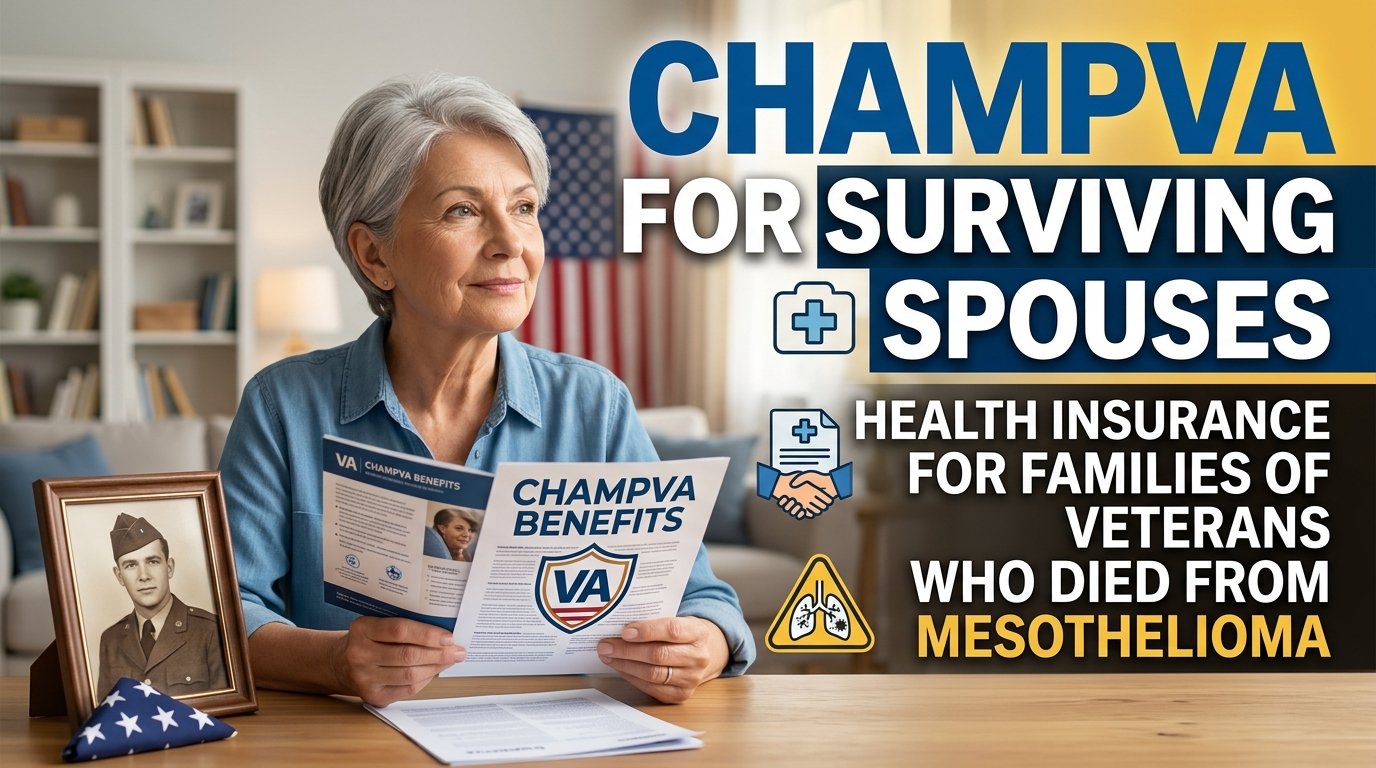
CHAMPVA for Surviving Spouses: Health Insurance for Families of Veterans Who Died from Mesothelioma

When Your Loved One Is Gone, but the Medical Bills Keep Coming

You lost your spouse to mesothelioma. The grief is overwhelming. But life does not stop. Your children need checkups. You need medications. Someone needs a dentist. Someone else needs glasses.

The bills keep coming. And without your spouse’s income, affording health insurance feels impossible.

Here is something you need to know. The VA offers a health insurance program for surviving spouses and children of veterans who died from service-connected conditions like mesothelioma. It is called CHAMPVA – the Civilian Health and Medical Program of the Department of Veterans Affairs.

CHAMPVA covers doctor visits, hospital stays, prescriptions, mental health care, dental care, vision care, and more. It is not free, but it is very affordable. And it can be a lifeline for families trying to rebuild after a devastating loss.

This guide will walk you through everything you need to know about CHAMPVA for surviving spouses. You will learn who qualifies, what services are covered, how much it costs, how to apply, and how to use it with your other health insurance.

No complicated government language. No confusion. Just clear, honest information to help you and your children get the health care you need.


Part 1: What Is CHAMPVA?

The Simple Explanation

CHAMPVA is a health insurance program for the surviving spouses and dependent children of veterans who:

  • Are permanently and totally disabled from a service-connected condition, OR
  • Died from a service-connected condition (like mesothelioma)

The program pays for most medical services. You can see any Medicare-certified provider. You do not have to go to VA hospitals.

CHAMPVA is not free. But it is very affordable. You pay an annual deductible (about 50perperson,50perperson,100 per family) and then cost-shares (25 percent of allowed amount). There is an annual catastrophic cap (about $3,000 per family) after which CHAMPVA pays 100 percent.

CHAMPVA vs. TRICARE: What Is the Difference?

Many people confuse CHAMPVA with TRICARE. They are different.

FeatureCHAMPVATRICARE
Who qualifies?Surviving spouses of veterans with service-connected deathSurviving spouses of military retirees or active duty
Veteran’s serviceAny service (active, Guard, Reserve)Usually 20+ years active duty or retired
VA facility?No – you see civilian doctorsYes – you can use military facilities
CostDeductible + 25% coinsuranceVaries by plan

If you qualify for TRICARE, you cannot also receive CHAMPVA. You must choose one. But most surviving spouses of veterans who died from mesothelioma qualify for CHAMPVA, not TRICARE.


Part 2: Do You Qualify for CHAMPVA as a Surviving Spouse?

You qualify for CHAMPVA if you meet all of the following requirements.

Requirement 1: You Are the Surviving Spouse of a Veteran

  • You were legally married to the veteran
  • The veteran died from a service-connected condition (mesothelioma qualifies)
  • You have not remarried (or you remarried after age 55 – see PACT Act changes below)

Requirement 2: The Veteran Died from a Service-Connected Condition

For mesothelioma, this means the veteran had a VA rating for mesothelioma, or the VA determined that their mesothelioma was caused by service-related asbestos exposure.

Even if the veteran never filed a VA claim, you can still qualify. You will need to prove that their mesothelioma was caused by military service.

Requirement 3: You Are Not Eligible for TRICARE

If you are eligible for TRICARE (as a surviving spouse of a military retiree), you cannot receive CHAMPVA. You must choose TRICARE.

Requirement 4: You Are Not Eligible for Medicare Part A (Hospital Insurance) at No Cost

If you are eligible for premium-free Medicare Part A, you must take it. CHAMPVA becomes secondary to Medicare.

Requirement 5: The Veteran Was Not Dishonorably Discharged

CHAMPVA requires that the veteran received an honorable or general discharge. Dishonorable discharge disqualifies you.

The PACT Act Change: Remarriage After Age 55

Before the PACT Act of 2022, remarrying at any age would cut off your CHAMPVA benefits. Now, if you remarry after age 55, you can keep your CHAMPVA benefits. This is a critical change for older surviving spouses.


Part 3: What Services Does CHAMPVA Cover?

CHAMPVA covers a wide range of medical services. Here is what is included.

Covered Services

  • Doctor visits: Primary care and specialist consultations
  • Hospital stays: Inpatient and outpatient surgery, emergency room visits
  • Prescription medications: Most drugs, including cancer medications
  • Mental health care: Therapy, counseling, psychiatry
  • Skilled nursing care: Short-term rehabilitation
  • Hospice care: End-of-life care
  • Home health care: Nursing and therapy at home
  • Durable medical equipment: Wheelchairs, oxygen, hospital beds
  • Ambulance services: Emergency and non-emergency transport
  • Physical, occupational, and speech therapy
  • Chiropractic care (limited)
  • Dental care (limited – see below)
  • Vision care (one exam per year, glasses only for certain conditions)
  • Hearing aids (one pair every 3 years)

Dental Coverage (Limited)

CHAMPVA dental coverage is limited to:

  • Emergency dental care (for accidents)
  • Dental care related to a covered medical condition (e.g., jaw surgery)
  • Extractions and other dental care required before radiation therapy for head/neck cancer

For routine dental care (cleanings, fillings, crowns), you need separate dental insurance.

Vision Coverage (Limited)

CHAMPVA covers:

  • One routine eye exam per year
  • Glasses or contact lenses only for specific conditions (cataract surgery, corneal transplant, severe refractive error over 8 diopters)

For routine glasses or contacts, you pay out of pocket.

What CHAMPVA Does NOT Cover

  • Routine dental care (cleanings, fillings, crowns)
  • Routine vision care (glasses, contacts) without a qualifying condition
  • Cosmetic surgery
  • Experimental or investigational treatments
  • Long-term nursing home care (custodial care)
  • Weight loss programs
  • Infertility treatments

Part 4: How Much Does CHAMPVA Cost?

CHAMPVA is not free, but it is very affordable compared to private insurance.

Annual Deductible (2026)

Family StatusDeductible
Individual (single person)$50
Family (two or more people)$100

You pay the deductible once per calendar year. After you meet the deductible, CHAMPVA pays its share.

Cost-Share (What You Pay After Deductible)

CHAMPVA pays 75 percent of the allowed amount. You pay 25 percent.

Example: Your doctor visit costs 200.CHAMPVAsallowedamountis200.CHAMPVAsallowedamountis150. You pay 25 percent of 150=150=37.50. CHAMPVA pays the rest.

Annual Catastrophic Cap

Family StatusCatastrophic Cap (2026)
Individual (single person)$3,000
Family (two or more people)$3,000

Once you pay $3,000 out of pocket in a calendar year, CHAMPVA pays 100 percent of covered services for the rest of the year.

Premiums

There are no monthly premiums for CHAMPVA. You only pay when you use services (deductible and cost-shares).

Comparison: CHAMPVA vs. Private Insurance

FeatureCHAMPVATypical Private Insurance
Monthly premium$0300300−800
Annual deductible5050−1001,0001,000−5,000
Cost-share25%20%-40%
Out-of-pocket max$3,0005,0005,000−10,000

CHAMPVA is significantly more affordable than most private insurance plans.


Part 5: How to Apply for CHAMPVA

Step One: Gather Your Documents

You will need:

  • Your marriage certificate (proving you were legally married to the veteran)
  • The veteran’s death certificate (showing mesothelioma as cause or contributing cause)
  • The veteran’s DD214 (military discharge papers)
  • The veteran’s VA rating decision (if available)
  • Your children’s birth certificates (if applying for them)
  • Your current health insurance cards (if you have other insurance)
  • Your Social Security card

Step Two: Complete VA Form 10-7959c

VA Form 10-7959c is the “Application for CHAMPVA Benefits.” It is a 6-page form.

The form asks for:

  • Your personal information
  • The veteran’s service information
  • The veteran’s cause of death
  • Your family members’ information
  • Your other health insurance information

Where to get the form:

  • Download from VA.gov
  • Request by mail by calling the CHAMPVA help line: 1-800-733-8387

Step Three: Submit Your Application

Mail your completed application and documents to:

VA CHAMPVA Center
PO Box 469028
Denver, CO 80246-9028

Pro tip: Send your application by certified mail with return receipt requested. This proves the VA received it.

Step Four: Wait for Your CHAMPVA ID Card

Processing times vary. It can take 3-6 months to receive your CHAMPVA ID card. You cannot use CHAMPVA until you have your ID card and the VA has processed your application.

While you wait: If you need medical care, you may be able to request expedited processing for urgent conditions. Call the CHAMPVA help line.


Part 6: Using CHAMPVA with Other Insurance

CHAMPVA works with other health insurance. It does not replace it. Here is how coordination works.

CHAMPVA and Medicare

If you are eligible for premium-free Medicare Part A (hospital insurance), you must take it. CHAMPVA becomes secondary to Medicare. Medicare pays first. CHAMPVA pays second.

If you are not eligible for premium-free Medicare, CHAMPVA pays as primary.

CHAMPVA and Employer-Sponsored Insurance

If you have health insurance through your employer, CHAMPVA pays secondary. Your employer insurance pays first. CHAMPVA pays the remaining covered expenses.

Example: Your employer insurance pays 80 percent of a bill. CHAMPVA pays 25 percent of the remaining 20 percent. You pay very little out of pocket.

CHAMPVA and No Other Insurance

If you have no other health insurance, CHAMPVA pays as primary. You pay the deductible and 25 percent cost-share.


Part 7: CHAMPVA for Dependent Children

Your dependent children are also eligible for CHAMPVA.

Who Qualifies as a Dependent Child?

  • Unmarried children under 18
  • Unmarried children between 18 and 23 who are attending school full-time
  • Unmarried children of any age who became permanently disabled before age 18

How to Add Children

Include them on your VA Form 10-7959c application. Provide their birth certificates. If they are over 18 and in school, provide school enrollment records.

What CHAMPVA Covers for Children

The same services covered for adults. Plus:

  • Well-child visits (including immunizations)
  • Pediatric dental care (cleanings, fluoride treatments, sealants)
  • Orthodontia (braces) only for severe medical necessity

Part 8: CHAMPVA Pharmacy Benefits

CHAMPVA covers prescription medications through a mail-order pharmacy program.

How It Works

  • Mail-order (preferred): Use the CHAMPVA mail-order pharmacy. You pay 25 percent of the cost. No deductible applies to medications.
  • Local pharmacy: You can use local pharmacies, but you may pay more.

Covered Medications

Most prescription drugs are covered, including:

  • Cancer medications
  • Pain medications
  • Heart and blood pressure medications
  • Diabetes medications
  • Mental health medications

Not Covered

  • Over-the-counter medications (unless prescribed by a doctor)
  • Experimental drugs
  • Medications for cosmetic purposes

Frequently Asked Questions

How long does it take to get CHAMPVA approved?
Usually 3-6 months. Apply as soon as possible after the veteran’s death.

Can I use CHAMPVA before I receive my ID card?
No. You must have your CHAMPVA ID card and the VA must have processed your application.

What if I have a medical emergency while waiting for CHAMPVA approval?
Get the care you need. Then apply for retroactive CHAMPVA coverage. Keep your receipts.

Can I keep CHAMPVA if I remarry?
If you remarry before age 55, you lose CHAMPVA. If you remarry after age 55, you keep CHAMPVA (PACT Act change).

What if I already have health insurance through my job?
CHAMPVA works as secondary insurance. Your job insurance pays first. CHAMPVA pays second. This can save you money.

What if I am eligible for both CHAMPVA and Medicaid?
You can have both. Medicaid pays first. CHAMPVA pays second.


Resources


Final Thoughts: You Are Not Alone

Losing your spouse to mesothelioma is devastating. The grief is heavy. The practical challenges – bills, insurance, raising children – can feel overwhelming.

But you are not alone. CHAMPVA is here to help. It provides affordable health insurance for you and your children. It covers doctor visits, hospital stays, prescriptions, mental health care, and more. It works with your other insurance. It is there for you.

Do not wait. Apply for CHAMPVA today. Call the CHAMPVA help line with questions. Talk to a Veterans Service Officer for free assistance.

Your spouse served our country. Your spouse died from a disease caused by that service. You deserve this benefit. Use it.


Disclaimer: This article provides general information about CHAMPVA for surviving spouses of veterans who died from mesothelioma. It does not constitute legal advice or official VA guidance. VA benefits rules change. Every situation is different. Always consult with a qualified Veterans Service Officer or the VA directly about your specific situation. If you are the surviving spouse of a veteran who died from mesothelioma, contact the CHAMPVA help line or a Veterans Service Officer to understand your benefits.

VA DIC for Surviving Spouses: A Complete Guide to Dependency and Indemnity Compensation After a Mesothelioma Death

The Letter No One Wants to Open

You have already been through so much. You watched your spouse fight mesothelioma with courage you never knew was possible. You sat beside them through the chemotherapy, the surgeries, the sleepless nights, and the endless appointments. You held their hand at the end.

And now they are gone.

The grief is overwhelming. But life does not stop. The bills keep coming. The mortgage is due. The car payment is due. You are suddenly trying to manage everything alone.

Here is something you need to know. The VA has a benefit for surviving spouses of veterans who died from service-connected conditions like mesothelioma. It is called Dependency and Indemnity Compensation (DIC) . It is a monthly, tax-free payment designed to help you replace the income you lost when your spouse passed away. And it can be thousands of dollars per month.

This guide will walk you through everything you need to know about VA DIC for surviving spouses. You will learn who qualifies, how much money you can receive each month, how to apply, what documents you need, and what to do if your claim is denied.

No complicated government language. No confusion. Just clear, honest information to help you get the benefits you deserve after your loss.


Part 1: What Is VA Dependency and Indemnity Compensation (DIC)?

The Simple Explanation

Dependency and Indemnity Compensation (DIC) is a monthly, tax-free payment from the Department of Veterans Affairs to the surviving spouse, children, or parents of a veteran who died from a service-connected condition.

Mesothelioma is almost always considered a service-connected condition for veterans who were exposed to asbestos during their military service. This means surviving spouses of these veterans are almost always eligible for DIC.

DIC is not the same as life insurance. It is not the same as VA pension. It is a separate benefit designed specifically for survivors of veterans who died from service-related causes.

DIC vs. VA Survivors Pension

Many people confuse these two benefits. They are different.

FeatureDICVA Survivors Pension
Who qualifies?Surviving spouse of veteran who died from service-connected conditionSurviving spouse of wartime veteran with low income
Income limit?NoYes (needs-based)
Payment amountHigher ($1,600+/month)Lower (up to ~$1,100/month)
Available to mesothelioma survivors?Yes (almost always)Possibly (depends on income)

If your spouse died from mesothelioma, apply for DIC first. It pays more and does not have income limits.


Part 2: Do You Qualify for DIC as a Surviving Spouse?

Basic Eligibility Requirements

To qualify for DIC as a surviving spouse, you must meet all of the following requirements.

Requirement 1: You were legally married to the veteran.

  • You must have been married to the veteran for at least one year, or
  • You had a child with the veteran, or
  • You married the veteran within 15 years of their discharge (for certain cases)

Requirement 2: The veteran died from a service-connected condition.

For mesothelioma, this is almost automatic if the veteran had a VA disability rating for mesothelioma or if the VA determines their mesothelioma was caused by service-related asbestos exposure.

Requirement 3: You are not currently remarried.

  • If you remarry after age 55, you can still receive DIC (this is a recent change, thanks to the PACT Act)
  • If you remarry before age 55, you generally lose DIC benefits

The PACT Act of 2022 made a significant change. Surviving spouses who remarry after age 55 can now keep their DIC benefits. Before this law, remarriage at any age cut off benefits.

Special Circumstances That Also Qualify

Even if the veteran did not have a VA disability rating before death, you may still qualify if:

  • The veteran was receiving VA disability compensation for a service-connected condition (mesothelioma) at the time of death, or
  • The veteran was rated at 100 percent disabled for at least eight years before death, or
  • The veteran died from a condition that the VA later determines was service-connected (this is common with mesothelioma)

What If the VA Never Rated the Veteran’s Mesothelioma?

Many veterans are diagnosed with mesothelioma late in life. Some die before their VA claim is approved. You can still file for DIC.

You will need to prove that the veteran’s mesothelioma was caused by service-related asbestos exposure. This means providing:

  • Medical records showing the mesothelioma diagnosis
  • Evidence of the veteran’s asbestos exposure during military service
  • A doctor’s opinion connecting the exposure to the disease

A VA-accredited attorney or Veterans Service Officer can help you with this.


Part 3: How Much Money Can You Receive?

2026 DIC Rates for Surviving Spouses

The rates below are effective December 1, 2025 through November 30, 2026. They include the annual Cost-of-Living Adjustment (COLA).

SituationMonthly Payment (2026)Annual Payment
Basic DIC (surviving spouse alone)$1,653.07$19,836.84

DIC for surviving spouse with additional benefits:

BenefitMonthly AdditionTotal (with basic DIC)
Basic DIC alone$1,653.07
+ Aid and Attendance (spouse needs help with daily activities)+$409.53$2,062.60
+ Housebound (spouse cannot leave home without help)+$191.85$1,844.92
+ 8-Year Provision (veteran rated 100% for 8+ years before death)+$351.02$2,004.09
+ Transitional Benefit (if you have children under 18)+$350.55 (first 2 years after death)$2,003.62

DIC for Surviving Spouse with Dependent Children

If you have children under 18 (or under 23 if still in school), you receive additional amounts.

Family StatusMonthly Payment (2026)
Surviving spouse with 1 child$2,159.37
Surviving spouse with 2 children$2,328.01
Surviving spouse with 3 children$2,496.65
Each additional child+$168.64

The 8-Year Provision Explained

The 8-Year Provision adds approximately $351 per month to your DIC payment if:

  • The veteran had a 100 percent VA disability rating (which applies to mesothelioma), and
  • The veteran held that 100 percent rating for at least eight continuous years before death

Because mesothelioma is rated at 100 percent, many surviving spouses qualify for this additional payment.

Aid and Attendance for Surviving Spouses

If you, as the surviving spouse, need help with daily activities (bathing, dressing, eating, using the bathroom), you can receive Aid and Attendance on top of your DIC.

The Aid and Attendance addition for surviving spouses is $409.53 per month (2026 rate) .


Part 4: How to Apply for DIC as a Surviving Spouse

Step One: Gather Your Documents

You will need the following documents before you start your application.

Personal Documents:

  • Your Social Security number
  • Your marriage certificate (proving you were legally married)
  • Your divorce decrees (if you were previously married)
  • Your current bank account information (for direct deposit)

Veteran’s Documents:

  • The veteran’s death certificate (showing mesothelioma as cause or contributing cause)
  • The veteran’s DD214 (military discharge papers)
  • The veteran’s VA disability rating decision letter (if available)
  • The veteran’s medical records showing mesothelioma diagnosis

Children’s Documents (if applicable):

  • Birth certificates for dependent children
  • School enrollment records for children over 18

Do not worry if you do not have all of these. A Veterans Service Officer can help you find what you need.

Step Two: Complete VA Form 21P-534EZ

VA Form 21P-534EZ is the “Application for Dependency and Indemnity Compensation (DIC), Death Pension, and Accrued Benefits by a Surviving Spouse or Child.” It is the main application form for DIC.

The form asks for:

  • Your personal information
  • The veteran’s military service history
  • The veteran’s medical conditions (mesothelioma)
  • Information about your marriage and any children
  • Your income and assets

Where to get the form:

Step Three: Submit Your Application

You can submit your application in three ways.

Online (fastest): Go to VA.gov. Create a login. Fill out the forms online. Upload your documents. Submit.

By mail: Mail your completed form and documents to:

Department of Veterans Affairs
Evidence Intake Center
PO Box 4444
Janesville, WI 53547-4444

In person: Go to your nearest VA regional office. Bring your documents. A VA representative will help you.

Step Four: Wait for the VA’s Decision

The VA will review your application. They may request additional information or documents. Processing times vary.

  • Simple, well-documented claims: 3-6 months
  • Complex claims (no prior VA rating): 6-12 months
  • Claims with expedited processing (terminal illness of spouse): faster

Pro tip: If you are struggling financially while you wait, you can request Accrued Benefits – a one-time payment covering the time between the veteran’s death and approval of your claim.


Part 5: What If Your Claim Is Denied?

Denials happen. Do not give up.

Common Reasons for Denial

  • The VA could not find evidence of service-connected asbestos exposure
  • The veteran’s death certificate does not list mesothelioma as a cause
  • Missing marriage certificate or other documents
  • The VA determined the veteran’s mesothelioma was not service-connected

How to Appeal

Option 1: Supplemental Claim (fastest)
If you have new evidence (more detailed medical records, witness statements, a doctor’s opinion), file a supplemental claim.

Option 2: Higher-Level Review
If you believe the VA made a legal mistake, request a higher-level review.

Option 3: Board of Veterans’ Appeals
If you are still denied, appeal to the Board of Veterans’ Appeals.

Get help. A Veterans Service Officer or VA-accredited attorney can help with your appeal. Their services are free or low-cost.


Part 6: Additional Benefits for Surviving Spouses

DIC is not the only benefit available to surviving spouses of veterans who died from mesothelioma.

ChampVA Health Insurance

ChampVA is a health insurance program for surviving spouses and dependent children of veterans who are permanently and totally disabled or who died from a service-connected condition.

What ChampVA covers:

  • Doctor visits
  • Hospital stays
  • Prescription medications
  • Mental health counseling
  • Medical equipment

Wait: ChampVA coverage begins on the date of the veteran’s death. You have a limited time to apply (usually within one year).

VA Home Loan Guaranty (Surviving Spouse)

Surviving spouses may be eligible for VA home loan benefits. This can help you:

  • Buy a home with no down payment
  • Refinance an existing mortgage
  • Get lower interest rates

VA Burial Benefits

The VA provides burial benefits for veterans and their spouses.

What is covered:

  • Burial in a VA national cemetery (free)
  • A headstone or grave marker (free)
  • A burial flag (free)
  • Presidential Memorial Certificate (free)
  • Reimbursement of burial expenses (up to $2,000)

Survivors Pension (if you do not qualify for DIC)

If you do not qualify for DIC, you may qualify for VA Survivors Pension. This is a needs-based benefit for low-income surviving spouses of wartime veterans.

2026 Survivors Pension rate: Approximately $1,100 per month (depending on income and dependents).


Part 7: Special PACT Act Changes for Surviving Spouses

The Honoring our PACT Act of 2022 made several important changes for surviving spouses.

Change 1: Remarriage After Age 55

Before the PACT Act, remarrying at any age cut off a surviving spouse’s DIC benefits. Now, if you remarry after age 55, you can keep your DIC benefits.

Change 2: Expanded Presumptive Conditions

The PACT Act added more than 20 new presumptive conditions for toxic exposure, including several cancers. While mesothelioma was already covered, these changes make it easier for surviving spouses to prove service connection.

Change 3: Easier Access to ChampVA

The PACT Act streamlined the ChampVA application process for surviving spouses of veterans who died from toxic exposure-related conditions.


Frequently Asked Questions

How long does a DIC claim take?
Processing times vary. Simple claims: 3-6 months. Complex claims: 6-12 months.

Do I need a lawyer to file for DIC?
No. You can file on your own. A Veterans Service Officer can help for free. For complex cases or appeals, a VA-accredited attorney can be helpful.

Can I receive DIC and Social Security survivor benefits at the same time?
Yes. DIC and Social Security are separate programs. You can receive both.

What if the veteran died before their VA claim was approved?
You can still file for DIC. You will need to prove the veteran’s mesothelioma was service-connected. A lawyer or VSO can help.

What if I was divorced from the veteran before they died?
Generally, divorced surviving spouses are not eligible for DIC unless they have a child with the veteran and were married for at least one year. There are exceptions. Talk to a VSO.

What if the veteran died from mesothelioma but never went to the VA?
You can still file. You will need to provide medical records and evidence of service-related asbestos exposure.


Final Thoughts: You Are Not Alone

Losing a spouse to mesothelioma is devastating. The grief does not go away. But the VA benefits exist to help you through this difficult time.

DIC gives you a monthly, tax-free payment that can help pay the mortgage, put food on the table, and keep the lights on. ChampVA gives you health insurance. Burial benefits help you honor your loved one.

You do not have to navigate this alone. There are Veterans Service Officers, VA-accredited attorneys, and support groups ready to help you. Take the first step today. Apply for DIC. You earned these benefits because of your spouse’s service and sacrifice.


Disclaimer: This article provides general information about VA Dependency and Indemnity Compensation (DIC) for surviving spouses of veterans with mesothelioma. It does not constitute legal advice or official VA guidance. VA benefits rules change. Every situation is different. Always consult with a qualified Veterans Service Officer, VA-accredited attorney, or the VA directly about your specific situation. If you are the surviving spouse of a veteran who died from mesothelioma, contact a VA-accredited claims agent or an attorney to understand your benefits.