Advertisement

VA Pension for Mesothelioma Veterans: Benefits for Low-Income Wartime Veterans Without a Service Connection

The Benefit You May Not Know About

You have mesothelioma. You need help. But there is a problem. You cannot prove your mesothelioma came from your military service. Maybe you served during peacetime. Maybe you served in a job that did not expose you to asbestos. Maybe you just cannot find the evidence.

Does this mean you get nothing from the VA? No.

There is a VA benefit called the VA Pension. It is a needs-based benefit for wartime veterans with limited income and assets. It does not require your mesothelioma to be service-connected. You just need to have served during wartime, have a disability, and have low income.

For veterans with mesothelioma who are not eligible for disability compensation, the VA Pension can provide a monthly, tax-free payment to help cover living expenses.

This guide will walk you through everything you need to know about the VA Pension for veterans with mesothelioma. You will learn who qualifies, how much money you can receive, how to apply, and how it differs from VA disability compensation.

No complicated government language. No confusion. Just clear, honest information to help you get the benefits you deserve.


Part 1: VA Disability Compensation vs. VA Pension

Before we dive in, let us clarify the difference between these two VA benefits.

FeatureVA Disability CompensationVA Pension
What is it?Monthly payment for service-connected disabilitiesMonthly payment for low-income wartime veterans
Service connection required?Yes (your disability must be caused by service)No
Income limit?NoYes (needs-based)
Asset limit?NoYes (needs-based)
Wartime service required?NoYes
Disability required?YesYes (must be permanently disabled)
Taxable?NoNo

Which Benefit Is Better for Mesothelioma?

If your mesothelioma is service-connected: VA Disability Compensation is better. It pays more. There is no income or asset limit. You can work (if you are able) and still receive payments.

If your mesothelioma is NOT service-connected, or if you are waiting for a decision on your service connection claim: VA Pension may be available to you. It pays less than disability compensation, but it is better than nothing.


Part 2: What Is the VA Pension?

The Simple Explanation

The VA Pension is a monthly, tax-free payment to low-income wartime veterans who are permanently and totally disabled. It is also called the “Improved Pension.”

The pension is designed to help veterans who cannot work and have limited income cover their basic living expenses – food, housing, utilities, and medical costs.

Who Qualifies for VA Pension?

To qualify for VA Pension, you must meet four requirements.

Requirement 1: Wartime service.
You must have served at least 90 days of active duty, with at least one day during a wartime period.

Requirement 2: Discharge status.
You must have received a discharge other than dishonorable.

Requirement 3: Disability.
You must be permanently and totally disabled. Mesothelioma qualifies as a permanent and total disability.

Requirement 4: Income and assets.
Your income must be below a certain limit. Your assets (net worth) must be below a certain limit.

Wartime Periods Recognized by the VA

War/PeriodStart DateEnd Date
World War IIDecember 7, 1941December 31, 1946
Korean ConflictJune 27, 1950January 31, 1955
Vietnam WarNovember 1, 1955May 7, 1975
Persian Gulf WarAugust 2, 1990Present (still ongoing)

Note about Gulf War: The Persian Gulf War period is still open. Veterans who served after August 2, 1990, including those who served in Afghanistan and Iraq, qualify as Gulf War-era veterans.

What Qualifies as “Permanently and Totally Disabled”?

For mesothelioma, this is straightforward. Mesothelioma is a terminal cancer. The VA considers it a permanent and total disability. You do not need to prove anything else.

For other conditions, you would need a doctor’s statement. For mesothelioma, your diagnosis is enough.


Part 3: How Much Does VA Pension Pay?

The VA Pension has a Maximum Annual Pension Rate (MAPR) . The amount depends on your family situation and whether you need Aid and Attendance.

2026 VA Pension Rates (Estimated)

Family SituationMAPR (Annual)Monthly Payment
Veteran alone$16,964.78$1,413.73
Veteran with spouse$22,215.85$1,851.32
Veteran with one dependent child (no spouse)$22,215.85$1,851.32
Veteran with spouse and one child$23,624.85$1,968.74
+ Aid and Attendance (veteran needs help)+$11,413.76Additional $951.15/month
+ Housebound (veteran cannot leave home)+$2,813.76Additional $234.48/month

Important: Your Income Reduces the Payment

The VA Pension is needs-based. You do not receive the full MAPR amount. Instead, the VA subtracts your income from the MAPR.

Formula: Your Pension = MAPR – Your Annual Income

Examples

Example 1: A single veteran with no dependents, MAPR = 16,965.Theveteransincome(SocialSecurity,etc.)is16,965.Theveteransincome(SocialSecurity,etc.)is10,000 per year.

  • Pension = 16,96516,965−10,000 = 6,965peryear(6,965peryear(580 per month)

Example 2: A married veteran with Aid and Attendance, MAPR = 22,216+22,216+11,414 = 33,630.Thecouplescombinedincomeis33,630.Thecouplescombinedincomeis15,000 per year.

  • Pension = 33,63033,630−15,000 = 18,630peryear(18,630peryear(1,552 per month)

What Income Counts?

  • Social Security benefits
  • Railroad retirement
  • Other retirement or pension income
  • Interest and dividends
  • Rental income (after expenses)
  • Spouse’s income (for married couples)

What Income Does NOT Count?

  • VA disability compensation
  • Food stamps (SNAP)
  • Housing assistance
  • Medicaid payments
  • Gift money (under certain limits)

Asset Limit (Net Worth)

The VA also has an asset limit. Your net worth (all assets minus debts) must be below approximately $150,000 (subject to annual adjustment).

Assets that count:

  • Bank accounts (checking and savings)
  • Stocks, bonds, and mutual funds
  • Real estate (other than your primary home)
  • Vehicles (other than one personal vehicle)

Assets that do NOT count:

  • Your primary home
  • One vehicle
  • Personal belongings (furniture, clothing)
  • Prepaid burial plots and funeral plans

Part 4: Aid and Attendance for VA Pension

If you need help with daily activities, you can receive an additional payment called Aid and Attendance (A&A) on top of your VA Pension.

Who Qualifies for Aid and Attendance?

You qualify if you need help with:

  • Bathing (getting in and out of the tub, washing yourself)
  • Dressing (putting on clothes, buttoning buttons)
  • Eating (feeding yourself)
  • Using the bathroom (getting on and off the toilet)
  • Transferring (getting in and out of bed or a chair)

How Much Extra Does Aid and Attendance Add?

For 2026, Aid and Attendance adds approximately **11,414peryear(11,414peryear∗∗(951 per month) to your MAPR.

How to Apply for Aid and Attendance

When you apply for VA Pension, check the box for Aid and Attendance. You will need a doctor’s statement confirming that you need help with daily activities.


Part 5: VA Pension for Surviving Spouses

If the veteran passes away, the surviving spouse may be eligible for Survivors Pension (also called Death Pension).

Who Qualifies for Survivors Pension?

  • You were married to the veteran at the time of death
  • The veteran served wartime service (same rules as above)
  • Your income is below the MAPR for survivors

2026 Survivors Pension Rates (Estimated)

Family SituationMAPR (Annual)Monthly Payment
Surviving spouse alone$11,382.78$948.57
Surviving spouse with one dependent child$14,894.78$1,241.23
+ Aid and Attendance+$7,229.76+$602.48/month
+ Housebound+$2,813.76+$234.48/month

Part 6: How to Apply for VA Pension

Step One: Gather Your Documents

You will need:

  • Your DD214 (military discharge papers)
  • Your mesothelioma diagnosis (doctor’s letter, biopsy report)
  • Evidence of your income (Social Security statement, tax returns, pension statements)
  • Evidence of your assets (bank statements, investment statements)
  • Marriage certificate (if applying with spouse)
  • Children’s birth certificates (if applying with dependents)

Step Two: Complete VA Form 21P-527EZ

VA Form 21P-527EZ is the “Application for Veterans Pension.” It is similar to the disability compensation form but asks about your income and assets.

Where to get the form:

  • Download from VA.gov
  • Pick up from your local VA regional office
  • Request by mail

Step Three: Submit Your Application

Submit online at VA.gov, by mail, or with the help of a VSO.

Step Four: Wait for a Decision

VA Pension claims typically take 3-6 months to process. If you have a terminal diagnosis, request expedited processing.


Part 7: VA Pension vs. VA Disability Compensation – Which Should You Apply For?

If Your Mesothelioma Is Service-Connected

Apply for VA Disability Compensation. It pays more and has no income or asset limits.

If Your Mesothelioma Is Not Service-Connected

Apply for VA Pension. It will provide monthly income while you work on your service connection claim.

If You Are Waiting for a Decision on Your Service Connection Claim

You can apply for VA Pension while you wait. If your disability compensation claim is later approved, the VA will switch you over. You may have to repay some pension payments (the VA will figure this out).

Can You Receive Both?

Generally, no. You cannot receive both VA Disability Compensation and VA Pension at the same time. The VA will pay you whichever is higher.


Part 8: VA Pension vs. Medicaid vs. SSI

The VA Pension is one of several needs-based benefits for low-income disabled individuals.

BenefitSourceDisability required?Asset limitIncome limit
VA PensionVAYes (permanent disability)~$150,000Yes
MedicaidState governmentYes (medical need)Very low (~$2,000)Yes
SSISocial SecurityYesVery low (~$2,000)Yes

Note about Medicaid and SSI

If you qualify for VA Pension, you may also qualify for Medicaid and SSI. Apply for all benefits you are eligible for. A VSO or elder law attorney can help.


Frequently Asked Questions

Do I need a service connection for VA Pension?
No. VA Pension does not require your disability to be service-connected.

Can I work and still receive VA Pension?
No. VA Pension requires you to be permanently and totally disabled. If you are working, you are not considered disabled.

What if my income is above the limit?
You may still qualify if you have high medical expenses. The VA allows you to deduct unreimbursed medical expenses from your income.

How do medical expenses affect VA Pension?
The VA subtracts your annual medical expenses from your income. If your medical expenses are high enough, they can reduce your countable income below the limit.

Medical expenses that count:

  • Health insurance premiums
  • Medicare premiums
  • Prescription drug costs
  • Doctor and hospital bills not covered by insurance
  • Long-term care costs
  • Home health aide costs
  • Medical equipment (wheelchairs, oxygen, hospital beds)

Can I get VA Pension if I am in a nursing home?
Yes. If you are a wartime veteran in a nursing home and have limited income, you may qualify for VA Pension. The Aid and Attendance rate is often available.

What if my claim for VA Pension is denied?
You can appeal, just like disability compensation claims. Get help from a VSO or VA-accredited attorney.


Resources


Final Thoughts: You May Qualify for More Than You Think

You have mesothelioma. You cannot work. Money is tight. But you served your country during wartime. You may be eligible for VA Pension – a monthly, tax-free payment to help you cover basic living expenses.

Even if you are waiting for a decision on your service connection claim, apply for VA Pension now. You can always switch later.

Do not assume you do not qualify. Do not let pride stop you from applying. You earned these benefits.

Apply today.


Disclaimer: This article provides general information about the VA Pension program for veterans with mesothelioma. It does not constitute legal advice, financial advice, or official VA guidance. VA benefits rules change. Income and asset limits are adjusted annually. Every veteran’s situation is different. Always consult with a qualified Veterans Service Officer, VA-accredited attorney, or financial professional about your specific situation.
VA Life Insurance for Veterans with Mesothelioma: SGLI, VGLI, and Service-Disabled Coverage to Protect Your Family

The Question Every Veteran Asks

You have mesothelioma. You are facing difficult treatments. You are worried about your family. What will happen to them when you are gone? How will they pay for the mortgage, the car payments, the kids’ college?

You want to leave something behind. You want to know your family will be okay.

Life insurance is the answer. But here is the problem. Many private life insurance companies will not cover someone with a terminal cancer diagnosis. If they do, the premiums are astronomical.

Here is what you need to know. The VA offers life insurance programs for veterans. Some of these programs are available to veterans with service-connected disabilities like mesothelioma.

This guide will walk you through everything you need to know about VA life insurance for veterans with mesothelioma. You will learn about Servicemembers’ Group Life Insurance (SGLI), Veterans’ Group Life Insurance (VGLI), Service-Disabled Veterans’ Life Insurance (S-DVI), and VALife (a newer program for disabled veterans).

No complicated government language. No confusion. Just clear, honest information to help you protect your family’s future.


Part 1: Why Life Insurance Matters for Mesothelioma Veterans

The Financial Impact of Mesothelioma

Mesothelioma is a devastating disease. It often strikes later in life, after retirement. But it can also strike younger veterans who were exposed to asbestos decades ago.

If you are the primary breadwinner for your family, your death could leave them in a difficult financial situation. Life insurance provides:

  • Money to pay off the mortgage
  • Money for your children’s education
  • Money to cover daily living expenses
  • Money for funeral and burial costs
  • Peace of mind for you

The Challenge of Private Life Insurance

Private life insurance companies use medical underwriting. They ask about your health. They request your medical records. If you have mesothelioma, you will almost certainly be denied coverage. Or you will be offered a policy with premiums that are impossibly high.

The VA does not use medical underwriting for its life insurance programs in the same way. If you qualify for the program, you are covered regardless of your health condition.


Part 2: Servicemembers’ Group Life Insurance (SGLI)

What Is SGLI?

Servicemembers’ Group Life Insurance (SGLI) is life insurance for active-duty service members, Guard members, and reservists. It provides up to $400,000 in term life insurance coverage.

Who Is Eligible for SGLI?

  • Active-duty service members
  • Ready Reserve and National Guard members
  • Commissioned Corps of the Public Health Service and NOAA

SGLI for Veterans with Mesothelioma

If you are no longer on active duty, you are not eligible for SGLI. However, you may be able to convert your SGLI to VGLI when you leave the service (see Part 3).

How Much Does SGLI Cost?

Premiums are deducted automatically from your pay. The rate is very low – approximately 0.06per0.06per1,000 of coverage per month.

Example: 400,000coveragecostsapproximately400,000coveragecostsapproximately24 per month.

Key Feature: Traumatic Injury Protection (TSGLI)

SGLI includes an automatic rider for traumatic injury protection. This is not relevant for mesothelioma (which is not a traumatic injury), but it is part of the SGLI package.


Part 3: Veterans’ Group Life Insurance (VGLI)

What Is VGLI?

Veterans’ Group Life Insurance (VGLI) is term life insurance for veterans who had SGLI while on active duty. You can convert your SGLI to VGLI when you leave the service.

VGLI provides up to $400,000 in coverage. You do not need to prove you are healthy. If you had SGLI, you can convert to VGLI regardless of your health condition.

Who Is Eligible for VGLI?

  • Veterans who had SGLI while on active duty
  • You must apply within 1 year and 120 days of leaving active duty
  • For mesothelioma veterans who served decades ago, you may have missed the window

What If You Missed the VGLI Deadline?

If you have a service-connected disability (like mesothelioma), you may be eligible for an extension. Contact the VA Office of Servicemembers’ Group Life Insurance (OSGLI) at 1-800-419-1473.

How Much Does VGLI Cost?

VGLI premiums increase every 5 years as you age. For a veteran in their 60s or 70s (typical age for mesothelioma diagnosis), premiums can be high.

Example 5-year term rates (age 65-69):

  • 100,000coverage:Approximately100,000coverage:Approximately120 per month
  • 200,000coverage:Approximately200,000coverage:Approximately240 per month
  • 400,000coverage:Approximately400,000coverage:Approximately480 per month

Is VGLI Right for Mesothelioma Veterans?

If you already have VGLI, keep it. You cannot get a better rate elsewhere with a mesothelioma diagnosis.

If you do not already have VGLI, you may not be able to get it now. The application window is limited. However, there are other VA life insurance programs for disabled veterans (see Parts 4 and 5).


Part 4: Service-Disabled Veterans’ Life Insurance (S-DVI)

What Is S-DVI?

Service-Disabled Veterans’ Life Insurance (S-DVI) is life insurance for veterans with service-connected disabilities (like mesothelioma). It was available to veterans who were rated for a service-connected disability within 1-2 years of leaving active duty.

Who Is Eligible for S-DVI?

  • Veterans who received a service-connected disability rating within 2 years of leaving active duty
  • The disability must be rated at 0 percent or higher (all service-connected disabilities qualify)

The Problem with S-DVI for Mesothelioma Veterans

Here is the challenge. Mesothelioma usually develops 20-50 years after asbestos exposure. Most veterans with mesothelioma were exposed during service but not diagnosed until decades later. They did not have a service-connected disability rating within 2 years of leaving active duty. Therefore, they are not eligible for S-DVI.

For Veterans Who Are Eligible

If you are one of the rare mesothelioma veterans who received a rating soon after service, S-DVI provides:

  • Up to $40,000 in coverage
  • Premiums deducted from your VA disability compensation
  • No medical exam required

Cost: Approximately 0.60per0.60per1,000 of coverage per month.

Note: The S-DVI program has been largely replaced by VALife (see Part 5). New applications for S-DVI are no longer accepted as of January 1, 2023, except for veterans with an existing S-DVI policy who want to increase coverage.


Part 5: VALife (Veterans Affairs Life Insurance)

What Is VALife?

VALife is a newer VA life insurance program for veterans with service-connected disabilities. It replaced S-DVI for new applicants starting January 1, 2023.

VALife is designed specifically for veterans who did not apply for life insurance within the 2-year window after leaving service. This includes most veterans with mesothelioma.

Who Is Eligible for VALife?

  • Veterans with a service-connected disability rating of 0 percent or higher
  • You must apply within 2 years of receiving your service-connected disability rating

For mesothelioma veterans: This means you must apply for VALife within 2 years of receiving your 100 percent rating for mesothelioma.

How Much Coverage Can You Get?

  • Standard coverage: Up to $40,000
  • Increments: 10,000,10,000,20,000, 30,000,or30,000,or40,000

How Much Does VALife Cost?

VALife premiums are based on:

  • Your age at enrollment
  • Your coverage amount
  • Your premium is fixed for life (does not increase as you age)

Example estimated premiums: Approximately 0.50to0.50to1.50 per $1,000 of coverage per month, depending on your age.

How to Apply for VALife

Step One: Have a service-connected disability rating (100 percent for mesothelioma).
Step Two: Apply online at VA.gov within 2 years of receiving your rating.
Step Three: No medical exam is required.

Processing time: 30-60 days after receiving all required documents.

Important Waiting Period

VALife has a waiting period before full benefits are paid.

  • First 2 years: If you die within 2 years of enrollment, the benefit is limited to the return of premiums plus interest (no death benefit).
  • After 2 years: Full death benefit is paid.

For veterans with advanced mesothelioma: This waiting period is a significant limitation. If you have a terminal diagnosis, VALife may not provide a death benefit for your family if you die within 2 years of enrollment.


Part 6: VALife vs. VGLI vs. S-DVI: Which Is Best for You?

FeatureVALifeVGLIS-DVI
EligibilityService-connected disability rated within 2 years of applicationHad SGLI, apply within 1 year 120 days of leaving serviceRated within 2 years of leaving service (closed to new applicants)
Coverage10k10k−40kUp to $400kUp to $40k
PremiumsFixed for lifeIncrease every 5 yearsDeducted from disability comp
Medical examNoNo (conversion from SGLI)No
Waiting period2 years (before full benefit)NoNo
Best for mesothelioma veteransYes (if newly rated)Yes (if already have it)Rarely

Recommendation for Mesothelioma Veterans

If you are newly rated (100 percent for mesothelioma): Apply for VALife as soon as possible. The waiting period means your family will not receive the full death benefit if you die within 2 years, but it is better than nothing.

If you already have VGLI: Keep it. Do not let it lapse. You cannot get a better policy elsewhere.

If you have neither: Explore private life insurance options carefully. Some companies offer guaranteed issue life insurance policies (no medical exam) for seniors, but the premiums are high and the death benefits are low.


Part 7: VA Life Insurance for Surviving Spouses

When a veteran with VA life insurance dies, the surviving spouse may receive benefits from the policy. But there is no separate VA life insurance for surviving spouses.

What Surviving Spouses Should Know

  • File a claim: As soon as the veteran dies, contact the VA Office of Servicemembers’ Group Life Insurance at 1-800-419-1473.
  • Documents needed: Veteran’s death certificate, policy number, your ID
  • Payment timeline: Usually 30-60 days after claim is approved

CHAMPVA and Other Survivor Benefits

Life insurance is separate from other survivor benefits like:

  • DIC (Dependency and Indemnity Compensation) – monthly tax-free payment
  • CHAMPVA – health insurance
  • VA burial benefits

You can receive life insurance proceeds AND DIC AND CHAMPVA. They do not affect each other.


Part 8: Private Life Insurance Options

If you do not qualify for VA life insurance, or if you want additional coverage, here are private options to consider.

Guaranteed Issue Life Insurance

Some companies offer guaranteed issue life insurance. No medical exam. No health questions. Everyone is accepted.

Trade-offs:

  • Low death benefits (typically 5,000to5,000to25,000)
  • High premiums relative to death benefit
  • Waiting period (usually 2 years before full benefit is paid)

Example: Colonial Penn, AARP, Globe Life

Burial Insurance

Burial insurance is a type of whole life insurance designed to cover funeral expenses. Typically 5,000to5,000to25,000 in coverage. No medical exam for some policies.

Trade-offs:

  • Low death benefits
  • Higher premiums than traditional life insurance

Term Life Insurance

Traditional term life insurance requires a medical exam. Unless you are in remission, you will likely be denied. If your mesothelioma is in remission (no active disease for 2-5 years), you may qualify for a standard policy. Talk to an independent insurance broker.


Frequently Asked Questions

Can I get VA life insurance if I already have mesothelioma?
Yes, if you apply for VALife within 2 years of receiving your service-connected disability rating.

How long does it take to get approved for VALife?
Typically 30-60 days after submitting all required documents.

Does VA life insurance pay for suicide?
Yes, after the waiting period. During the waiting period, suicide may result in return of premiums only.

Can I name anyone as my beneficiary?
Yes. You can name your spouse, children, parents, siblings, a trust, or even a charity.

What if I die during the VALife waiting period?
Your beneficiary will receive a return of your premiums plus interest (not the full death benefit).

Can I have both VALife and VGLI?
No. You cannot have multiple VA life insurance policies.


Resources


Final Thoughts: Protect Your Family’s Future

You have mesothelioma. You are fighting for your life. But you also need to think about what happens after you are gone. Your family will need financial support. The mortgage will still be due. The kids may still need college tuition.

VA life insurance can help. If you are newly rated for mesothelioma, apply for VALife. The waiting period is a challenge, but something is better than nothing.

If you already have VGLI, keep it. Do not let it lapse.

Do not leave your family unprotected. Apply for VA life insurance today.


Disclaimer: This article provides general information about VA life insurance programs for veterans with mesothelioma. It does not constitute financial advice, insurance advice, or official VA guidance. VA benefits rules change. Every veteran’s situation is different. Always consult with a qualified financial advisor, insurance professional, or the VA directly about your specific situation. If you have been diagnosed with mesothelioma, speak with a doctor immediately and contact a VA-accredited claims agent or an attorney to understand your benefits, including life insurance.

VA Travel Reimbursement for Mesothelioma Veterans: Getting Paid for Mileage, Meals, and Lodging When You Travel for Treatment

The Cost of Getting to Care

You have mesothelioma. You need specialized treatment. The nearest VA hospital that offers the care you need is 100 miles away. Or 200 miles. Or across the state.

You are already dealing with fatigue, pain, and shortness of breath. Now you have to add hours of driving to every appointment. Gas is expensive. Tolls add up. Sometimes you need a hotel room. Sometimes you need to eat on the road.

The costs add up quickly. And when you cannot work because of your illness, every dollar matters.

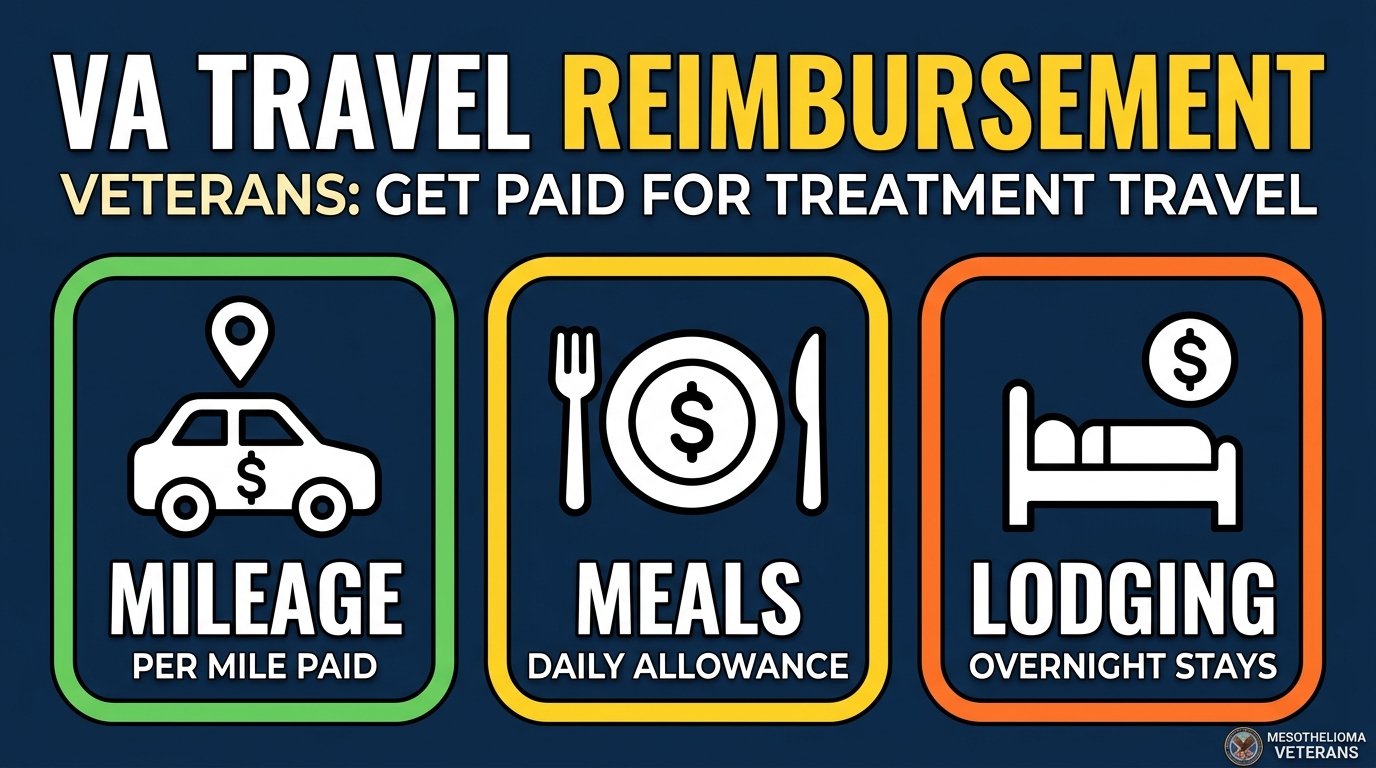
Here is something you need to know. The VA has a program that reimburses veterans for travel to VA-approved medical appointments. It is called the Beneficiary Travel Program. It pays for mileage, tolls, parking, and in some cases, meals and lodging.

For veterans with mesothelioma who travel long distances for specialized care, this program can save you hundreds or even thousands of dollars per year.

This guide will walk you through everything you need to know about VA travel reimbursement for veterans with mesothelioma. You will learn who qualifies, how much you can get, what expenses are covered, how to claim your reimbursement, and how to get pre-approved for long-distance travel.

No complicated government language. No confusion. Just clear, honest information to help you get paid for the miles you drive to get the care you need.


Part 1: What Is the VA Beneficiary Travel Program?

The Simple Explanation

The VA Beneficiary Travel Program reimburses eligible veterans for travel expenses to and from VA-approved medical appointments. This includes:

  • Mileage (per mile rate set by the VA)
  • Tolls
  • Parking fees
  • In some cases, meals and lodging

The program exists because the VA recognizes that veterans should not have to choose between getting medical care and paying their bills. If you need to travel for treatment, the VA will help cover the cost.

Why This Matters for Veterans with Mesothelioma

Mesothelioma is a rare cancer. Not every VA hospital has specialists who can treat it. Many veterans with mesothelioma must travel to specialized centers like:

  • MD Anderson Cancer Center (Houston, Texas)
  • Brigham and Women’s Hospital (Boston, Massachusetts)
  • Memorial Sloan Kettering Cancer Center (New York, New York)
  • Mayo Clinic (Rochester, Minnesota)

These centers may be hundreds of miles from your home. The Beneficiary Travel Program can help cover those travel costs.


Part 2: Do You Qualify for Travel Reimbursement?

Basic Eligibility Requirements

You qualify for VA travel reimbursement if you meet any of the following criteria.

Criterion 1: You have a service-connected disability rated at 30 percent or higher.

For veterans with mesothelioma (rated at 100 percent), you qualify automatically. This is the most common path for mesothelioma veterans.

Criterion 2: You are traveling for a VA-approved service related to your service-connected condition.

Your appointment must be at a VA facility or a VA-approved community care provider. The appointment must be for treatment of your service-connected condition (mesothelioma qualifies).

Criterion 3: You have a low income (if your disability rating is below 30 percent).

This does not apply to mesothelioma veterans since you have a 100 percent rating.

Criterion 4: You are traveling for a VA-approved transplant or other specialized procedure.

What Appointments Are Covered?

  • VA hospital or clinic appointments
  • Community care (VCCP) appointments at non-VA facilities
  • VA-approved C&P exams
  • VA-approved mental health appointments
  • VA-approved dental appointments
  • VA-approved pharmacy pickups (if the pharmacy is more than 20 miles away)

What Appointments Are NOT Covered?

  • Appointments you miss or cancel without rescheduling
  • Appointments for conditions not related to your service-connected disability (unless you have a 50 percent or higher rating)
  • Routine trips for non-medical purposes

Part 3: How Much Does the VA Pay for Travel?

Mileage Rate (2026)

The VA reimburses at a rate per mile. The rate is set annually and is typically close to the federal business mileage rate.

2026 VA mileage rate: Approximately 0.22to0.22to0.25 per mile (varies slightly by region)

Example: You drive 100 miles one way to a VA appointment. Round trip is 200 miles. At 0.22permile,yourreimbursementis0.22permile,yourreimbursementis44.00.

Deductible

Here is something important to know. For each one-way trip, the VA subtracts a deductible. The deductible is $6.00 per one-way trip (2026 rate).

Why the deductible exists: The VA assumes the first few miles of any trip are your responsibility (like your daily commute). The deductible reduces the total reimbursement.

Example: Your one-way trip is 100 miles. Reimbursement: 100 miles x 0.22=0.22=22.00. Subtract 6.00deductible=6.00deductible=16.00 for one way. Round trip = $32.00.

Note: Some veterans are exempt from the deductible. See Part 4 below.

Tolls and Parking

In addition to mileage reimbursement, the VA reimburses for:

  • Tolls: Actual cost of tolls for the most direct route
  • Parking: Actual cost of parking at the VA facility (not for valet parking)

Keep your receipts for tolls and parking. Submit them with your claim.

Meals and Lodging (Long-Distance Travel)

If you need to travel more than 100 miles one way, you may be eligible for reimbursement of meals and lodging.

Meal allowance: Approximately 1515−20 per meal (breakfast, lunch, dinner)

Lodging allowance: Up to the local federal per diem rate for hotels

Pre-approval required: You must get pre-approval from the VA Beneficiary Travel office before you travel for meals and lodging reimbursement. Call before you go.

Special Mode Transportation (Ambulance, Medivan, Air)

If you are too sick to drive yourself, the VA may pay for:

  • Ambulance transport (emergency and non-emergency)
  • Medivan or wheelchair van transport
  • Commercial airfare (for very long distances)

Pre-approval required: Always required for special mode transportation.


Part 4: Who Is Exempt from the Deductible?

Some veterans are exempt from the $6.00 per trip deductible.

You are exempt if:

  • You have a service-connected disability rated at 50 percent or higher (mesothelioma veterans qualify)
  • You are traveling for a VA-approved transplant
  • You are traveling for a VA-approved C&P exam
  • You are a former prisoner of war
  • You receive Aid and Attendance benefits

For mesothelioma veterans: Because you have a 100 percent rating, you are exempt from the deductible. You do not need to subtract $6.00 per trip.

Example with exemption: 100 miles one way x 0.22=0.22=22.00. No deductible. 22.00foroneway.Roundtrip=22.00foroneway.Roundtrip=44.00.


Part 5: How to Claim Your Travel Reimbursement

Option 1: Online Through VA.gov (Fastest)

This is the easiest and fastest way to claim travel reimbursement.

Step One: Log into VA.gov.
Step Two: Navigate to “Beneficiary Travel” under the “Health Care” section.
Step Three: Enter the date, location, and purpose of your appointment.
Step Four: Enter the number of miles driven.
Step Five: Submit your claim.

Payment time: 7-14 days via direct deposit (if you have VA direct deposit set up) or by check.

Option 2: In-Person Kiosk at VA Facility

Many VA medical centers have self-service kiosks for travel reimbursement.

Step One: After your appointment, find a travel reimbursement kiosk (usually near the pharmacy or main lobby).
Step Two: Scan your VA ID card.
Step Three: Confirm your appointment information.
Step Four: The kiosk will print a voucher.
Step Five: Submit the voucher to the travel office (or it may be automatically processed).

Payment time: 7-14 days

Option 3: By Mail (Slowest)

If you cannot use online or kiosk, you can submit a paper claim.

Step One: Complete VA Form 10-3542 (Application for Reimbursement of Travel Expenses).
Step Two: Attach copies of your toll and parking receipts.
Step Three: Mail to your local VA medical center’s Beneficiary Travel office.

Payment time: 4-8 weeks


Part 6: Pre-Approval for Long-Distance Travel

If you need to travel for specialized mesothelioma treatment at a distant facility, you should get pre-approval before you go.

Why Pre-Approval Matters

  • It confirms that the VA will pay for your travel
  • It allows you to claim meals and lodging
  • It prevents claim denials

How to Get Pre-Approval

Step One: Ask your VA provider for a referral to the distant facility (if not already approved).
Step Two: Call the Beneficiary Travel office at your local VA medical center.
Step Three: Tell them you need to travel for specialized mesothelioma treatment.
Step Four: They will issue an authorization letter.

Appointments that may require pre-approval:

  • Out-of-state travel
  • Travel for clinical trials
  • Travel for specialized surgery or HIPEC
  • Travel for initial consultation at a distant cancer center

Part 7: Travel Reimbursement for Caregivers

If you are a caregiver driving a veteran to appointments, you may also be eligible for travel reimbursement.

Caregiver Eligibility

  • You must be the veteran’s primary family caregiver
  • The veteran must be unable to drive themselves
  • You must be traveling to a VA-approved appointment

How Caregivers Claim Travel

The veteran must claim the travel reimbursement on behalf of the caregiver. The veteran completes the claim online or by paper.

Documents needed:

  • A note from the veteran’s doctor stating the veteran is unable to drive
  • The caregiver’s name and relationship to the veteran

Payment

The reimbursement is paid to the veteran, not to the caregiver. The veteran can then reimburse the caregiver.


Part 8: Special Considerations for Mesothelioma Veterans

Frequent Appointments

Mesothelioma treatment often involves frequent appointments. Chemotherapy every 3 weeks. Radiation daily for several weeks. Follow-up scans every few months.

You can claim travel reimbursement for every appointment. There is no limit on the number of claims.

Community Care (VCCP) Appointments

If you are receiving treatment at a local non-VA hospital through the Veterans Community Care Program (VCCP), those appointments are also covered. You can claim travel reimbursement for VCCP appointments just like VA appointments.

Ambulance Transport

If you need emergency ambulance transport to the hospital, call the Beneficiary Travel office within 72 hours. You may be reimbursed for the ambulance cost.

Air Travel

For very long distances (e.g., living in Alaska and needing treatment in Houston), the VA may approve commercial air travel. Pre-approval is always required. You cannot fly first class – only economy.


Frequently Asked Questions

How long does it take to get reimbursed?
Online claims: 7-14 days. Kiosk claims: 7-14 days. Paper claims: 4-8 weeks.

Do I need to keep receipts?
Yes. Keep receipts for tolls and parking. You do not need receipts for mileage (the VA uses your stated miles).

What if I drive an electric car?
The VA pays the same per-mile rate regardless of fuel type. You do not get extra for electricity.

What if I carpool with another veteran?
Each veteran can claim their own travel reimbursement. You do not need to divide the miles.

What if I miss my appointment?
You cannot claim reimbursement for missed appointments. If you reschedule, you can claim for the new appointment.

What if the VA says my claim is denied?
You can appeal. Contact the Beneficiary Travel office at your local VA medical center. Ask why it was denied. Provide additional documentation if needed.


Resources

  • VA Beneficiary Travel Information: www.va.gov/health-benefits/beneficiary-travel/
  • File a Travel Claim Online: www.va.gov (log in, go to Health Care, then Beneficiary Travel)
  • Beneficiary Travel Helpline: 1-800-827-1000 (ask for Beneficiary Travel)
  • VA Form 10-3542: Download from VA.gov
  • Find Your Local VA Medical Center: www.va.gov/find-locations/

Final Thoughts: Get Reimbursed for Every Mile

You are already dealing with enough. Fatigue. Pain. Treatment side effects. Worry about your family. Worry about money.

You should not have to worry about the cost of driving to your appointments. The VA Beneficiary Travel Program is here to help. It reimburses you for mileage, tolls, and parking. For long-distance trips, it can cover meals and lodging.

You have a 100 percent service-connected disability. You are exempt from the deductible. You qualify for full reimbursement.

Do not leave money on the table. File your travel claims after every appointment. Use the online system – it takes two minutes. Get paid.

Every dollar helps. You earned it.


Disclaimer: This article provides general information about the VA Beneficiary Travel Program for veterans with mesothelioma. It does not constitute legal advice or official VA guidance. VA benefits rules change. Travel reimbursement rates and deductibles are subject to change. Every veteran’s situation is different. Always consult with your local VA Beneficiary Travel office about your specific situation. If you have been diagnosed with mesothelioma, speak with a doctor immediately and contact a VA-accredited claims agent or an attorney to understand your benefits, including travel reimbursement.

VA Vocational Rehabilitation for Veterans with Mesothelioma: Employment Help, Retraining, and Career Support When You Need It Most

When Work Is No Longer Possible – Or When You Want a New Path

You have mesothelioma. The diagnosis turned your world upside down. You may be facing difficult treatments. You may be exhausted, in pain, or struggling to breathe.

Work may be impossible right now. And that is okay. Your health comes first.

But what if you still want to work? What if your mesothelioma is in remission? What if you cannot go back to your old physically demanding job but could work in a less demanding role? What if you need retraining for a new career?

The VA has a program for exactly this situation. It is called Vocational Rehabilitation and Employment (VR & E) . It is sometimes called “Chapter 31” or “VRE.”

This program helps veterans with service-connected disabilities prepare for, find, and keep meaningful employment. For veterans with mesothelioma, VRE can provide job retraining, education benefits, resume help, interview coaching, and even assistive technology.

This guide will walk you through everything you need to know about VA Vocational Rehabilitation for veterans with mesothelioma. You will learn who qualifies, what services are available, how to apply, and how to get the support you need to return to work – or to find a new path forward.

No complicated government language. No confusion. Just clear, honest information to help you take the next step in your career journey.


Part 1: What Is VA Vocational Rehabilitation (VR&E)?

The Simple Explanation

VA Vocational Rehabilitation and Employment (VR & E) is a program that helps veterans with service-connected disabilities prepare for, find, and keep jobs that are a good fit for their skills and limitations.

The program is also called Chapter 31 (referring to the section of US law that created it).

VRE is not just about finding any job. It is about finding a job that works with your disability. If your mesothelioma prevents you from doing physical labor, VRE can help you retrain for an office job. If you need a wheelchair or oxygen, VRE can help you find an employer who will accommodate you. If you want to start your own business, VRE can help with that too.

Why This Matters for Veterans with Mesothelioma

Mesothelioma is a devastating disease. But it affects everyone differently. Some veterans with early-stage mesothelioma are still able to work. Others want to work but cannot return to their old jobs.

  • A former construction worker with mesothelioma may not be able to handle the physical demands of the job but could work as a construction estimator or safety coordinator.
  • A former Navy machinist’s mate may not be able to work on ships but could work in a supervisory or training role on land.
  • A veteran whose mesothelioma is in remission may want to start a small business.

VRE can help with all of these scenarios.


Part 2: Do You Qualify for VA Vocational Rehabilitation?

Basic Eligibility Requirements

To qualify for VA Vocational Rehabilitation, you must meet all of the following requirements.

Requirement 1: You have a service-connected disability rating of at least 10 percent. (For mesothelioma, you have 100 percent, so you qualify.)

Requirement 2: You have an employment handicap. This means your disability makes it harder for you to find or keep a job. For mesothelioma, the employment handicap is obvious – the disease affects your physical abilities, energy levels, and ability to work consistently.

Requirement 3: You are not already employed in a job that is suitable for your skills and disability. If you are unemployed or underemployed (working a job that does not use your skills or pays below your potential), you may qualify.

Requirement 4: You have an honorable or general discharge (no dishonorable discharge).

Special Rules for Seriously Disabled Veterans

If you have a 100 percent disability rating (like mesothelioma), you are automatically considered to have a serious employment handicap. This means you do not need to prove that your disability affects your ability to work – the VA presumes it does.

What If You Cannot Work at All?

If your mesothelioma is advanced and you cannot work at all, VRE may not be the right program for you. However, the VA has other programs for veterans who are totally and permanently disabled, including:

  • Total Disability Individual Unemployability (TDIU) – pays you at the 100 percent rate even if your rating is lower (covered in a previous post)
  • Independent Living Program – helps veterans who cannot work learn to live as independently as possible

If you are not sure whether VRE is right for you, apply anyway. A VRE counselor will evaluate your situation and recommend the best path.


Part 3: What Services Does VA Vocational Rehabilitation Provide?

VRE offers five “tracks” or services. Depending on your needs, you may use one or more of these tracks.

Track 1: Reemployment (Returning to Your Old Job)

If you left your job because of your mesothelioma but want to return (if your condition improves or treatment allows), VRE can help.

Services include:

  • Working with your former employer to accommodate your disability
  • Advocating for reasonable accommodations (flexible schedule, lighter duties, work from home)
  • Job coaching to help you transition back to work

Track 2: Direct Job Placement (Finding a New Job)

If you cannot return to your old job but you have skills that could be used in a different job, VRE can help you find a new position.

Services include:

  • Job search assistance
  • Resume writing and interview coaching
  • Networking with employers who hire veterans
  • Job placement services

Track 3: Retraining (Education and Training)

If you need new skills to find a suitable job, VRE can pay for education or training.

What VRE will pay for:

  • College degree (associate’s, bachelor’s, master’s)
  • Vocational or technical training (certificate programs)
  • Apprenticeships and on-the-job training
  • Online courses
  • Licensing and certification exams

What VRE provides while you are in school:

  • Full tuition and fees (to a public college or university; some private schools covered)
  • Monthly living stipend (based on your school’s location and your number of dependents)
  • Books and supplies (up to an annual limit)
  • Computer and equipment (if needed for your studies)

2026 living stipend examples (full-time student):

  • No dependents: Approximately $780 per month
  • One dependent: Approximately $970 per month
  • Each additional dependent: Additional money

Track 4: Supported Employment (For Veterans with Significant Disabilities)

If you have a severe disability that makes it hard to work independently, VRE can provide ongoing support.

Services include:

  • Job coaches who work with you on the job
  • Ongoing support to help you maintain employment
  • Assistance with workplace accommodations

Track 5: Independent Living Program (For Veterans Who Cannot Work)

If you cannot work at all, VRE can help you live as independently as possible.

Services include:

  • Home modifications (ramps, roll-in showers, grab bars)
  • Assistive technology (wheelchairs, oxygen equipment, communication devices)
  • Vocational counseling and adjustment to disability
  • Recreational therapy and community reintegration

Part 4: How to Apply for VA Vocational Rehabilitation

Step One: Determine If You Are Ready

VRE is not for every veteran at every stage of their illness. Consider applying if:

  • You are in remission or your condition is stable enough to consider working
  • You want to return to work but need accommodations or a different job
  • You want to retrain for a new career

If you are actively in treatment and cannot work, focus on your health. You can apply for VRE later when you are ready.

Step Two: Complete VA Form 28-1900

VA Form 28-1900 is the “Disabled Veterans Application for Vocational Rehabilitation.”

The form asks for:

  • Your personal information
  • Your VA disability rating
  • Your employment history
  • Your education history
  • Your employment goals

Where to get the form:

  • Download from VA.gov
  • Pick up from your local VA regional office
  • Apply online through VA.gov (easiest)

Step Three: Submit Your Application

Apply online at VA.gov. You can also apply by mail or in person.

Step Four: Attend Your VRE Orientation and Evaluation

Once your application is received, the VA will schedule an orientation session. You will learn more about the program. You will also undergo an evaluation to determine your employment handicap and your vocational goals.

Step Five: Develop Your Individualized Plan

If you are accepted into VRE, you will work with a VRE counselor to develop an Individualized Plan for Employment (IPE) . This plan outlines:

  • Your employment goal (what job you are working toward)
  • The services you will receive (education, training, job placement)
  • The timeline for completing your plan

Step Six: Start Your Plan

Once your IPE is approved, you can start your education, training, or job search. Your VRE counselor will support you throughout the process.


Part 5: Education Benefits Under VRE (Chapter 31 vs. Chapter 33)

VRE education benefits are different from the Post-9/11 GI Bill (Chapter 33). Here is how they compare.

FeatureVRE (Chapter 31)GI Bill (Chapter 33)
PurposeOvercome employment handicap from disabilityGeneral education benefit for all veterans
EligibilityService-connected disability (10%+), employment handicap90+ days active duty after 9/10/2001
Length of benefitsUp to 48 monthsUp to 36 months
Monthly living stipendBased on school location and dependentsBased on school location and service
Tuition coverageFull tuition (public schools); limited privateFull tuition (public); capped private
Books and suppliesUp to annual limitUp to $1,000/year
ComputerYes (if needed)No

Can you use both VRE and GI Bill? Yes, but not at the same time. You can use up to 48 months of total combined benefits. Many veterans use VRE first (since it offers a higher living stipend in some cases), then use their GI Bill for additional education.


Part 6: Special Considerations for Veterans with Mesothelioma

Physical Limitations

If your mesothelioma causes shortness of breath, fatigue, or pain, your VRE counselor will work with you to find jobs that accommodate your limitations.

Example accommodations:

  • Sedentary work (desk job, computer-based work)
  • Flexible schedule (work from home, part-time hours)
  • Ergonomic equipment (adjustable desk, supportive chair)
  • Medical leave for treatments

Prognosis and Terminal Illness

If your mesothelioma is advanced, you may still qualify for VRE services – but your plan will be adjusted to reflect your prognosis. The Independent Living Program may be more appropriate than employment-focused services.

Treatment Schedule

VRE can accommodate your treatment schedule. Your IPE can include breaks for chemotherapy, surgery, or recovery. You can pause your plan and restart later.


Part 7: VRE and TDIU: Can You Receive Both?

This is a common question.

Total Disability Individual Unemployability (TDIU) pays you at the 100 percent rate because you cannot work. If you are receiving TDIU, you are telling the VA that you cannot work.

If you apply for VRE, you are telling the VA that you want to work. These two positions are contradictory in the eyes of the VA.

The rule: Generally, you cannot receive both TDIU and VRE at the same time. If you are approved for VRE, the VA may reduce or terminate your TDIU payments.

But there is an exception. If you are approved for the Independent Living Program (not employment-focused), you can keep your TDIU.

What to do: Talk to your VSO or VRE counselor. Be honest about your goals. If you want to work, VRE may be the right path. If you cannot work, focus on TDIU and the Independent Living Program.


Frequently Asked Questions

How long does it take to get approved for VRE?
The application process typically takes 2-4 months. Once approved, you can start your plan right away.

Can I use VRE if I am already employed?
Yes. VRE can help you advance in your current job, get accommodations, or transition to a better job.

What if my VRE plan is denied?
You can appeal. The appeals process is similar to other VA claims. A VSO can help.

Can I use VRE for graduate school?
Yes. If a master’s degree or professional certification is necessary for your employment goal, VRE will pay for it.

Does VRE pay for online programs?
Yes. VRE covers online degree programs and online certificate programs.

What if my health worsens and I cannot complete my VRE plan?
You can withdraw from the program or request a leave of absence. You can reapply later if your health improves.


Resources


Final Thoughts: A Second Chance at Work

Mesothelioma changes everything. It may take away your ability to do the job you once loved. But it does not have to take away your ability to work entirely.

VA Vocational Rehabilitation is a second chance. It is a program designed to help veterans with service-connected disabilities find meaningful employment that works with their limitations, not against them.

If you are in remission. If your treatment is working. If you want to get back to work. Apply for VRE.

You served your country. You have skills, experience, and value to offer. Let the VA help you find a job that honors your abilities and works with your health.

You are not done yet. There is still work to be done. And you can do it.


Disclaimer: This article provides general information about VA Vocational Rehabilitation and Employment (VR&E) for veterans with mesothelioma. It does not constitute legal advice or official VA guidance. VA benefits rules change. Every veteran’s situation is different. Always consult with a qualified Veterans Service Officer, VA-accredited attorney, or the VA directly about your specific situation. If you have been diagnosed with mesothelioma, speak with a doctor immediately and contact a VA-accredited claims agent or an attorney to understand your benefits, including VR&E.

State Veterans Benefits for Mesothelioma: Additional Financial Help Beyond Federal VA Programs

The Benefits You May Not Know About

You have filed your federal VA claim for mesothelioma. You are receiving disability compensation. You have health care through the VA. You may even have Aid and Attendance or DIC.

But here is something many veterans do not know. Your state may offer additional benefits for veterans with service-connected disabilities. These benefits are separate from federal VA benefits. You can receive both. And for veterans with mesothelioma (rated at 100 percent), many of these benefits are automatically available.

Every state has its own veterans benefits agency. Each state offers different benefits. Some states are very generous. Others offer less. But almost every state offers something.

This guide will walk you through the most common state-level benefits for veterans with mesothelioma. You will learn about property tax exemptions, income tax exclusions, vehicle and driver’s license benefits, education benefits for dependents, and more.

No complicated government language. No confusion. Just clear, honest information to help you get every benefit you have earned.


Part 1: Why State Veterans Benefits Matter

The Federal VA Is Not the Only Source

The federal VA provides excellent benefits – disability compensation, health care, home loans, education, and burial benefits. But there are gaps. The federal VA does not pay your property taxes. It does not waive your vehicle registration fees. It does not give your children free college tuition.

That is where state benefits come in.

Each state has its own Department of Veterans Affairs (or similar agency). These agencies administer benefits funded by state taxes. Most states offer benefits specifically for veterans with service-connected disabilities.

The 100 Percent Rating Advantage

Many state benefits require a 100 percent VA disability rating. Mesothelioma is rated at 100 percent. This means you qualify for the highest level of state benefits in almost every state.

If you have a 100 percent rating (or TDIU paying at the 100 percent rate), you should check your state’s benefits. You may be eligible for significant property tax savings, free vehicle registration, free hunting and fishing licenses, and more.


Part 2: Property Tax Exemptions

This is often the most valuable state benefit for veterans with mesothelioma. A property tax exemption reduces or eliminates the property taxes you pay on your home.

How Property Tax Exemptions Work

Most states offer a property tax exemption for veterans with a 100 percent service-connected disability. The exemption amount varies by state.

Full exemption (no property taxes): Some states waive 100 percent of property taxes for 100 percent disabled veterans. This is the most generous benefit.

Partial exemption: Some states waive a portion of property taxes (e.g., the first $50,000 of assessed value).

Income-based exemptions: Some states offer property tax exemptions based on income as well as disability rating.

State Examples

Texas (most generous): 100 percent disabled veterans are exempt from 100 percent of property taxes on their primary residence.

Florida: 100 percent disabled veterans are exempt from 100 percent of property taxes on their primary residence.

California: 100 percent disabled veterans are eligible for a property tax exemption of up to $160,000 of assessed value (partial exemption).

New York: 100 percent disabled veterans are eligible for a property tax exemption of up to 50 percent of assessed value (varies by locality).

Illinois: 100 percent disabled veterans are exempt from 100 percent of property taxes on their primary residence.

Ohio: 100 percent disabled veterans are exempt from 100 percent of property taxes on their primary residence.

How to Apply

Contact your local county tax assessor’s office. They will have the application forms. You will need:

  • Your VA rating decision letter (showing 100 percent disability)
  • Proof of ownership (deed or title)
  • Proof of residency

Pro tip: Apply as soon as you move into your home. Many states require you to apply by a certain date (e.g., April 15) to receive the exemption for that tax year.


Part 3: Income Tax Exemptions

Several states exclude all or part of your VA disability compensation from state income taxes. Some states also offer additional exemptions for disabled veterans.

How Income Tax Exemptions Work

VA disability compensation is already exempt from federal income tax. Most states also exempt it from state income tax. But some states go further – they offer additional deductions or credits for disabled veterans.

State Examples

Pennsylvania: 100 percent disabled veterans are exempt from all state income tax on military retirement pay and disability compensation.

Michigan: 100 percent disabled veterans can deduct up to $20,000 of military retirement pay from state income tax.

Virginia: 100 percent disabled veterans are exempt from state income tax on all military retirement pay.

Georgia: 100 percent disabled veterans can deduct up to $35,000 of military retirement pay from state income tax.

What About Disability Compensation?

In almost every state, VA disability compensation is already exempt from state income tax. You do not need to do anything special. When you file your state taxes, simply do not include your VA disability payments as income.

How to Apply

Check your state’s department of revenue website. Most states do not require a separate application. You simply report the correct information on your annual tax return.


Part 4: Vehicle and Driver’s License Benefits

Many states offer vehicle-related benefits for disabled veterans.

Free or Reduced-Cost Vehicle Registration

Some states offer free or reduced-cost vehicle registration for 100 percent disabled veterans.

State examples:

  • Texas: Free vehicle registration for 100 percent disabled veterans
  • Florida: Free vehicle registration for 100 percent disabled veterans
  • California: Reduced registration fees for disabled veterans
  • New York: Free vehicle registration for 100 percent disabled veterans

Disabled Veteran License Plates

All states offer special license plates for disabled veterans. These plates may allow you to park in disabled parking spaces without a separate placard.

Eligibility: Most states require a 50 percent or higher VA disability rating. Some require 100 percent.

How to apply: Contact your state’s DMV. You will need your VA rating decision letter.

Driver’s License Exemptions

Some states offer free driver’s licenses for disabled veterans. Others offer exemptions from certain testing requirements.

State examples:

  • Texas: Free driver’s license for 100 percent disabled veterans
  • Florida: Free driver’s license for 100 percent disabled veterans

How to Apply

Contact your state’s DMV. Bring your VA rating decision letter and your current driver’s license.


Part 5: Hunting and Fishing Licenses

Almost every state offers free or reduced-cost hunting and fishing licenses for disabled veterans.

How It Works

Most states offer:

  • Free fishing license for 100 percent disabled veterans
  • Free hunting license for 100 percent disabled veterans
  • Reduced-cost combination licenses

State examples:

  • Texas: Free “Super Combo” hunting and fishing license for 100 percent disabled veterans
  • Florida: Free hunting and fishing licenses for 100 percent disabled veterans
  • California: Reduced-cost hunting and fishing licenses for disabled veterans

How to Apply

Contact your state’s fish and wildlife department. You will need your VA rating decision letter.


Part 6: Education Benefits for Dependents

Many states offer tuition assistance or free tuition at state colleges and universities for dependents of 100 percent disabled veterans.

How It Works

If you are rated at 100 percent disabled (or died from a service-connected condition), your spouse and children may be eligible for:

  • Free tuition at state colleges and universities
  • Free room and board
  • Fee waivers for application, registration, and other costs

State Examples

Texas (Hazlewood Act): Dependents of 100 percent disabled veterans are eligible for up to 150 credit hours of free tuition at Texas public colleges and universities.

Florida (Congressional Medal of Honor and Veterans’ Dependents Educational Benefits):Dependents of 100 percent disabled veterans are eligible for free tuition and fees at Florida public colleges and universities.

California (CalVet College Fee Waiver): Dependents of 100 percent disabled veterans are eligible for a fee waiver at California public colleges and universities.

Illinois (Illinois Veteran Grant): Dependents of 100 percent disabled veterans are eligible for free tuition at Illinois public colleges and universities.

New York (Veterans Tuition Award): Dependents of disabled veterans may be eligible for tuition assistance.

How to Apply

Contact your state’s veterans affairs agency or the financial aid office at the college or university. You will need:

  • Your VA rating decision letter (showing 100 percent disability)
  • The dependent’s birth certificate or proof of relationship
  • The dependent’s school enrollment verification

Part 7: Employment and Job Training Benefits

Many states offer employment assistance and job training programs for disabled veterans.

State Veterans Preference

Most states give disabled veterans preference in state government hiring. If you apply for a state job, you may receive additional points on your exam or be placed ahead of non-veteran applicants.

Job Training Programs

Many states offer free or low-cost job training programs for disabled veterans. These include:

  • Vocational rehabilitation
  • Apprenticeship programs
  • On-the-job training
  • Certification programs (CDL, welding, IT, etc.)

How to Apply

Contact your state’s veterans affairs agency or state department of labor.


Part 8: Other State Benefits

Free State Park Access

Many states offer free admission to state parks for disabled veterans.

State examples: Texas, Florida, California, New York, Michigan, Ohio

Reduced-Cost or Free Public Transit

Some states and localities offer reduced-cost or free public transit for disabled veterans.

State examples: New York (MTA reduced fare), Washington (King County Metro reduced fare)

Veterans Treatment Courts

Many states have Veterans Treatment Courts for veterans with legal issues related to their service or disability. These courts focus on treatment rather than punishment.

State Veterans Homes

Most states operate state veterans homes that provide nursing home care, assisted living, and domiciliary care for elderly or disabled veterans. These are often more accessible than VA nursing homes.


Part 9: How to Find Your State’s Benefits

Step One: Find Your State Veterans Agency

Every state has a Department of Veterans Affairs or similar agency. Search online for “[your state] veterans affairs.”

Step Two: Look for “State Benefits for Disabled Veterans”

Most state VA websites have a section listing benefits for disabled veterans. Look for:

  • Property tax exemptions
  • Vehicle and driver’s license benefits
  • Education benefits for dependents
  • Hunting and fishing licenses
  • Employment preference

Step Three: Contact a State Veterans Service Officer (VSO)

Your state has VSOs who can help you navigate state benefits. They are similar to federal VSOs but focus on state programs.

Step Four: Apply

Each benefit has its own application process. You will almost always need:

  • Your VA rating decision letter (showing 100 percent disability)
  • Your DD214
  • Proof of residency

Part 10: State vs. Federal Benefits – Can You Get Both?

Yes. State benefits are separate from federal VA benefits. You can receive both. They do not affect each other.

Examples:

  • You can receive federal VA disability compensation AND a state property tax exemption.
  • You can receive federal VA health care AND free state hunting and fishing licenses.
  • Your dependents can receive federal Chapter 35 DEA benefits AND state tuition assistance.

Do not assume that because you receive federal benefits, you are not eligible for state benefits. Check. Apply. You may be leaving money on the table.


Frequently Asked Questions

Do I need to be 100 percent disabled for state benefits?
Many state benefits require a 100 percent disability rating. However, some have lower thresholds (50 percent, 70 percent). Check your state’s requirements.

What if I have TDIU (paid at 100 percent but not rated 100 percent)?
Most states treat TDIU the same as a 100 percent schedular rating for benefit purposes. Confirm with your state.

Do state benefits affect my federal VA benefits?
No. They are separate.

What if I move to another state?
Your benefits may change. Some states are more generous than others. Research before moving.

Can surviving spouses receive state benefits?
Yes. Many states offer property tax exemptions, education benefits, and other benefits for surviving spouses of veterans who died from service-connected conditions.

How do I prove my disability rating to the state?
Use your VA rating decision letter. You can get a copy from VA.gov or your local VA regional office.


Resources

  • National Association of State Directors of Veterans Affairs: www.nasdva.us (links to every state VA agency)
  • VA Rating Decision Letter: Request from VA.gov or your local VA regional office
  • State VSO Locator: Contact your state VA agency

Final Thoughts: Do Not Leave Benefits on the Table

You served your country. You have mesothelioma. You have a 100 percent VA disability rating. You have earned every benefit available – federal AND state.

Many veterans do not know about state benefits. They receive their federal VA compensation and assume that is all. But your state may offer property tax exemptions worth thousands of dollars per year. Free vehicle registration. Free hunting and fishing licenses. Free tuition for your children.

These benefits are not charity. You earned them. Do not leave them on the table.

Contact your state veterans affairs agency today. Ask about benefits for 100 percent disabled veterans. Apply for everything you qualify for.

You served. You deserve.


Disclaimer: This article provides general information about state veterans benefits for veterans with mesothelioma. State benefits vary significantly by state. Laws change. Every situation is different. Always consult with your state’s veterans affairs agency or a qualified state Veterans Service Officer about your specific situation. If you have been diagnosed with mesothelioma, speak with a doctor immediately and contact a VA-accredited claims agent or an attorney to understand your federal and state benefits.

VA Home Loan Guaranty for Veterans with Mesothelioma: A Complete Guide to Buying a Home with Zero Down Payment

A Home to Call Your Own

You served your country. You worked hard. You raised a family. Then came the diagnosis that changed everything. Mesothelioma.

Now you are facing treatment. You cannot work the way you used to. Your income has dropped. But your dream of owning a home – or staying in the home you already have – still matters.

Here is something you need to know. The VA offers a home loan guaranty program that can help you buy, build, or refinance a home with zero down payment. For veterans with service-connected disabilities like mesothelioma, there are additional benefits. You may be exempt from the VA funding fee. You may qualify for grants to modify your home for accessibility.

This guide will walk you through everything you need to know about the VA Home Loan Guaranty program for veterans with mesothelioma. You will learn who qualifies, how the program works, the benefits for disabled veterans, and how to apply.

No complicated government language. No confusion. Just clear, honest information to help you achieve the dream of homeownership.


Part 1: What Is the VA Home Loan Guaranty?

The Simple Explanation

The VA Home Loan Guaranty is a program that helps veterans, active-duty service members, and surviving spouses buy, build, or refinance a home. The VA does not lend you money directly. Instead, the VA guarantees a portion of the loan to a private lender (like a bank or mortgage company).

Because the VA guarantees the loan, lenders are willing to offer better terms:

  • Zero down payment (no money down, up to the conforming loan limit)
  • No private mortgage insurance (PMI) (saves hundreds per month)
  • Lower interest rates than conventional loans
  • Limited closing costs
  • No prepayment penalty
  • Easier credit requirements

For veterans with mesothelioma who may have irregular income or medical debt, the VA Home Loan is often the most accessible path to homeownership.

Why This Matters for Veterans with Mesothelioma

Mesothelioma can affect your ability to work and earn a steady income. This can make it harder to qualify for a conventional mortgage. The VA Home Loan program is more forgiving. It looks at your residual income (money left after paying bills) rather than just your debt-to-income ratio. This gives you more flexibility.

Additionally, if you are a disabled veteran (mesothelioma is rated at 100 percent), you may be fully exempt from the VA funding fee. This saves you thousands of dollars.


Part 2: Do You Qualify for a VA Home Loan?

Basic Eligibility Requirements

To qualify for a VA Home Loan, you must meet one of the following service requirements.

For veterans who served during wartime:

  • 90 consecutive days of active service

For veterans who served during peacetime:

  • 181 days of active service

For veterans with a service-connected disability:

  • You qualify regardless of length of service

For surviving spouses:

  • If your spouse died from a service-connected condition (like mesothelioma), you may qualify.

For mesothelioma veterans: Because you have a service-connected disability, you qualify regardless of how long you served.

Certificate of Eligibility (COE)

Before you can apply for a VA Home Loan, you need a Certificate of Eligibility (COE) . This document proves to lenders that you are eligible for the VA Home Loan Guaranty.

How to get your COE:

  • Online through VA.gov (fastest)
  • Through your lender (most lenders can pull your COE electronically)
  • By mail using VA Form 26-1880

Documents needed:

  • Your DD214 (military discharge papers)
  • Your VA rating decision letter (if you are a disabled veteran)

Part 3: Benefits for Disabled Veterans with Mesothelioma

Veterans with service-connected disabilities receive additional benefits under the VA Home Loan program.

VA Funding Fee Exemption

Most veterans pay a VA funding fee when they get a VA Home Loan. This fee helps keep the program running. The fee ranges from 1.25 percent to 3.3 percent of the loan amount.

Example: On a 300,000home,thefundingfeewouldbe300,000home,thefundingfeewouldbe3,750 to $9,900.

But here is the good news. If you receive VA disability compensation for a service-connected condition like mesothelioma, you are exempt from the VA funding fee. You do not have to pay it.

How to claim the exemption: Your lender will ask for your VA rating decision letter. Provide it. The fee will be waived.

No Down Payment

Conventional mortgages typically require a 5-20 percent down payment. On a 300,000home,thatis300,000home,thatis15,000 to $60,000.

VA Home Loans require zero down payment for qualified veterans. You can buy a home with no money down.

No Private Mortgage Insurance (PMI)

Conventional loans with less than 20 percent down require private mortgage insurance (PMI). PMI typically costs 100100−300 per month. VA Home Loans do not require PMI. That money stays in your pocket.

Lower Interest Rates

VA Home Loans generally have lower interest rates than conventional or FHA loans. Over the life of a 30-year mortgage, a lower interest rate can save you tens of thousands of dollars.

Easier Credit Requirements

VA lenders are more flexible with credit scores and credit history. If you have medical debt or your credit has been affected by your mesothelioma diagnosis, you may still qualify.

Residual Income Guidelines

VA lenders look at your residual income – the money you have left after paying your monthly bills. This is more flexible than the strict debt-to-income ratios used by conventional lenders.


Part 4: Types of VA Home Loans

Purchase Loan

Use a VA Home Loan to buy a home. Zero down payment. Competitive interest rates. No PMI.

Eligible properties:

  • Single-family homes
  • Condominiums (VA-approved)
  • Multi-unit properties (up to 4 units, you must live in one unit)
  • Manufactured homes (with land)
  • New construction

Cash-Out Refinance

If you already own a home, you can refinance your existing mortgage and take cash out. You can use the cash for any purpose – paying medical bills, home improvements, or debt consolidation.

Requirements:

  • You must occupy the home
  • You must have sufficient equity

Interest Rate Reduction Refinance Loan (IRRRL)

Also called a “VA Streamline Refinance,” this allows you to refinance an existing VA Home Loan to a lower interest rate with minimal paperwork. You may not need an appraisal or income verification.

Native American Direct Loan (NADL)

For Native American veterans who want to buy, build, or improve a home on federal trust land.

Adapted Housing Grants

Veterans with serious service-connected disabilities may qualify for grants to modify their homes for accessibility. See Part 6 below.


Part 5: How to Apply for a VA Home Loan

Step One: Get Your Certificate of Eligibility (COE)

Get your COE online at VA.gov. It takes about 10 minutes.

Step Two: Find a VA-Approved Lender

Not all lenders offer VA Home Loans. Look for lenders that are VA-approved. Many major banks and mortgage companies have VA specialists.

Questions to ask a lender:

  • How many VA Home Loans do you close each month?
  • Do you have experience with disabled veterans?
  • What are your current VA interest rates?
  • What fees do you charge?

Step Three: Get Prequalified

The lender will review your income, credit, and COE. They will tell you how much house you can afford.

Documents you will need:

  • DD214
  • COE
  • VA rating decision letter (if disabled)
  • Tax returns (last 2 years)
  • W-2s or pay stubs (last 2 years)
  • Bank statements

Step Four: Find a Home and Make an Offer

Work with a real estate agent who understands VA Home Loans. Make an offer on a home. The contract should include a VA escape clause (protects you if the home does not appraise at the purchase price).

Step Five: VA Appraisal

The VA will send an appraiser to evaluate the home. The appraiser checks that the home is safe, sanitary, and structurally sound. The appraiser also determines the fair market value.

Important: The VA will not lend more than the appraised value. If the home appraises lower than your offer, you can negotiate with the seller or walk away.

Step Six: Closing

Once your loan is approved, you go to closing. You sign the paperwork. You get the keys. You move into your new home.


Part 6: Adapted Housing Grants for Veterans with Mesothelioma

For veterans with serious service-connected disabilities, the VA offers grants to modify their homes for accessibility. This is especially important for veterans with mesothelioma who may need:

  • Ramps for wheelchair access
  • Widened doorways
  • Roll-in showers
  • Lowered countertops
  • Grab bars
  • Other modifications to make the home safe and accessible

Specially Adapted Housing (SAH) Grant

Maximum grant (2026): $117,937

Who qualifies: Veterans with certain severe service-connected disabilities, including loss of use of limbs, blindness, or severe burns.

For mesothelioma: While mesothelioma alone may not qualify for the full SAH grant, veterans with mesothelioma who also have other qualifying disabilities should apply.

Special Home Adaptation (SHA) Grant

Maximum grant (2026): $23,610

Who qualifies: Veterans with service-connected disabilities that cause loss of use of hands or feet, blindness, or severe burns.

More applicable to mesothelioma: If your mesothelioma causes severe weakness, paralysis, or loss of use of limbs, you may qualify for the SHA grant.

How to Apply for Adapted Housing Grants

Step One: Complete VA Form 26-4555 (Application for Specially Adapted Housing or Special Home Adaptation Grant).

Step Two: Submit the form with your VA rating decision letter and a doctor’s statement describing your functional limitations.

Step Three: Wait for VA approval. Once approved, you can use the grant to modify your existing home or build a new accessible home.


Part 7: VA Home Loans for Surviving Spouses

If your spouse died from mesothelioma, you may be eligible for a VA Home Loan as a surviving spouse.

Eligibility Requirements for Surviving Spouses

  • You have not remarried (if you remarried after age 55, you may still qualify under the PACT Act)
  • Your spouse died from a service-connected condition (mesothelioma qualifies)
  • Your spouse received an honorable discharge

Surviving Spouse Benefits

  • Same zero down payment
  • Same low interest rates
  • Same no PMI
  • Exempt from VA funding fee

How to Apply

You will need your spouse’s DD214 and death certificate showing mesothelioma as the cause. You will also need your Certificate of Eligibility (COE) as a surviving spouse. Apply online at VA.gov.


Part 8: VA Home Loan Limits (2026)

The VA does not have a maximum loan amount. However, if you want zero down payment, your loan amount cannot exceed the conforming loan limit for your county.

Conforming Loan Limit (2026)

  • Most counties: $806,500
  • High-cost counties (California, New York, etc.): Up to $1,209,750

If you want to borrow more than the conforming limit, you can make a down payment on the excess amount.

Jumbo VA Loans

For homes above the conforming limit, you can still use a VA Home Loan. You will need to make a down payment on the portion of the loan above the limit. Many lenders offer VA Jumbo Loans.


Frequently Asked Questions

Can I use a VA Home Loan if I am currently in treatment for mesothelioma?
Yes. As long as you meet the service requirements and can demonstrate the ability to make your mortgage payments (using disability payments, retirement income, or other stable income), you can qualify.

What if I cannot work because of mesothelioma?
Your VA disability compensation counts as income. Many veterans qualify for VA Home Loans using only their disability payments.

Can I use a VA Home Loan to refinance medical debt?
Yes. You can use a VA Cash-Out Refinance to pay off medical bills, credit cards, or other debts.

What if I already have a VA Home Loan but need to modify my home for accessibility?
Apply for a Special Home Adaptation (SHA) grant. The grant can pay for modifications to your existing home.

Can I use a VA Home Loan to buy a home in another state?
Yes. VA Home Loans are available nationwide.

What if I have bad credit?
VA lenders are more flexible than conventional lenders. You may still qualify with a lower credit score, especially if you can explain negative items (like medical debt or missed work due to illness).


Resources


Final Thoughts: A Home Is More Than a Building

A home is where you make memories. It is where you raise your family. It is where you find peace and comfort, especially when facing a serious illness like mesothelioma.

You served your country. You deserve a place to call your own. The VA Home Loan program can help you achieve that dream – with zero down payment, no PMI, and lower interest rates.

If you have mesothelioma and receive VA disability compensation, you are also exempt from the VA funding fee. That saves you thousands of dollars.

Do not let your diagnosis stop you from pursuing homeownership. Talk to a VA-approved lender today. Get your COE. Start the process.

You have earned this benefit. Use it.


Disclaimer: This article provides general information about the VA Home Loan Guaranty program for veterans with mesothelioma. It does not constitute legal advice, financial advice, or official VA guidance. VA benefits rules change. Every veteran’s situation is different. Always consult with a qualified VA-approved lender, financial advisor, or the VA directly about your specific situation. If you have been diagnosed with mesothelioma, speak with a doctor immediately and contact a VA-accredited claims agent or an attorney to understand your benefits.

TDIU for Veterans with Mesothelioma: Total Disability Individual Unemployability When You Cannot Work

When 100 Percent Is Not Enough

You have mesothelioma. You cannot work. The fatigue is overwhelming. The shortness of breath makes it impossible to do physical labor. The pain makes it hard to concentrate. Your doctor says you cannot work. You know you cannot work.

You applied for VA disability compensation. You received a rating. But it was not 100 percent. Maybe you received 60 percent. Maybe 80 percent. The VA says you are not fully disabled. But you know you cannot hold down a job.

What do you do?

There is a VA benefit designed exactly for this situation. It is called Total Disability Individual Unemployability (TDIU) . TDIU pays you at the 100 percent disability rate even if your combined disability rating is less than 100 percent. All you need to prove is that you cannot work because of your service-connected conditions.

For veterans with mesothelioma who are still working through treatment or who are in the early stages of the disease, TDIU can be a critical benefit.

This guide will walk you through everything you need to know about TDIU. You will learn who qualifies, how much money you can receive, how to apply, and how to prove you cannot work. No complicated government language. No confusion. Just clear, honest information to help you get the benefits you deserve.


Part 1: What Is TDIU?

The Simple Explanation

Total Disability Individual Unemployability (TDIU) is a VA benefit that pays you at the 100 percent disability compensation rate when:

  • Your combined VA disability rating is less than 100 percent, BUT
  • You cannot work because of your service-connected conditions

In other words, TDIU says: “We do not rate your disabilities as 100 percent on paper. But we recognize that you cannot work because of them. So we will pay you as if you are 100 percent disabled.”

For veterans with mesothelioma, TDIU can be a lifesaver. Mesothelioma is almost always rated at 100 percent, but there are cases where the rating is lower (especially in early stages or certain cell types). TDIU fills the gap.

Why TDIU Exists

The VA disability rating system is based on a schedule that assigns percentage points to specific symptoms. But that schedule does not always capture the full impact of a condition on your ability to work.

You might have a 60 percent rating for mesothelioma based on your current symptoms. But the fatigue, the treatment schedule, and the emotional toll make it impossible to hold a job. TDIU recognizes that reality.


Part 2: Do You Qualify for TDIU?

Basic Eligibility Requirements

To qualify for TDIU, you must meet two requirements.

Requirement 1: You have at least one service-connected disability rated at 60 percent or higher.

OR

You have two or more service-connected disabilities with a combined rating of 70 percent or higher, with at least one disability rated at 40 percent or higher.

For mesothelioma patients, this is usually easy to meet. Mesothelioma is typically rated at 100 percent. But even if you are in the early stages and have a lower rating, you likely meet this requirement.

Requirement 2: You cannot work because of your service-connected conditions.

This is the key requirement. You must prove that:

  • You are not currently working (or you are working in a sheltered/protected environment)
  • Your inability to work is caused by your service-connected conditions, not by other factors (like age or a bad economy)

What counts as “unable to work”? The VA defines this as being unable to secure or follow substantially gainful employment. “Substantially gainful employment” means a job that pays above the federal poverty threshold (approximately $15,000 per year).

What does NOT count as unable to work?

  • Odd jobs or hobby income
  • Working in a family business where you are not genuinely employable elsewhere
  • Sheltered employment (jobs designed for people with disabilities)
  • Working a few hours a week

Special Rules for Mesothelioma

Mesothelioma is a terminal cancer. The VA treats terminal conditions differently. If you have a terminal diagnosis, you do not need to prove that you cannot work. The VA will presume you are unemployable.

Proof required: A doctor’s statement that your mesothelioma is terminal or that your prognosis is less than six months.

Even if your mesothelioma is not yet terminal, a doctor’s statement that you cannot work due to your symptoms (fatigue, pain, shortness of breath, treatment schedule) is usually enough.


Part 3: How Much Money Can You Get?

TDIU Pays at the 100 Percent Rate

If approved for TDIU, you receive the same monthly payment as a veteran with a 100 percent disability rating.

2026 VA Disability Rates for 100% Rating (TDIU same as 100%)

Family StatusMonthly Payment (2026)Annual Payment
Veteran alone$3,938.58$47,262.96
Veteran with spouse$4,158.17$49,898.04
Veteran with spouse and one child$4,318.99$51,827.88
Veteran with spouse and two children$4,479.81$53,757.72

Plus Aid and Attendance (if needed): Add approximately $1,973 per month

TDIU vs. 100% Schedular Rating

Feature100% SchedularTDIU
Based onYour symptoms meeting the rating scheduleYour inability to work
Can you work?Possibly (if sheltered or marginal employment)No (cannot hold substantially gainful employment)
Payment amountSameSame
Additional benefits (CHAMPVA, education, etc.)YesYes

Important: TDIU has work restrictions that a 100 percent schedular rating does not. If you receive TDIU, you cannot earn more than the federal poverty threshold (about $15,000 per year) from work. If you receive a 100 percent schedular rating, you can work without restriction (if you are able).


Part 4: How to Apply for TDIU

Step One: Complete VA Form 21-8940

VA Form 21-8940 is the “Veteran’s Application for Increased Compensation Based on Unemployability.” It is the main application for TDIU.

The form asks for:

  • Your personal information
  • Your VA disability ratings
  • Your employment history from the last 5 years
  • The dates you last worked
  • The reason you stopped working
  • Your average monthly earnings

Where to get the form:

  • Download from VA.gov
  • Pick up from your local VA regional office
  • Ask a Veterans Service Officer for a copy

Step Two: Complete VA Form 21-4192

VA Form 21-4192 is the “Request for Employment Information in Connection with Claim for Disability Benefits.” This form goes to your last employer.

What the form asks for:

  • Your job title and duties
  • Your dates of employment
  • Your earnings
  • The reason your employment ended

Important: Many employers do not respond to this form. If they do not, do not worry. The VA will still process your claim. Just tell the VA you requested the form but did not receive a response.

Step Three: Get a Doctor’s Statement

The most important evidence for TDIU is a doctor’s statement that you cannot work because of your service-connected condition.

Ask your oncologist or primary care doctor to write:

“To whom it may concern: [Veteran’s name] has been diagnosed with mesothelioma, a service-connected cancer. Due to [list specific symptoms: fatigue, pain, shortness of breath, treatment schedule], the veteran is unable to secure or follow substantially gainful employment. This condition is permanent and is expected to continue for the rest of the veteran’s life.”

Step Four: Submit Your Application

Submit your completed VA Form 21-8940, VA Form 21-4192 (if available), and your doctor’s statement.

Submit online: VA.gov
Submit by mail: VA Evidence Intake Center, PO Box 4444, Janesville, WI 53547-4444
Submit with help: A Veterans Service Officer can submit for you


Part 5: What Evidence Does the VA Need?

The VA will look at three types of evidence.

Medical Evidence

  • Your mesothelioma diagnosis (biopsy report, imaging results)
  • Treatment records (surgery, chemotherapy, radiation, immunotherapy)
  • Doctor’s notes describing your symptoms and functional limitations
  • A doctor’s statement that you cannot work

Employment Evidence

  • Your employment history (jobs held in the last 5 years)
  • Earnings records (pay stubs, tax returns)
  • VA Form 21-4192 from your last employer
  • A personal statement describing why you cannot work

Personal Statement

Write a letter to the VA in your own words. Describe:

  • Your typical day (how much time in bed, how much activity you can handle)
  • How mesothelioma affects your ability to work (fatigue, pain, treatment schedule, mental fog)
  • The last job you tried to do and why you could not continue

Example:

“I was diagnosed with mesothelioma in November 2024. I have undergone chemotherapy every three weeks since then. For the week after each treatment, I am bedridden with fatigue and nausea. I cannot concentrate. I cannot drive. I have missed all of my shifts. My employer let me go because I could not reliably show up. I am currently in treatment. My doctor says I cannot work now and does not expect me to be able to work in the future.”


Part 6: What If You Are Working a Little Bit?

Marginal Employment

You can still qualify for TDIU if you are working in “marginal employment.” Marginal employment means:

  • Your earnings are below the federal poverty threshold (about $15,000 per year), OR
  • Your job is in a sheltered or protected environment (like a family business that would not hire someone else to do your job)

Example: You work 10 hours a week at your son’s bookstore, earning $5,000 per year. This is marginal employment. You can still qualify for TDIU.

Protected Work Environment

If you are working in a job that is specifically designed for people with disabilities, or if your employer makes special accommodations for you that they would not make for another employee, this is a “protected work environment.” It does not disqualify you from TDIU.

Example: Your family owns a farm. You do light work for a few hours a week. Your family would not hire someone else to do your job. This is protected employment. You can still qualify for TDIU.


Part 7: TDIU vs. Other VA Benefits

TDIU vs. 100% Schedular Rating (Comparison)

FeatureTDIU100% Schedular
Work allowedOnly marginal employmentAny employment (if able)
Income limit~$15,000/yearNone
Payment amountSameSame
EligibilityMust prove unemployabilityBased on symptom schedule

Can You Receive Both TDIU and Aid and Attendance?

Yes. TDIU and Aid and Attendance are separate benefits. You can receive both.

  • TDIU pays you at the 100 percent rate because you cannot work
  • Aid and Attendance adds extra money because you need help with daily activities

If you qualify for both, your monthly payment could exceed $5,900.

Can You Receive TDIU and Social Security Disability (SSDI)?

Yes. VA benefits and Social Security are separate programs. You can receive both. However, the VA will look at your SSDI approval as evidence that you cannot work.


Part 8: What If Your TDIU Claim Is Denied?

Denials are common. Do not give up.

Common Reasons for Denial

  • The VA says your condition does not prevent you from working
  • The VA says you do not have a qualifying disability rating (60% or 70/40%)
  • Your doctor’s statement was not specific enough
  • You are working above the poverty threshold

How to Appeal

Option 1: Supplemental Claim (fastest)
If you have new evidence (a more detailed doctor’s letter), file a supplemental claim.

Option 2: Higher-Level Review
If you believe the VA made a legal mistake, request a higher-level review.

Option 3: Board of Veterans’ Appeals
If still denied, appeal to the Board of Veterans’ Appeals.

Get help. A Veterans Service Officer or VA-accredited attorney can help with your appeal.


Frequently Asked Questions

Can I get TDIU if I am already receiving 100 percent disability?
No. TDIU is only for veterans who are rated below 100 percent but cannot work. If you already have a 100 percent rating, you do not need TDIU.

Can I work while receiving TDIU?
Yes, but only in marginal employment (earning less than about $15,000 per year). If you earn more than that, the VA may reduce or terminate your TDIU.

Does the VA automatically consider TDIU?
Sometimes. When you file a claim for an increased rating, the VA is supposed to consider TDIU if your evidence shows you are unemployable. But it is safer to apply specifically for TDIU.

How long does a TDIU claim take?
Most TDIU claims are processed in 4-6 months. If you have a terminal diagnosis, request expedited processing.

What if I am retired?
Retirement does not automatically disqualify you from TDIU. You must prove you cannot work because of your service-connected condition, not because you chose to retire.

What if I was fired from my job?
Being fired does not disqualify you. What matters is why you were fired. If you were fired because you could not perform your job due to mesothelioma, that supports your TDIU claim.


Final Thoughts: You Deserve the 100 Percent Rate

Mesothelioma is a devastating disease. Even in its early stages, it can make it impossible to work. The fatigue, the pain, the treatment schedule, the mental fog – all of these add up to a profound inability to hold a job.

The VA disability rating system does not always capture this reality. You might have a 60 percent or 80 percent rating on paper, but in real life, you cannot work. TDIU exists to bridge that gap.

Do not settle for less than you deserve. If you cannot work because of mesothelioma, apply for TDIU. Get the 100 percent payment rate. Get the benefits you earned.

You served. You sacrificed. Now it is time for the VA to serve you.


Disclaimer: This article provides general information about Total Disability Individual Unemployability (TDIU) for veterans with mesothelioma. It does not constitute legal advice or official VA guidance. VA benefits rules change. Every veteran’s situation is different. Always consult with a qualified Veterans Service Officer, VA-accredited attorney, or the VA directly about your specific situation. If you have been diagnosed with mesothelioma, speak with a doctor immediately and contact a VA-accredited claims agent or an attorney to understand your benefits, including TDIU.

Aid and Attendance for Veterans with Mesothelioma: A Complete Guide to VA Form 21-2680, Monthly Payment Rates, and How to Qualify

When You Can No Longer Care for Yourself

Mesothelioma is a relentless disease. It does not just attack your body. It steals your independence. The shortness of breath makes it hard to walk to the bathroom. The fatigue makes it impossible to cook your own meals. The pain makes it difficult to bathe or dress yourself.

You were always the strong one. The one who took care of everyone else. Now you need help. Asking for help is hard. But here is the truth. The VA has a benefit designed specifically for veterans like you. It is called Aid and Attendance.

Aid and Attendance is not charity. It is not welfare. It is a benefit you earned through your service. It adds hundreds of dollars to your monthly VA disability payment. For veterans with mesothelioma, who typically have a 100 percent disability rating, Aid and Attendance can push your monthly payment over $5,000 per month.

This guide will walk you through everything you need to know. You will learn what Aid and Attendance is, who qualifies, how much money you can get, how to fill out VA Form 21-2680, and how to apply.

No complicated government language. No confusion. Just clear, honest information to help you get the care you need and the benefits you deserve.


Part 1: What Is Aid and Attendance?

The Simple Explanation

Aid and Attendance (A&A) is an additional monthly payment from the VA for veterans who need help with everyday activities. It is not a separate benefit. It is an add-on to an existing VA benefit. You can receive A&A on top of:

  • VA Disability Compensation (for service-connected conditions like mesothelioma)
  • VA Pension (for low-income wartime veterans)

Because mesothelioma is rated at 100 percent disability, most veterans with mesothelioma apply for A&A on top of their disability compensation.

What Kind of Help Qualifies?

The VA pays Aid and Attendance to veterans who need help with activities of daily living (ADLs). These include:

  • Bathing (getting in and out of the tub or shower, washing yourself)
  • Dressing (putting on clothes, buttoning buttons, tying shoes)
  • Grooming (brushing hair, shaving, brushing teeth)
  • Eating (preparing food, feeding yourself)
  • Using the bathroom (getting on and off the toilet, cleaning yourself)
  • Transferring (getting in and out of bed or a chair)

You do not need to need help with all of these. You only need to need help with some of them. The key question is: Can you live independently without regular assistance from another person?

Aid and Attendance vs. Housebound Benefits

Many veterans confuse these two benefits. They are different.

FeatureAid and AttendanceHousebound
Who qualifies?Veterans who need help with daily activitiesVeterans who cannot leave their home without assistance
Disability requirementA single 100% disability or combined 60%+A single 100% disability or combined 60%+
Payment amountHigher (adds ~$1,973/month to 100% rate)Lower (adds ~$197/month to 100% rate)
Typical vet with mesotheliomaYes — most qualifyYes — but A&A pays more

Important: You cannot receive both Aid and Attendance and Housebound at the same time. You can only receive one. For most veterans with mesothelioma, Aid and Attendance is the better choice because it pays more.


Part 2: Do You Qualify for Aid and Attendance?

Basic Eligibility Requirements

To qualify for Aid and Attendance, you must meet three requirements.

Requirement 1: You already receive a VA pension or disability compensation.

For veterans with mesothelioma, you likely already have a 100 percent disability rating. You are already receiving VA disability compensation. This makes you eligible to apply for A&A.

Requirement 2: You have a single disability rated at 100 percent OR a combined rating of at least 60 percent.

Mesothelioma is rated at 100 percent. You meet this requirement automatically.

Requirement 3: You need the regular aid and attendance of another person.

This is the key requirement. Your doctor must certify that you need help with activities of daily living.

Medical Criteria (What Your Doctor Must Certify)

The VA uses specific medical criteria to determine if you qualify for Aid and Attendance. Your doctor must certify at least one of the following:

  • You are blind or nearly blind (5/200 visual acuity or less in both eyes)
  • You are a patient in a nursing home because of mental or physical incapacity
  • You need help from another person to perform personal functions required in everyday living (bathing, dressing, eating, toileting, transferring)
  • You are bedridden (cannot get out of bed without help)
  • You need to be protected from yourself or others due to confusion, disorientation, or memory loss

For most veterans with mesothelioma, the qualifying condition is the third one: you need help with personal functions required in everyday living.

Special Considerations for Mesothelioma Patients

Mesothelioma causes specific symptoms that make you a good candidate for Aid and Attendance.

Shortness of breath: You cannot walk to the bathroom without stopping to catch your breath. You cannot stand long enough to take a shower. You need help.

Fatigue: You are exhausted all the time. You do not have the energy to cook, clean, or dress yourself. You need help.

Pain: The chest pain or abdominal pain makes it hard to move. You cannot lift your arms to put on a shirt. You cannot bend to tie your shoes. You need help.

Weakness: You have lost muscle mass. You are weak. You cannot get out of bed or out of a chair without someone helping you. You need help.

Cognitive changes: The stress of the disease, the medications, and the treatments can cause confusion or memory problems. You may need someone to remind you to take your medications or to keep you safe.

If any of these sound like you, you likely qualify for Aid and Attendance.


Part 3: How Much Money Can You Get?

Aid and Attendance Payment Rates (2026)

The rates below are effective December 1, 2025 through November 30, 2026. They include the annual Cost-of-Living Adjustment (COLA).

For veterans receiving VA Disability Compensation (100% rating):

Benefit LevelMonthly Payment (2026)Annual Payment
100% disability alone$3,938.58$47,262.96
100% disability + Aid and Attendance$5,912.10$70,945.20
Difference with A&A+$1,973.52+$23,682.24

Example: If you are a single veteran with no dependents and you qualify for Aid and Attendance, your monthly VA payment will increase from approximately 3,938toapproximately3,938toapproximately5,912. That is an extra 1,973permonth∗∗or∗∗1,973permonth∗∗or∗∗23,682 per year.

For veterans receiving VA Pension (wartime veterans with low income):

Family StatusMaximum Annual Pension Rate (MAPR) 2026+ Aid and Attendance
No dependents$16,964.78$28,378.54
With spouse or one child$22,215.85$33,634.83

Aid and Attendance Plus Special Monthly Compensation (SMC)

If you already receive Special Monthly Compensation (SMC) for other conditions, Aid and Attendance may increase your SMC level.

SMC LevelMonthly Payment (2026)Qualifying Condition
SMC-K$141.89Loss of use of a creative organ
SMC-L$406.51Need for Aid and Attendance (daily living)
SMC-R1$4,739.25Need for regular Aid and Attendance at the highest level

Most veterans with mesothelioma who qualify for Aid and Attendance will receive SMC-L or higher.


Part 4: VA Form 21-2680 – The Application

What Is VA Form 21-2680?

VA Form 21-2680 is the “Examination for Housebound Status or Permanent Need for Regular Aid and Attendance.” It is the application form you need to file to receive Aid and Attendance benefits.

The form is divided into two main parts. The veteran fills out part one. The doctor fills out part two.

How to Fill Out VA Form 21-2680 (Step by Step)

Section 1: Veteran Information (You fill this out)

  • Your full name, VA file number, and Social Security number
  • Your date of birth and place of birth
  • Your current address and phone number
  • Your service number and branch of service
  • Your dates of active duty service

Section 2: Claim for Aid and Attendance or Housebound (You fill this out)

Check the box that says: “I claim permanent need for regular Aid and Attendance (A&A).”

Do not check the Housebound box unless your doctor specifically recommends it (A&A pays more).

Section 3: Statement of Veteran (You fill this out)

This is your chance to tell the VA in your own words why you need help. Be honest. Be specific. Do not be shy.

Write something like:

“I have been diagnosed with mesothelioma, a terminal cancer caused by asbestos exposure during my Navy service. The disease causes severe shortness of breath, fatigue, and pain. I cannot bathe myself without assistance because I get too winded standing in the shower. I cannot dress myself without help because lifting my arms causes chest pain. I cannot prepare my own meals because I am too exhausted to stand at the stove. My spouse helps me with all of these activities every day.”

Section 4: Physician’s Statement (Your doctor fills this out)

Your doctor must complete this section. It asks:

  • Your diagnosis (mesothelioma, confirmed by biopsy)
  • Your current health status and symptoms
  • Whether you need help with bathing, dressing, eating, toileting, or transferring
  • Whether you are bedridden or require nursing home care
  • Whether you are blind or have severe visual impairment

Pro tip: Make an appointment with your doctor specifically to complete this form. Bring the form with you. Do not just drop it off. Sit with your doctor and go through each question together.

Section 5: Signature and Certification

You sign and date the form. Your doctor signs and dates the form.

Where to Get VA Form 21-2680

Where to Submit VA Form 21-2680

Mail the completed form to your nearest VA regional office. You can also submit it in person or upload it through VA.gov if you have an online account.


Part 5: How to Apply for Aid and Attendance (Step by Step)

Step One: Determine If You Qualify

Review the medical criteria above. If you need help with daily activities, you likely qualify.

Step Two: Gather Your Evidence

You will need:

  • Your VA disability rating decision letter (showing 100 percent rating)
  • Medical records showing your mesothelioma diagnosis
  • A completed VA Form 21-2680 with your doctor’s statement

Step Three: Complete VA Form 21-2680

Fill out your part. Have your doctor fill out their part.

Step Four: Submit Your Application

Mail or upload the form to the VA. Keep a copy for your records.

Step Five: Wait for the VA’s Decision

The VA will review your application. They may schedule a C&P exam to confirm your need for Aid and Attendance. Processing times vary. Some veterans receive a decision in 2-3 months. Others wait 6 months or longer.

Pro tip: If you have a terminal diagnosis, request expedited processing. Include a letter from your doctor stating that your condition is terminal.

Step Six: Receive Your Decision

The VA will send you a letter telling you whether your application was approved. If approved, your monthly payment will increase. You will also receive back pay to the date you applied.


Part 6: What If Your Application Is Denied?

Do not panic. Many Aid and Attendance applications are denied the first time for simple reasons.

Common Reasons for Denial

  • Doctor’s statement was not specific enough (vague language)
  • Missing medical records
  • Form filled out incorrectly
  • VA determined you do not need help based on their C&P exam

How to Appeal

Option 1: Supplemental Claim (fastest)
If you have new evidence (a more detailed doctor’s letter), file a supplemental claim. The VA will review your case again.

Option 2: Higher-Level Review
If you believe the VA made a legal mistake, request a higher-level review.

Option 3: Board of Veterans’ Appeals
If you are still denied, appeal to the Board of Veterans’ Appeals.

Get help. A Veterans Service Officer (VSO) or VA-accredited attorney can help with your appeal. Their services are free or low-cost.


Part 7: Housebound Benefits (The Alternative)

If you do not qualify for Aid and Attendance, you may qualify for Housebound benefits. Housebound is for veterans who cannot leave their home without assistance.

Housebound Criteria

  • You have a single disability rated at 100 percent, and
  • You cannot leave your home without assistance, and
  • Your condition is likely to continue for life

Housebound Payment Rate (2026)

Benefit LevelMonthly Payment (2026)
100% disability alone$3,938.58
100% disability + Housebound$4,135.58
Difference with Housebound+$197.00

Housebound pays significantly less than Aid and Attendance (197vs.197vs.1,973). If you qualify for Aid and Attendance, apply for that instead.


Frequently Asked Questions

Can I receive Aid and Attendance if I am already in a nursing home?
Yes. Nursing home residents often qualify for Aid and Attendance. The VA pays the nursing home directly in some cases.

Can I receive Aid and Attendance if my spouse is my caregiver?
Yes. The VA does not require you to hire a professional caregiver. Your spouse, adult child, or other family member can provide the care. The VA does not pay your family member directly. The extra payment goes to you.

Does Aid and Attendance affect my other VA benefits?
No. Aid and Attendance is an additional payment. It does not reduce your disability compensation or pension.

Do I need to reapply for Aid and Attendance every year?
No. Once approved, Aid and Attendance is permanent. You do not need to reapply unless your condition improves.

What if I am a surviving spouse applying for DIC?
Surviving spouses can also receive Aid and Attendance on top of DIC. The form is different (VA Form 21-2680 is still used). The payment for surviving spouses is approximately $409 per month (2026 rate).


Final Thoughts: You Deserve This Benefit

Asking for help is hard. You are a veteran. You are proud. You have spent your life taking care of others. Now you need help bathing, dressing, and getting out of bed. It feels like a loss of dignity.

But here is the truth. Accepting help is not a sign of weakness. It is a sign of wisdom. The Aid and Attendance benefit exists because the VA understands that veterans with serious disabilities need help. There is no shame in accepting it.

You earned this benefit. You served. You sacrificed. Now it is time for the VA to serve you.

Do not wait. Download VA Form 21-2680 today. Make an appointment with your doctor. Fill out the form. Submit your application. The money is there. You deserve it.


Disclaimer: This article provides general information about VA Aid and Attendance benefits for veterans with mesothelioma. It does not constitute legal advice or official VA guidance. VA benefits rules change. Every veteran’s situation is different. Always consult with a qualified Veterans Service Officer, VA-accredited attorney, or the VA directly about your specific situation. If you have been diagnosed with mesothelioma, speak with a doctor immediately and contact a VA-accredited claims agent or an attorney to understand your benefits.

2026 VA Disability for Mesothelioma: Monthly Rates, PACT Act Presumptive Status, and How to File Your Claim

A Letter to Our Veterans

If you are reading this, you or someone you love has probably been through something no human should have to endure. You served your country. You stood in the shipyards, on the decks of Navy vessels, or in the engine rooms of ships built between the 1930s and 1980s. You did your job without complaint. You did not know that the insulation on the pipes, the gaskets on the engines, and the lining of the boiler rooms were slowly putting microscopic asbestos fibers into your lungs.

Now, decades later, you have mesothelioma. The anger, the confusion, and the fear are all valid.

But here is something you need to know. The United States Department of Veterans Affairs (VA) recognizes mesothelioma as a service-connected condition for veterans exposed to asbestos during their military service. This is not a favor. This is not charity. This is a benefit you earned with your blood, sweat, and years of service.

This guide will walk you through everything you need to know about VA disability for mesothelioma in 2026. You will learn how much money you can get each month, how the PACT Act changed everything for veterans, which military jobs put you at the highest risk, and exactly how to file your claim step by step.

No complicated government language. No hidden tricks. Just clear, honest information to help you get what you deserve.


Part 1: Why the VA Considers Mesothelioma a “Presumptive Condition”

Before 2022, veterans had to prove that their asbestos exposure happened specifically during their military service. This was often difficult. Records were lost. Witnesses had passed away. Memories faded.

The Honoring our PACT Act of 2022 changed everything.

Under the PACT Act, mesothelioma is now classified as a presumptive condition for veterans who served in specific locations and time periods. This means the VA assumes your mesothelioma was caused by your military service. You do not have to prove the connection. The burden of proof shifts from you to the VA.

Which Veterans Qualify for Presumptive Status?

You qualify for presumptive status if you served in any of the following locations and later developed mesothelioma:

  • The Persian Gulf, Afghanistan, or Djibouti (August 2, 1990 to present)
  • Vietnam War (January 9, 1962 to May 7, 1975) — including service on inland waterways and offshore waters
  • The Korean Demilitarized Zone (September 1, 1967 to August 31, 1971)
  • Any active duty military service where you were exposed to asbestos through your job duties

Most importantly for mesothelioma: If you served on a Navy ship, in a Navy shipyard, or in any military occupation listed on the VA’s “high-risk for asbestos exposure” list, the VA will presume your mesothelioma is service-connected. You do not need to prove anything else.

The High-Risk Occupations List

The VA maintains a list of military occupations that are considered high-risk for asbestos exposure. If you held any of these jobs, your claim is almost automatically approved.

  • Boiler Tender
  • Machinist’s Mate
  • Pipefitter
  • Electrician’s Mate
  • Engineman
  • Gunner’s Mate
  • Hull Maintenance Technician
  • Insulator
  • Shipyard worker (any capacity)
  • Construction worker (military construction battalions)
  • Any sailor who served on a ship built before 1983

Even if your specific job is not on this list, you can still qualify. Asbestos was everywhere on older ships and bases. Talk to a VA-accredited claims agent about your specific situation.


Part 2: 2026 VA Disability Rates for Mesothelioma

Now let us talk about money. This is what most veterans want to know first. How much will I get?

Mesothelioma is universally rated by the VA as a 100 percent disabling condition. This is the highest possible rating. You cannot get a higher rating than 100 percent.

2026 VA Disability Monthly Rates (100% Rating)

The rates below are effective December 1, 2025 through November 30, 2026. They include the annual Cost-of-Living Adjustment (COLA) based on inflation.

Family StatusMonthly PaymentAnnual Payment
Veteran alone (no dependents)$3,938.58$47,262.96
Veteran with one parent (no spouse)$4,014.17$48,170.04
Veteran with spouse (no children)$4,158.17$49,898.04
Veteran with spouse and one child under 18$4,318.99$51,827.88
Veteran with spouse and two children under 18$4,479.81$53,757.72
Veteran with one child under 18 (no spouse)$4,082.15$48,985.80
Veteran with two children under 18 (no spouse)$4,243.67$50,924.04

Additional amounts:

  • Each additional child under 18: $106.14 per month
  • Each child between 18-23 in school: $344.23 per month
  • Spouse receiving Aid and Attendance: Add $195.92 per month

Special Monthly Compensation (SMC)

Some veterans with mesothelioma qualify for Special Monthly Compensation on top of the 100 percent rate. This is for veterans who:

  • Need the regular aid and attendance of another person (can no longer dress, bathe, or feed themselves independently)
  • Are housebound (cannot leave their home without assistance)
  • Have lost the use of one or more limbs

For mesothelioma patients, the most common SMC is Aid and Attendance. If you qualify, you receive an additional payment of approximately $1,973.52 per month on top of your 100 percent rate.

SMC Rate Table (2026)

SMC LevelMonthly Payment (2026)Typical Qualifying Condition
SMC-R1$4,739.25Aid and Attendance (daily living assistance needed)
SMC-S$4,027.90Housebound (cannot leave home unassisted)
SMC-K$141.89Loss of use of a creative organ (varies)

Part 3: The Navy Asbestos Exposure Problem

If you served in the United States Navy, your risk of mesothelioma is significantly higher than veterans from other branches. This is not speculation. This is documented fact recognized by the VA and the Department of Defense.

Why Navy Vets Are at Higher Risk

From the 1930s until the early 1980s, the Navy used asbestos in nearly every part of its ships. Why? Asbestos was cheap, heat-resistant, and fireproof. On a ship, fire is the greatest danger. Asbestos was seen as a miracle material.

But that “miracle” came with a deadly price.

Asbestos was used in:

  • Boiler rooms and engine rooms (insulation on pipes and boilers)
  • Navigation rooms and sleeping quarters (wall panels and ceiling tiles)
  • Galleys and mess halls (floor tiles and countertops)
  • Pump rooms and valve systems (gaskets and packing materials)
  • Electrical wiring insulation
  • Brake pads and clutches on ship vehicles

Every time a worker cut, repaired, or removed these materials, microscopic asbestos fibers filled the air. You breathed them in. You did not know it. No one warned you.

Which Ships Had Asbestos?

Almost every ship built before 1983 contained asbestos. This includes:

  • Aircraft carriers (Essex-class, Midway-class, Forrestal-class, Kitty Hawk-class, Enterprise-class, Nimitz-class)
  • Battleships (Iowa-class, South Dakota-class, North Carolina-class)
  • Cruisers (Baltimore-class, Cleveland-class, Des Moines-class, Boston-class)
  • Destroyers (Fletcher-class, Allen M. Sumner-class, Gearing-class, Forrest Sherman-class)
  • Frigates (Knox-class, Oliver Hazard Perry-class)
  • Submarines (Gato-class, Balao-class, Los Angeles-class, George Washington-class)
  • Amphibious assault ships (Iwo Jima-class, Tarawa-class)
  • Auxiliary ships (tankers, supply ships, repair ships, tenders)

If you served on any ship built before 1983, the VA presumes you were exposed to asbestos.

What If You Never Served on a Ship?

Many Navy veterans were exposed to asbestos even if they never set foot on a ship.

  • Shipyard workers: You worked in Navy shipyards building, repairing, or maintaining ships. The shipyards themselves were filled with asbestos.
  • Shore-based personnel: You worked on naval bases, barracks, offices, and other facilities that contained asbestos in insulation, flooring, ceiling tiles, and wall panels.
  • Aviation personnel: You worked on Navy aircraft that contained asbestos in brake pads, gaskets, and insulation.

If you served in the Navy, you were exposed. Period.


Part 4: How to File Your VA Claim for Mesothelioma

Filing a VA claim for mesothelioma is easier than filing for other conditions because of the presumptive status. But you still need to follow the steps carefully.

Step One: Gather Your Evidence

You will need three types of evidence.

1. Military Service Records

  • Your DD214 (Certificate of Release or Discharge from Active Duty)
  • Any ship or unit records showing where you served
  • If you do not have your DD214, request it from the National Archives online

2. Medical Records

  • Your mesothelioma diagnosis from a qualified doctor
  • Pathology report (biopsy results showing mesothelioma)
  • Imaging scan results (CT, MRI, PET)
  • Treatment records (surgery, chemotherapy, radiation, immunotherapy)

3. Asbestos Exposure History

  • A written statement from you describing your exposure (dates, locations, specific jobs)
  • Witness statements from fellow service members (if available)
  • Ship records showing asbestos was present (your lawyer or VSO can help find these)

Do not worry if you do not have all of this. A Veterans Service Officer (VSO) or VA-accredited claims agent can help you find what you need.

Step Two: Complete VA Form 21-526EZ

VA Form 21-526EZ is the application for disability compensation. It is available online, by mail, or in person at a VA regional office.

The form asks for:

  • Your personal information (name, address, service number)
  • Your military service history
  • Your medical conditions (list mesothelioma)
  • Your exposure history (asbestos exposure during service)

Pro tip: When listing your medical condition, write “Mesothelioma (presumptive condition under PACT Act).” This flags your claim for expedited processing.

Step Three: Submit Your Claim

You can submit your claim in three ways.

Online (fastest): Go to VA.gov. Create a login (or use your existing one). Fill out the forms online. Upload your evidence. Submit.

By mail: Print VA Form 21-526EZ. Fill it out. Mail it with copies of your evidence to:

Department of Veterans Affairs
Claims Intake Center
PO Box 4444
Janesville, WI 53547-4444

In person: Go to your nearest VA regional office. Bring your documents. A VA representative will help you.

Step Four: VA Processing and C&P Exam

Once you submit your claim, the VA will review it. They may schedule a Compensation and Pension (C&P) exam. This is a free medical exam to confirm your diagnosis and assess your disability level.

For mesothelioma, the C&P exam is usually a standard physical exam plus a review of your medical records. The doctor will confirm you have mesothelioma and cannot work.

Important: Because mesothelioma is presumptive under the PACT Act, the VA does not need to prove a connection between your service and your disease. Your claim should be approved faster.

Step Five: Receive Your Decision

The VA will send you a letter in the mail. This is called a Rating Decision. It will tell you:

  • Whether your claim was approved
  • Your disability rating (should be 100 percent for mesothelioma)
  • Your monthly payment amount
  • The effective date (when your benefits start)

If your claim is approved: You will receive back pay from the effective date. Your monthly payments will start within 30 days.

If your claim is denied: Do not give up. Many claims are denied the first time due to missing paperwork. You can appeal. Contact a Veterans Service Officer or VA-accredited attorney for help.


Part 5: What If Your Claim Is Denied?

Denials happen. Do not take it personally. The VA has strict rules, and sometimes paperwork gets lost or incomplete.

Why Denials Happen for Mesothelioma Claims

  • Missing DD214 or other service records
  • Medical records not received
  • Exposure evidence not strong enough
  • Administrative errors (wrong dates, missing signatures)

How to Appeal

The VA has three appeal options.

1. Supplemental Claim (fastest)
If you have new evidence you did not submit before, you can file a supplemental claim. The VA will review your case again with the new evidence.

2. Higher-Level Review
If you believe the VA made a legal mistake, you can request a higher-level review. A senior VA reviewer looks at your case again without new evidence.

3. Board of Veterans’ Appeals
If you are still denied, you can appeal to the Board of Veterans’ Appeals. This is a formal process. You can request a hearing with a judge.

Do not go through this alone. A Veterans Service Officer or VA-accredited attorney can help with every level of appeal.


Part 6: Additional Benefits You May Qualify For

VA disability compensation is not the only benefit available to veterans with mesothelioma.

VA Health Care

Veterans with service-connected mesothelioma are eligible for free health care at VA hospitals and clinics. This includes:

  • Doctor visits and specialist consultations
  • Hospital stays
  • Surgery
  • Chemotherapy
  • Radiation therapy
  • Immunotherapy
  • HIPEC for peritoneal mesothelioma
  • Palliative care and pain management
  • Prescription medications
  • Mental health counseling
  • Home health care
  • Hospice care

Veterans Community Care Program (VCCP)

If you live far from a VA hospital or the VA cannot provide the specialized mesothelioma treatment you need, you may be eligible for the VCCP. This program pays for you to receive care from non-VA doctors and hospitals in your community.

VA Pension

If your income is below a certain threshold, you may qualify for VA Pension in addition to disability compensation. Pension is a needs-based benefit for wartime veterans.

Aid and Attendance

As mentioned above, if you need help with daily activities (bathing, dressing, eating, using the bathroom), you qualify for Aid and Attendance. This adds hundreds of dollars per month to your disability or pension payment.

Dependency and Indemnity Compensation (DIC)

If you eventually pass away from mesothelioma, your surviving spouse may be eligible for DIC. This is a monthly, tax-free payment of approximately $1,653 per month (2026 rate) plus additional amounts for dependent children.


Frequently Asked Questions

How long does a VA claim take for mesothelioma?
Processing times vary. Some claims are approved in 3-4 months. Others take 6-12 months. Because mesothelioma is a presumptive condition under the PACT Act, your claim should process faster. If you have a terminal diagnosis, request expedited processing.

Do I need a lawyer to file a VA claim for mesothelioma?
No. You can file on your own. But for complex cases or if your claim is denied, a VA-accredited attorney or claims agent can be very helpful. Their fees are capped by law and paid only if you win.

Can I receive VA benefits and also sue asbestos companies?
Yes. VA benefits come from the government. Lawsuits and trust fund claims come from private companies. They are completely separate. One does not affect the other.

What if I was exposed to asbestos in the Navy and also in civilian jobs?
That is fine. Your lawyer will pursue all sources of compensation. Your VA claim only cares about your military exposure. Your lawsuit cares about all exposure.

What if my mesothelioma was diagnosed after I already had a VA disability rating?
File a new claim for an increased rating. You will need to submit your new medical records showing the mesothelioma diagnosis.


Final Thoughts: You Earned These Benefits

You served your country. You put on the uniform. You stood ready to give your life. You did not know that the greatest threat to your health would come not from enemy fire, but from the asbestos hidden in the ships where you served.

That was not your fault. The companies that made and sold asbestos products knew the danger. They hid the truth. They kept selling asbestos to the Navy for decades.

Now you have mesothelioma. You are facing surgery, chemotherapy, radiation, or immunotherapy. You are worried about your family. You are worried about your finances.

But here is the truth. The VA has benefits for people like you. Monthly tax-free payments. Free health care. Help for your family after you are gone.

These benefits are not charity. You earned them. You served. Now it is time for your country to serve you.

Do not wait. File your VA claim today. Get a Veterans Service Officer to help you. The process is free. The money is there. You deserve it.


Disclaimer: This article provides general information about VA benefits for veterans with mesothelioma. It does not constitute legal advice or official VA guidance. VA benefits rules change. Every veteran’s situation is different. Always consult with a qualified Veterans Service Officer, VA-accredited attorney, or the VA directly about your specific situation. If you have been diagnosed with mesothelioma, speak with a doctor immediately and contact a VA-accredited claims agent or an attorney to understand your benefits.