

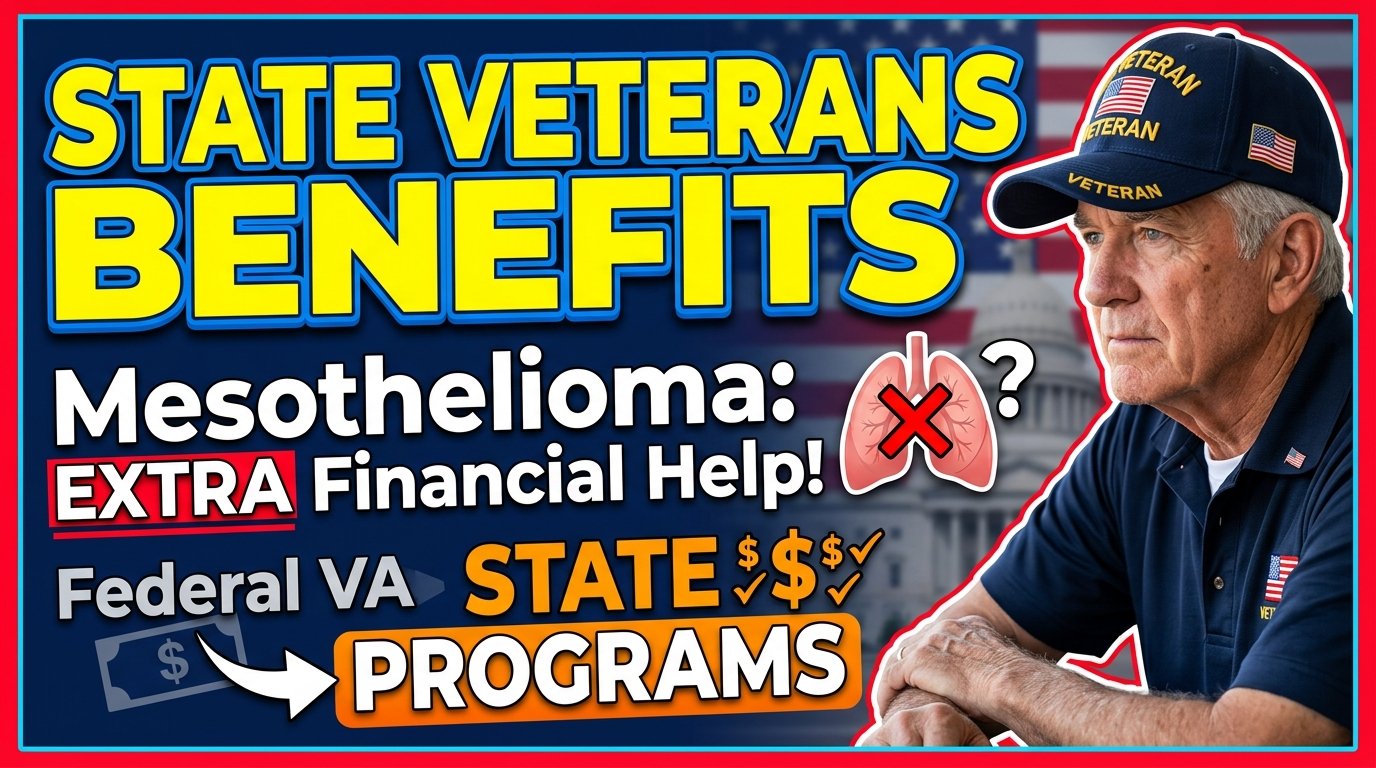
The Benefits You May Not Know About
You have filed your federal VA claim for mesothelioma. You are receiving disability compensation. You have health care through the VA. You may even have Aid and Attendance or DIC.
But here is something many veterans do not know. Your state may offer additional benefits for veterans with service-connected disabilities. These benefits are separate from federal VA benefits. You can receive both. And for veterans with mesothelioma (rated at 100 percent), many of these benefits are automatically available.
Every state has its own veterans benefits agency. Each state offers different benefits. Some states are very generous. Others offer less. But almost every state offers something.
This guide will walk you through the most common state-level benefits for veterans with mesothelioma. You will learn about property tax exemptions, income tax exclusions, vehicle and driver’s license benefits, education benefits for dependents, and more.
No complicated government language. No confusion. Just clear, honest information to help you get every benefit you have earned.
Part 1: Why State Veterans Benefits Matter
The Federal VA Is Not the Only Source
The federal VA provides excellent benefits – disability compensation, health care, home loans, education, and burial benefits. But there are gaps. The federal VA does not pay your property taxes. It does not waive your vehicle registration fees. It does not give your children free college tuition.
That is where state benefits come in.
Each state has its own Department of Veterans Affairs (or similar agency). These agencies administer benefits funded by state taxes. Most states offer benefits specifically for veterans with service-connected disabilities.
The 100 Percent Rating Advantage
Many state benefits require a 100 percent VA disability rating. Mesothelioma is rated at 100 percent. This means you qualify for the highest level of state benefits in almost every state.
If you have a 100 percent rating (or TDIU paying at the 100 percent rate), you should check your state’s benefits. You may be eligible for significant property tax savings, free vehicle registration, free hunting and fishing licenses, and more.
Part 2: Property Tax Exemptions
This is often the most valuable state benefit for veterans with mesothelioma. A property tax exemption reduces or eliminates the property taxes you pay on your home.
How Property Tax Exemptions Work
Most states offer a property tax exemption for veterans with a 100 percent service-connected disability. The exemption amount varies by state.
Full exemption (no property taxes): Some states waive 100 percent of property taxes for 100 percent disabled veterans. This is the most generous benefit.
Partial exemption: Some states waive a portion of property taxes (e.g., the first $50,000 of assessed value).
Income-based exemptions: Some states offer property tax exemptions based on income as well as disability rating.
State Examples
Texas (most generous): 100 percent disabled veterans are exempt from 100 percent of property taxes on their primary residence.
Florida: 100 percent disabled veterans are exempt from 100 percent of property taxes on their primary residence.
California: 100 percent disabled veterans are eligible for a property tax exemption of up to $160,000 of assessed value (partial exemption).
New York: 100 percent disabled veterans are eligible for a property tax exemption of up to 50 percent of assessed value (varies by locality).
Illinois: 100 percent disabled veterans are exempt from 100 percent of property taxes on their primary residence.
Ohio: 100 percent disabled veterans are exempt from 100 percent of property taxes on their primary residence.
How to Apply
Contact your local county tax assessor’s office. They will have the application forms. You will need:
- Your VA rating decision letter (showing 100 percent disability)
- Proof of ownership (deed or title)
- Proof of residency
Pro tip: Apply as soon as you move into your home. Many states require you to apply by a certain date (e.g., April 15) to receive the exemption for that tax year.
Part 3: Income Tax Exemptions
Several states exclude all or part of your VA disability compensation from state income taxes. Some states also offer additional exemptions for disabled veterans.
How Income Tax Exemptions Work
VA disability compensation is already exempt from federal income tax. Most states also exempt it from state income tax. But some states go further – they offer additional deductions or credits for disabled veterans.
State Examples
Pennsylvania: 100 percent disabled veterans are exempt from all state income tax on military retirement pay and disability compensation.
Michigan: 100 percent disabled veterans can deduct up to $20,000 of military retirement pay from state income tax.
Virginia: 100 percent disabled veterans are exempt from state income tax on all military retirement pay.
Georgia: 100 percent disabled veterans can deduct up to $35,000 of military retirement pay from state income tax.
What About Disability Compensation?
In almost every state, VA disability compensation is already exempt from state income tax. You do not need to do anything special. When you file your state taxes, simply do not include your VA disability payments as income.
How to Apply
Check your state’s department of revenue website. Most states do not require a separate application. You simply report the correct information on your annual tax return.
Part 4: Vehicle and Driver’s License Benefits
Many states offer vehicle-related benefits for disabled veterans.
Free or Reduced-Cost Vehicle Registration
Some states offer free or reduced-cost vehicle registration for 100 percent disabled veterans.
State examples:
- Texas: Free vehicle registration for 100 percent disabled veterans
- Florida: Free vehicle registration for 100 percent disabled veterans
- California: Reduced registration fees for disabled veterans
- New York: Free vehicle registration for 100 percent disabled veterans
Disabled Veteran License Plates
All states offer special license plates for disabled veterans. These plates may allow you to park in disabled parking spaces without a separate placard.
Eligibility: Most states require a 50 percent or higher VA disability rating. Some require 100 percent.
How to apply: Contact your state’s DMV. You will need your VA rating decision letter.
Driver’s License Exemptions
Some states offer free driver’s licenses for disabled veterans. Others offer exemptions from certain testing requirements.
State examples:
- Texas: Free driver’s license for 100 percent disabled veterans
- Florida: Free driver’s license for 100 percent disabled veterans
How to Apply
Contact your state’s DMV. Bring your VA rating decision letter and your current driver’s license.
Part 5: Hunting and Fishing Licenses
Almost every state offers free or reduced-cost hunting and fishing licenses for disabled veterans.
How It Works
Most states offer:
- Free fishing license for 100 percent disabled veterans
- Free hunting license for 100 percent disabled veterans
- Reduced-cost combination licenses
State examples:
- Texas: Free “Super Combo” hunting and fishing license for 100 percent disabled veterans
- Florida: Free hunting and fishing licenses for 100 percent disabled veterans
- California: Reduced-cost hunting and fishing licenses for disabled veterans
How to Apply
Contact your state’s fish and wildlife department. You will need your VA rating decision letter.
Part 6: Education Benefits for Dependents
Many states offer tuition assistance or free tuition at state colleges and universities for dependents of 100 percent disabled veterans.
How It Works
If you are rated at 100 percent disabled (or died from a service-connected condition), your spouse and children may be eligible for:
- Free tuition at state colleges and universities
- Free room and board
- Fee waivers for application, registration, and other costs
State Examples
Texas (Hazlewood Act): Dependents of 100 percent disabled veterans are eligible for up to 150 credit hours of free tuition at Texas public colleges and universities.
Florida (Congressional Medal of Honor and Veterans’ Dependents Educational Benefits):Dependents of 100 percent disabled veterans are eligible for free tuition and fees at Florida public colleges and universities.
California (CalVet College Fee Waiver): Dependents of 100 percent disabled veterans are eligible for a fee waiver at California public colleges and universities.
Illinois (Illinois Veteran Grant): Dependents of 100 percent disabled veterans are eligible for free tuition at Illinois public colleges and universities.
New York (Veterans Tuition Award): Dependents of disabled veterans may be eligible for tuition assistance.
How to Apply
Contact your state’s veterans affairs agency or the financial aid office at the college or university. You will need:
- Your VA rating decision letter (showing 100 percent disability)
- The dependent’s birth certificate or proof of relationship
- The dependent’s school enrollment verification
Part 7: Employment and Job Training Benefits
Many states offer employment assistance and job training programs for disabled veterans.
State Veterans Preference
Most states give disabled veterans preference in state government hiring. If you apply for a state job, you may receive additional points on your exam or be placed ahead of non-veteran applicants.
Job Training Programs
Many states offer free or low-cost job training programs for disabled veterans. These include:
- Vocational rehabilitation
- Apprenticeship programs
- On-the-job training
- Certification programs (CDL, welding, IT, etc.)
How to Apply
Contact your state’s veterans affairs agency or state department of labor.
Part 8: Other State Benefits
Free State Park Access
Many states offer free admission to state parks for disabled veterans.
State examples: Texas, Florida, California, New York, Michigan, Ohio
Reduced-Cost or Free Public Transit
Some states and localities offer reduced-cost or free public transit for disabled veterans.
State examples: New York (MTA reduced fare), Washington (King County Metro reduced fare)
Veterans Treatment Courts
Many states have Veterans Treatment Courts for veterans with legal issues related to their service or disability. These courts focus on treatment rather than punishment.
State Veterans Homes
Most states operate state veterans homes that provide nursing home care, assisted living, and domiciliary care for elderly or disabled veterans. These are often more accessible than VA nursing homes.
Part 9: How to Find Your State’s Benefits
Step One: Find Your State Veterans Agency
Every state has a Department of Veterans Affairs or similar agency. Search online for “[your state] veterans affairs.”
Step Two: Look for “State Benefits for Disabled Veterans”
Most state VA websites have a section listing benefits for disabled veterans. Look for:
- Property tax exemptions
- Vehicle and driver’s license benefits
- Education benefits for dependents
- Hunting and fishing licenses
- Employment preference
Step Three: Contact a State Veterans Service Officer (VSO)
Your state has VSOs who can help you navigate state benefits. They are similar to federal VSOs but focus on state programs.
Step Four: Apply
Each benefit has its own application process. You will almost always need:
- Your VA rating decision letter (showing 100 percent disability)
- Your DD214
- Proof of residency
Part 10: State vs. Federal Benefits – Can You Get Both?
Yes. State benefits are separate from federal VA benefits. You can receive both. They do not affect each other.
Examples:
- You can receive federal VA disability compensation AND a state property tax exemption.
- You can receive federal VA health care AND free state hunting and fishing licenses.
- Your dependents can receive federal Chapter 35 DEA benefits AND state tuition assistance.
Do not assume that because you receive federal benefits, you are not eligible for state benefits. Check. Apply. You may be leaving money on the table.
Frequently Asked Questions
Do I need to be 100 percent disabled for state benefits?
Many state benefits require a 100 percent disability rating. However, some have lower thresholds (50 percent, 70 percent). Check your state’s requirements.
What if I have TDIU (paid at 100 percent but not rated 100 percent)?
Most states treat TDIU the same as a 100 percent schedular rating for benefit purposes. Confirm with your state.
Do state benefits affect my federal VA benefits?
No. They are separate.
What if I move to another state?
Your benefits may change. Some states are more generous than others. Research before moving.
Can surviving spouses receive state benefits?
Yes. Many states offer property tax exemptions, education benefits, and other benefits for surviving spouses of veterans who died from service-connected conditions.
How do I prove my disability rating to the state?
Use your VA rating decision letter. You can get a copy from VA.gov or your local VA regional office.
Resources
- National Association of State Directors of Veterans Affairs: www.nasdva.us (links to every state VA agency)
- VA Rating Decision Letter: Request from VA.gov or your local VA regional office
- State VSO Locator: Contact your state VA agency
Final Thoughts: Do Not Leave Benefits on the Table
You served your country. You have mesothelioma. You have a 100 percent VA disability rating. You have earned every benefit available – federal AND state.
Many veterans do not know about state benefits. They receive their federal VA compensation and assume that is all. But your state may offer property tax exemptions worth thousands of dollars per year. Free vehicle registration. Free hunting and fishing licenses. Free tuition for your children.
These benefits are not charity. You earned them. Do not leave them on the table.
Contact your state veterans affairs agency today. Ask about benefits for 100 percent disabled veterans. Apply for everything you qualify for.
You served. You deserve.
Disclaimer: This article provides general information about state veterans benefits for veterans with mesothelioma. State benefits vary significantly by state. Laws change. Every situation is different. Always consult with your state’s veterans affairs agency or a qualified state Veterans Service Officer about your specific situation. If you have been diagnosed with mesothelioma, speak with a doctor immediately and contact a VA-accredited claims agent or an attorney to understand your federal and state benefits.