

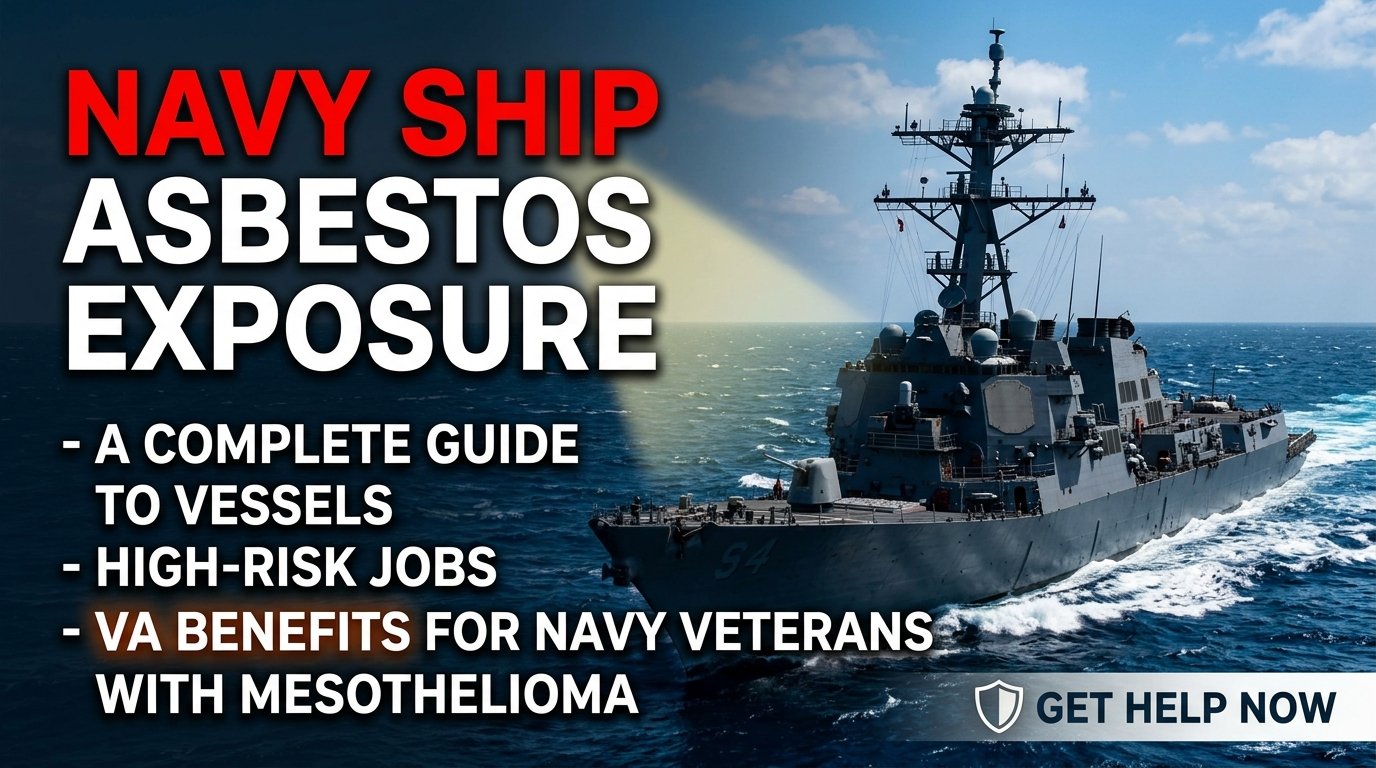
The Silent Danger Beneath the Deck
You served your country at sea. You stood watch in the engine room, the boiler room, or the navigation room. You slept in cramped berthing areas. You ate in the mess hall. You did your job without complaint.
What you did not know was that the ship you served on was filled with asbestos. It was in the insulation wrapped around the pipes. It was in the gaskets sealing the valves. It was in the boiler room walls. It was in the floor tiles and the ceiling panels. It was everywhere.
The Navy used asbestos on ships for decades. From the 1930s until the early 1980s, asbestos was seen as a miracle material. It was cheap. It was heat-resistant. It was fireproof. On a ship, fire is the greatest danger. Asbestos was supposed to protect you.
Instead, it put microscopic fibers into the air you breathed every day. Those fibers settled in your lungs. Decades later, they caused mesothelioma.
If you are a Navy veteran who served on a ship built before 1983, you were almost certainly exposed to asbestos. The VA now recognizes this. Under the PACT Act, mesothelioma is a presumptive condition for Navy veterans. You do not need to prove which ship or which job. The VA presumes your service caused your cancer.
This guide will walk you through everything you need to know about Navy ship asbestos exposure. You will learn which ships and jobs had the highest risk, why the Navy used so much asbestos, what symptoms to watch for, and how to get the VA benefits you deserve.
Part 1: Why the Navy Used So Much Asbestos
The “Miracle Mineral”
Asbestos is a group of naturally occurring minerals. They form into long, thin fibers. These fibers are incredibly strong. They are resistant to heat, fire, and chemicals. They do not conduct electricity.
For the Navy, asbestos was perfect. Ships face constant fire risk. A fire at sea can be a death sentence. Asbestos was used to fireproof nearly every part of the ship.
From the 1930s until the early 1980s, the Navy required asbestos in shipbuilding. It was used in:
- Insulation: Wrapped around pipes, boilers, and turbines
- Gaskets and packing: Sealing valves, pumps, and hatches
- Fireproofing: Coating walls, ceilings, and bulkheads
- Flooring and ceiling tiles: Throughout the ship
- Electrical wiring: Insulation on cables
- Brake pads and clutches: On ship vehicles and equipment
Thousands of tons of asbestos were on a single aircraft carrier. Every sailor aboard was exposed.
The Hidden Danger
The danger was not the asbestos itself. The danger came when asbestos was disturbed. When workers cut, sanded, removed, or repaired asbestos-containing materials, microscopic fibers floated into the air.
You could not see them. You could not smell them. You did not know you were breathing them in.
Those fibers got stuck in your lungs. Your body could not break them down or get rid of them. They sat there for years, causing inflammation and scarring. Twenty, thirty, forty, or fifty years later, that damage turned into mesothelioma.
Part 2: Which Navy Ships Had Asbestos?
Almost every ship built before 1983 contained asbestos. The older the ship, the more asbestos it had. The list includes:
Aircraft Carriers
Aircraft carriers were floating cities. They had thousands of compartments, miles of pipes, and massive engines. All of it was insulated with asbestos.
- Essex-class (built 1942-1950)
- Midway-class (built 1943-1947)
- Forrestal-class (built 1952-1959)
- Kitty Hawk-class (built 1956-1968)
- Enterprise-class (built 1960-1961) – the first nuclear-powered carrier, still used asbestos extensively
- Nimitz-class (built 1968-2009) – early ships in this class contained asbestos; later ships did not
Highest risk jobs on aircraft carriers: Boiler tenders, machinist’s mates, pipefitters, electrician’s mates, insulators, and anyone working in the engine room or boiler room.
Battleships
Battleships were the pride of the Navy. They were also filled with asbestos. The massive boilers and engines required extensive insulation.
- Iowa-class (built 1942-1944) – including the USS Iowa, USS New Jersey, USS Missouri, USS Wisconsin
- South Dakota-class (built 1939-1942)
- North Carolina-class (built 1937-1941)
Cruisers
Cruisers served as escorts for aircraft carriers and battleships. They had the same asbestos issues as larger ships.
- Baltimore-class (built 1941-1945)
- Cleveland-class (built 1940-1946)
- Des Moines-class (built 1945-1949)
- Boston-class (built 1952-1955)
Destroyers
Destroyers were smaller, faster ships. They were cramped. Asbestos was everywhere.
- Fletcher-class (built 1941-1945)
- Allen M. Sumner-class (built 1943-1945)
- Gearing-class (built 1944-1946)
- Forrest Sherman-class (built 1953-1959)
- Spruance-class (built 1972-1983)
Frigates
Frigates were similar to destroyers but focused on anti-submarine warfare.
- Knox-class (built 1965-1974)
- Oliver Hazard Perry-class (built 1975-2004)
Submarines
Submarines were cramped, enclosed spaces. Asbestos fibers had nowhere to go. Submariners breathed recirculated air filled with asbestos fibers.
- Gato-class (built 1940-1944)
- Balao-class (built 1942-1946)
- Los Angeles-class (built 1972-1996) – early ships contained asbestos
- George Washington-class (built 1959-1961) – the first ballistic missile submarines
Amphibious Assault Ships
These ships carried Marines and landing craft. They were built with the same asbestos materials as other vessels.
- Iwo Jima-class (built 1960-1970)
- Tarawa-class (built 1973-1980)
Auxiliary Ships
Auxiliary ships provided fuel, supplies, repairs, and other support. They were often older and had significant asbestos.
- Tankers (AO, AOR, AOE classes)
- Supply ships (AF, AFS, AKE classes)
- Repair ships (AR, ARL classes)
- Tenders (AD, AS, AVT classes)
Part 3: High-Risk Navy Jobs for Asbestos Exposure
Every sailor on a ship built before 1983 was exposed to asbestos. But some jobs had much higher exposure than others.
Boiler Tenders (BT)
Boiler tenders worked directly with boilers that were insulated with asbestos. They worked in boiler rooms where asbestos fibers were constantly in the air. They repaired and maintained boilers, disturbing the asbestos insulation.
Risk level: Extremely high
Machinist’s Mates (MM)
Machinist’s mates worked on engines, pumps, and other machinery. They replaced gaskets and packing materials that contained asbestos. They worked in confined spaces where asbestos fibers accumulated.
Risk level: Extremely high
Pipefitters (PF) and Pipefitter Mates
Pipefitters worked on pipes throughout the ship. The pipes were insulated with asbestos. When they cut, removed, or repaired pipes, they released asbestos fibers into the air. They also worked with asbestos gaskets and packing.
Risk level: Extremely high
Electrician’s Mates (EM)
Electrician’s mates worked with electrical wiring that was insulated with asbestos. They cut and stripped wires, releasing asbestos fibers. They also worked in confined spaces where asbestos exposure was high.
Risk level: High
Enginemen (EN)
Enginemen operated and maintained engines, boilers, and auxiliary equipment. They were surrounded by asbestos every single day.
Risk level: High
Hull Maintenance Technicians (HT)
Hull maintenance technicians repaired and maintained the ship’s structure. They worked with asbestos-containing materials used in bulkheads, decks, and other structural components.
Risk level: High
Gunner’s Mates (GM)
Gunner’s mates worked with weapons systems. Older weapons systems used asbestos-containing components. They were also exposed to asbestos in their workspaces.
Risk level: Moderate to High
Insulators
Insulators were responsible for installing and repairing insulation throughout the ship. Much of that insulation contained asbestos. This job had probably the highest asbestos exposure of all.
Risk level: Extremely high
Shipyard Workers (Civilian and Military)
Shipyard workers built, repaired, and maintained ships. They worked with asbestos every day. Welders, pipefitters, electricians, insulators, carpenters, and laborers were all exposed. Even office workers and storekeepers in shipyards were exposed to asbestos fibers in the air.
Risk level: Extremely high
Damage Controlmen (DC)
Damage controlmen responded to emergencies on the ship, including fires. When fires damaged asbestos-containing materials, they were exposed to high levels of asbestos fibers.
Risk level: High
Part 4: What If You Were Not in a High-Risk Job?
Many Navy veterans assume they were not exposed because their job was not on the “high-risk” list. This is not true.
Asbestos was everywhere on Navy ships. If you breathed the air on a ship built before 1983, you were exposed. It does not matter if you were a cook, a storekeeper, a radioman, or a yeoman. Asbestos fibers circulated through the ventilation system. They settled in berthing areas, mess halls, and offices.
Every sailor on a ship built before 1983 was exposed to asbestos. The VA recognizes this. Under the PACT Act, Navy service on a ship built before 1983 is enough to qualify for presumptive status.
Part 5: What If You Never Served on a Ship?
Many Navy veterans were exposed to asbestos even if they never set foot on a ship.
Shipyard Workers
You worked in Navy shipyards building, repairing, or maintaining ships. The shipyards themselves were filled with asbestos. Dry docks, workshops, and offices all contained asbestos materials.
Shore-Based Personnel
You worked on naval bases, barracks, offices, and other facilities that contained asbestos in insulation, flooring, ceiling tiles, and wall panels. Asbestos was used in military construction for decades.
Aviation Personnel
You worked on Navy aircraft that contained asbestos in brake pads, gaskets, and insulation. Even if you never went to sea, you were exposed.
If you served in the Navy in any capacity before the 1980s, you were exposed to asbestos.Period.
Part 6: Symptoms of Mesothelioma – What to Watch For
Mesothelioma takes 20 to 50 years to develop after asbestos exposure. Many Navy veterans are being diagnosed now, decades after their service.
Common Symptoms of Pleural Mesothelioma (Lung Lining)
- Shortness of breath that gets worse over time
- Pain in your chest or under your ribcage
- A dry cough that will not go away
- Coughing up blood
- Trouble swallowing
- Hoarseness in your voice
- Swelling in your face or arms
- Unexplained weight loss
- Extreme fatigue
- Night sweats or fever
Common Symptoms of Peritoneal Mesothelioma (Abdominal Lining)
- Pain or swelling in your abdomen
- Nausea and vomiting
- Loss of appetite
- Unexplained weight loss
- Diarrhea or constipation
- Swelling in your legs
- Extreme fatigue
If you have any of these symptoms and you served on a Navy ship, see a doctor immediately. Tell the doctor about your asbestos exposure.
Part 7: VA Benefits for Navy Veterans with Mesothelioma
You Are Presumptive Under the PACT Act
The PACT Act of 2022 made mesothelioma a presumptive condition for Navy veterans who served on ships built before 1983 or in shipyards. This means:
- You do not need to prove a direct connection between your service and your mesothelioma
- The VA presumes your mesothelioma was caused by your service
- Your claim should be approved
How to Apply
Step One: Gather your DD214 and medical records showing your mesothelioma diagnosis.
Step Two: Complete VA Form 21-526EZ (Application for Disability Compensation).
Step Three: In the exposure section, write: “I was exposed to asbestos during my Navy service aboard [ship name/years]. Asbestos was used throughout the ship. I have been diagnosed with mesothelioma.”
Step Four: Submit your application online at VA.gov, by mail, or with the help of a Veterans Service Officer.
How Much Will You Receive?
Mesothelioma is rated at 100 percent disability. For 2026, a single Navy veteran with a 100 percent rating receives approximately 3,938permonth∗∗.WithAidandAttendance(ifyouneedhelpwithdailyactivities),youcanreceiveapproximately∗∗3,938permonth∗∗.WithAidandAttendance(ifyouneedhelpwithdailyactivities),youcanreceiveapproximately∗∗5,912 per month.
Frequently Asked Questions
Do I need to know which ship I served on?
No. Under the PACT Act, you do not need to provide specific ship names. General service dates and locations are enough.
What if I served on a ship built after 1983?
Ships built after 1983 used less asbestos, but some still contained it. You may still be eligible. Talk to a VSO.
What if I only served on a ship for a short time?
Even short-term exposure can cause mesothelioma. The length of exposure does not matter. File your claim.
Can I receive VA benefits and also sue asbestos companies?
Yes. VA benefits come from the government. Lawsuits and trust fund claims come from private companies. They are completely separate.
How long does a VA claim take for Navy veterans?
Most claims are processed in 3-6 months. With a terminal diagnosis, you can request expedited processing.
What if my claim was denied before the PACT Act?
You can reapply. File a Supplemental Claim citing the PACT Act. Your claim should be approved under the new rules.
Final Thoughts: You Served. Now It Is Time to Be Served.
You stood in the engine room, the boiler room, or the navigation room. You did your job without complaint. You did not know that the asbestos around you was slowly killing you.
That was not your fault. The Navy knew asbestos was dangerous. The companies that made asbestos products knew. They hid the truth. They kept using it anyway.
Now you have mesothelioma. You are facing surgery, chemotherapy, radiation, or immunotherapy. You are worried about your family. You are worried about your finances.
But here is the truth. The VA has benefits for Navy veterans like you. Monthly tax-free payments. Free health care. Help for your family.
These benefits are not charity. You earned them. You served. Now it is time for your country to serve you.
Do not wait. File your VA claim today. Get a Veterans Service Officer to help you. The process is free. The money is there. You deserve it.
Disclaimer: This article provides general information about Navy ship asbestos exposure and VA benefits for Navy veterans with mesothelioma. It does not constitute legal advice or official VA guidance. VA benefits rules change. Every veteran’s situation is different. Always consult with a qualified Veterans Service Officer, VA-accredited attorney, or the VA directly about your specific situation. If you are a Navy veteran with symptoms of mesothelioma, see a doctor immediately. If you have been diagnosed with mesothelioma, contact a VA-accredited claims agent or an attorney to understand your benefits.