

The Invisible Victims
You never served in the military. You never worked in a shipyard or a construction site. You never handled asbestos directly. But you have mesothelioma. How is that possible?
Your father served in the Navy. Your husband worked as a mechanic. Your brother was a pipefitter. They came home every day covered in invisible asbestos fibers. You washed their uniforms. You hugged them hello. You sat next to them on the couch. You breathed in the same fibers they brought home from work.
Decades later, you are the one who is sick.
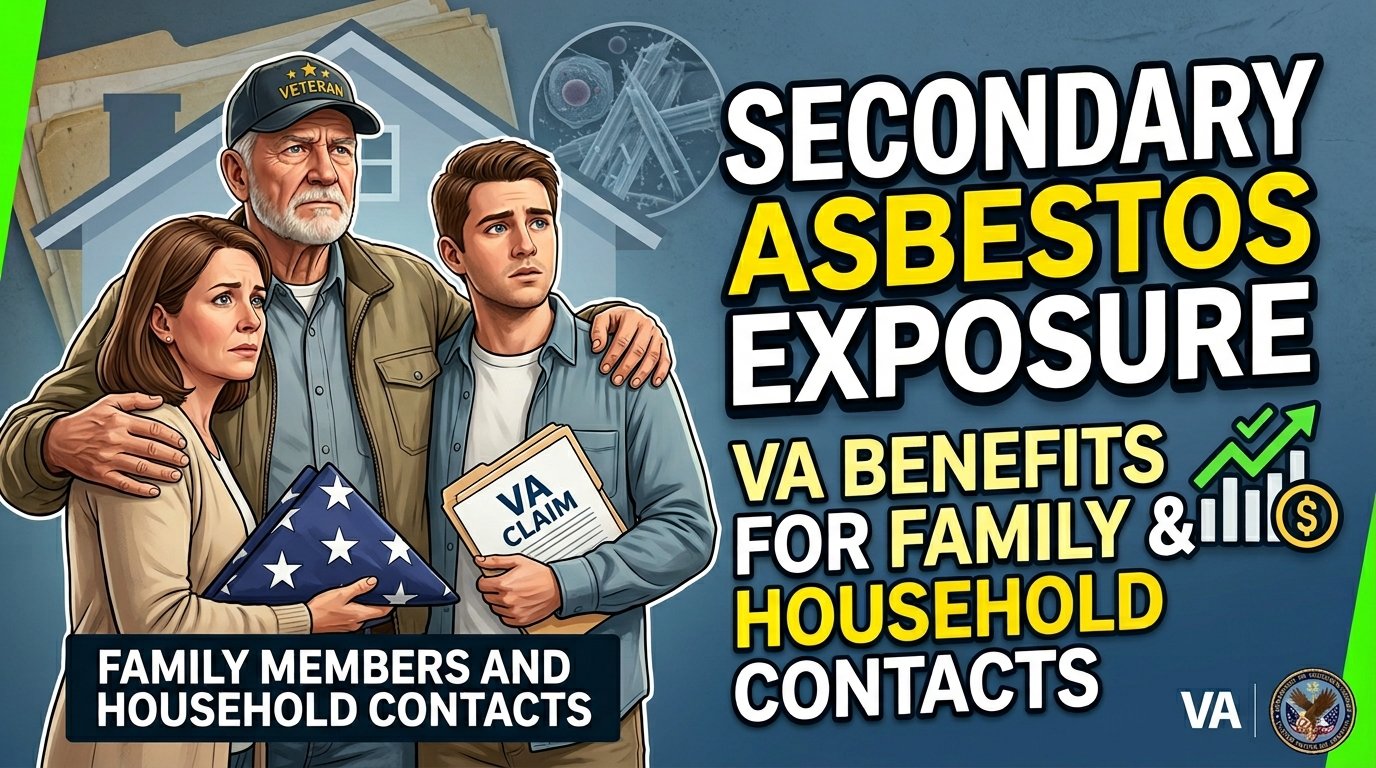
This is called secondary asbestos exposure or take-home asbestos exposure. And yes, the VA recognizes it. Family members and household contacts of veterans who were exposed to asbestos during service may be eligible for VA benefits if they developed mesothelioma.
This guide will walk you through everything you need to know about secondary asbestos exposure VA claims. You will learn who qualifies, how to prove exposure, what evidence you need, and how to apply for compensation.
No complicated government language. No confusion. Just clear, honest information to help you get the benefits you deserve.
Part 1: What Is Secondary Asbestos Exposure?
The Simple Explanation
Secondary asbestos exposure happens when a person who does not work with asbestos directly is exposed through someone who does. The asbestos fibers stick to the worker’s:
- Work clothes (uniforms, coveralls, jackets, pants)
- Shoes and boots
- Hair and skin
- Personal items (lunch boxes, tools, bags)
When the worker comes home, those fibers become airborne. Family members breathe them in. The fibers settle on furniture, carpets, and bedding. Over time, family members inhale enough asbestos to develop mesothelioma, lung cancer, or asbestosis.
How Common Is Secondary Exposure?
Studies show that secondary exposure is a significant problem. Research indicates that:
- 2-5 percent of all mesothelioma cases are caused by secondary exposure
- Wives of asbestos workers have a much higher rate of mesothelioma than the general population
- Children who grew up in households with asbestos workers have elevated rates of asbestos-related diseases
Who Is at Risk for Secondary Exposure?
- Wives and husbands of veterans who worked around asbestos
- Children who lived with veterans who worked around asbestos
- Parents who lived with veterans who worked around asbestos
- Siblings who shared a home with veterans who worked around asbestos
- Roommates who lived with veterans who worked around asbestos
Part 2: The Different Types of Secondary Exposure
Laundry-Related Exposure
This is the most common type of secondary exposure. The family member (usually a wife or mother) would shake out, wash, and fold the veteran’s asbestos-laden work clothes. Each time, fibers became airborne.
High-risk activities:
- Shaking out work clothes before washing
- Hand-washing uniforms (before washing machines were common)
- Sorting and folding contaminated laundry
- Ironing work clothes (heat releases fibers)
Direct Contact Exposure
Family members were exposed by simply being near the veteran.
- Hugging the veteran when they came home from work
- Sitting on the veteran’s lap
- Sleeping in the same bed
- Sharing a car
- The veteran carrying the family member while still in work clothes
Household Contamination
Asbestos fibers settled throughout the home. They accumulated on:
- Furniture (couches, chairs, beds)
- Carpets and rugs
- Curtains and drapes
- Kitchen counters and tables
- Bathroom surfaces
Children who crawled or played on floors were at especially high risk.
Vehicle Exposure
Many veterans drove home from work in their own cars while still in work clothes. The car interior became contaminated. Family members riding in the car were exposed.
Part 3: Which Veterans Had the Highest Risk of Bringing Asbestos Home?
Not every veteran posed the same risk to their family. Veterans who worked in certain jobs were more likely to bring asbestos home.
Highest-Risk Jobs for Secondary Exposure
- Navy personnel (especially those who served on ships built before 1983)
- Shipyard workers (military and civilian)
- Construction workers (military construction battalions)
- Insulators (military and civilian)
- Pipefitters and steamfitters
- Boiler tenders and machinist’s mates
- Electrician’s mates
- Mechanics (military vehicle maintenance)
- Demolition workers
Why Navy Veterans Pose the Highest Risk
Navy veterans were surrounded by asbestos on ships. Their uniforms were heavily contaminated. They often wore the same uniforms for days or weeks. They slept in barracks or on the ship, then came home on leave still wearing the same clothes.
For these reasons, family members of Navy veterans have the highest rates of secondary exposure mesothelioma.
Part 4: Can You Receive VA Benefits for Secondary Exposure?
The Short Answer
Yes. The VA recognizes secondary asbestos exposure as a valid basis for service connection. However, the rules are different than for direct exposure.
The Long Answer
Secondary exposure claims are more difficult to prove than direct exposure claims. For direct exposure (the veteran was exposed during their own service), the PACT Act makes mesothelioma presumptive for many veterans. No proof is needed.
For secondary exposure, the VA does not automatically presume the connection. You must prove:
- The veteran had significant asbestos exposure during service
- You lived with the veteran during or shortly after their service
- Your mesothelioma was caused by that secondary exposure
Who Is Eligible?
You are eligible to file a VA claim for secondary exposure if:
- You are the spouse, child, parent, or sibling of a veteran
- The veteran had documented asbestos exposure during military service
- You lived with the veteran during their service or after they returned
- You have been diagnosed with mesothelioma (or another asbestos-related disease)
Do You Need to Be a Veteran Yourself?
No. You do not need to have served in the military. Secondary exposure claims are for family members who were not in the military. This is one of the few ways a non-veteran can receive VA benefits.
Part 5: How to Prove a Secondary Exposure VA Claim
Proving a secondary exposure claim requires more evidence than a direct exposure claim. Here is what you need.
Evidence of the Veteran’s Asbestos Exposure
You must prove that the veteran was exposed to asbestos during their military service.
What to provide:
- The veteran’s DD214 (military discharge papers)
- Ship names and dates of service (for Navy veterans)
- Duty stations and job descriptions
- Military records showing asbestos exposure (if available)
- Statements from fellow service members
Under the PACT Act: If the veteran served in a qualifying location (Vietnam, Persian Gulf, Afghanistan, or on a ship built before 1983), you can reference the PACT Act in your claim. While secondary exposure is not automatically presumptive, the veteran’s exposure is.
Evidence of Your Relationship to the Veteran
You must prove that you lived with the veteran during the time they were bringing asbestos home.
What to provide:
- Marriage certificate (for spouses)
- Birth certificate (for children)
- School records showing your address
- Census records
- Witness statements from family members or neighbors
- Photographs of the family together
Evidence of Your Mesothelioma Diagnosis
You need medical records showing your mesothelioma diagnosis.
What to provide:
- Biopsy report
- Imaging results (CT, MRI, PET scans)
- Pathology report
- Treatment records
- Doctor’s statement linking your mesothelioma to asbestos exposure
A Doctor’s Medical Opinion (Nexus Letter)
This is the most important piece of evidence for a secondary exposure claim. Your doctor must write a letter stating that, in their professional opinion, your mesothelioma was caused by secondary asbestos exposure from the veteran.
What the letter should say:
- Your diagnosis
- Your history of living with the veteran
- The veteran’s known asbestos exposure
- The doctor’s opinion that your mesothelioma is linked to that exposure
Sample language:
“I have reviewed [claimant name]’s medical records and exposure history. [Claimant name] lived with [veteran name] during [veteran’s] military service from [dates]. [Veteran name] was exposed to asbestos during their service as [job/assignment]. In my medical opinion, it is at least as likely as not that [claimant name]’s mesothelioma was caused by secondary asbestos exposure from [veteran name]’s military service.”
Part 6: Step-by-Step Guide to Filing a Secondary Exposure Claim
Step One: Gather Your Evidence
Collect everything listed in Part 5. This will take time. Do not rush.
Step Two: Complete VA Form 21-526EZ
This is the standard VA disability claim form. In the exposure section, write clearly:
“I am filing a secondary exposure claim. My [father/husband/mother] served in the [branch of service] from [dates]. They were exposed to asbestos during their service. I lived with them during and after their service. I was exposed to asbestos through their work clothes, laundry, and household contamination. I have been diagnosed with mesothelioma.”
Step Three: Submit Your Claim
Submit your claim online at VA.gov, by mail, or with the help of a Veterans Service Officer (VSO).
Step Four: VA Review
The VA will review your claim. They may request additional evidence. They may schedule a C&P exam.
Step Five: Receive Your Decision
If approved, you will receive a disability rating and monthly compensation.
Part 7: Common Challenges in Secondary Exposure Claims
Challenge 1: The Veteran Is Deceased
If the veteran who exposed you has passed away, you can still file a claim. You will need:
- The veteran’s death certificate
- Any available service records
- Witness statements from other family members
Challenge 2: No Service Records
If the veteran’s service records are lost or destroyed, you can still file. Provide:
- Witness statements from fellow service members
- Statements from family members who remember the veteran’s service
- Any other documentation (photos, letters, discharge papers)
Challenge 3: The VA Denies Your Claim
Many secondary exposure claims are denied the first time. Do not give up. Common reasons for denial include:
- Insufficient evidence of the veteran’s exposure
- Insufficient evidence of your living arrangement
- Lack of a strong medical opinion (nexus letter)
How to appeal: File a Supplemental Claim with new evidence. Get a stronger nexus letter. Add more witness statements.
Challenge 4: The Veteran’s Exposure Was Not Documented
Even if the veteran’s exposure was not formally documented, you can still file. Provide:
- Statements from the veteran (if still alive)
- Statements from fellow service members
- General knowledge of asbestos use in that branch/era
Part 8: Secondary Exposure Claims for Children of Veterans
Children of veterans are often the most heartbreaking cases. A child who grew up hugging their father after he came home from a shipyard should not have mesothelioma.
Special Considerations for Children
- Childhood exposure: Children are more vulnerable to asbestos because their lungs are still developing. Smaller amounts of asbestos can cause disease.
- Long latency period: Mesothelioma takes 20-50 years to develop. Children exposed in the 1970s may just now be getting sick.
- No alternative exposure sources: For a child, the most likely source of asbestos was secondary exposure from a parent.
How Children Can Prove Their Claim
- Birth certificate showing parent’s name
- School records showing residence at same address as veteran
- Witness statements from siblings or other family members
- Medical records
- Strong nexus letter
Part 9: Secondary Exposure Claims for Wives of Veterans
Wives of veterans are the most common secondary exposure claimants. They often did the laundry, cleaned the work clothes, and slept next to the veteran.
Special Considerations for Wives
- Laundry exposure: Wives who shook out, hand-washed, and ironed work clothes had high exposure.
- Hugging and physical contact: Wives who hugged their husbands hello when they came home were directly exposed.
- Shared spaces: Sleeping in the same bed, riding in the same car, sitting on the same furniture.
What Wives Need to Prove
- Marriage certificate
- Evidence that the couple lived together during the veteran’s service
- Evidence of the veteran’s asbestos exposure
- Medical records and nexus letter
Part 10: Can You Receive Other VA Benefits?
If your secondary exposure claim is approved, you may be eligible for other VA benefits.
Health Care
Family members with service-connected mesothelioma are eligible for VA health care at no cost. This includes:
- Doctor visits and specialist consultations
- Hospital stays
- Surgery, chemotherapy, radiation, immunotherapy
- Prescription medications
- Palliative care
CHAMPVA (For Surviving Spouses)
If you are the surviving spouse of a veteran who died from mesothelioma and you have secondary exposure yourself, you may be eligible for CHAMPVA health insurance.
VA Burial Benefits
If you die from mesothelioma caused by secondary exposure, your family may be eligible for VA burial benefits.
Frequently Asked Questions
How long does a secondary exposure claim take?
6-12 months on average. Some take longer. Complex claims may take 1-2 years.
What if the veteran is still alive?
That helps. The veteran can provide a statement about their service and exposure.
What if the veteran does not want to help?
You can still file. Provide other evidence (service records, witness statements).
Can I file a claim if the veteran was exposed in a civilian job?
No. The exposure must come from military service, not a civilian job.
Do I need a lawyer for a secondary exposure claim?
Not necessarily. A VSO can help for free. But complex claims may benefit from an attorney.
What if I am not sure the veteran had asbestos exposure?
Research the veteran’s branch, ship, and job. Many military jobs had documented asbestos exposure. A VSO or attorney can help.
Resources
- VA Secondary Exposure Information: www.va.gov/disability/how-to-file-claim/evidence-needed/secondary-exposure/
- Find a VSO: www.va.gov/ogc/apps/accreditation/
- National Archives (for service records): www.archives.gov/veterans
- Mesothelioma Applied Research Foundation: www.curemeso.org (has resources for secondary exposure)
- Patient Advocate (if your claim is delayed): Ask your local VA medical center
Final Thoughts: Your Exposure Was Real
You never served. You never worked with asbestos. But you got sick anyway. You washed those uniforms. You hugged that veteran. You breathed that contaminated air.
Your exposure was real. Your disease is real. You deserve compensation.
Do not let anyone tell you that secondary exposure does not count. The VA recognizes it. Thousands of family members have received benefits. You can too.
Gather your evidence. Get a strong nexus letter. Work with a VSO or attorney. File your claim.
You deserve justice. You deserve benefits. You deserve to be heard.
Disclaimer: This article provides general information about secondary asbestos exposure VA claims. It does not constitute legal advice or official VA guidance. VA benefits rules change. Every case is different. Always consult with a qualified Veterans Service Officer, VA-accredited attorney, or the VA directly about your specific situation. If you have been diagnosed with mesothelioma from secondary exposure, speak with a doctor immediately and contact a VA-accredited claims agent or an attorney to understand your benefits.