

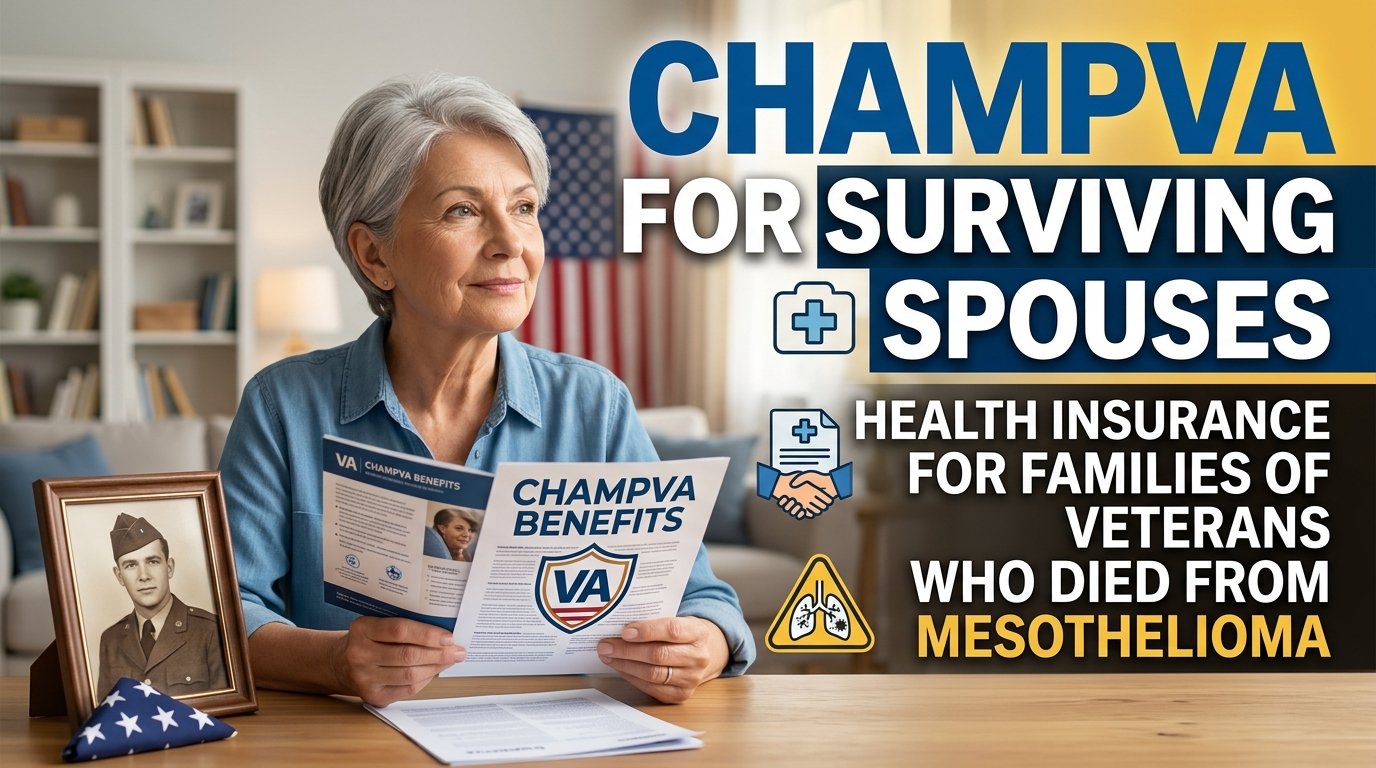
When Your Loved One Is Gone, but the Medical Bills Keep Coming
You lost your spouse to mesothelioma. The grief is overwhelming. But life does not stop. Your children need checkups. You need medications. Someone needs a dentist. Someone else needs glasses.
The bills keep coming. And without your spouse’s income, affording health insurance feels impossible.
Here is something you need to know. The VA offers a health insurance program for surviving spouses and children of veterans who died from service-connected conditions like mesothelioma. It is called CHAMPVA – the Civilian Health and Medical Program of the Department of Veterans Affairs.
CHAMPVA covers doctor visits, hospital stays, prescriptions, mental health care, dental care, vision care, and more. It is not free, but it is very affordable. And it can be a lifeline for families trying to rebuild after a devastating loss.
This guide will walk you through everything you need to know about CHAMPVA for surviving spouses. You will learn who qualifies, what services are covered, how much it costs, how to apply, and how to use it with your other health insurance.
No complicated government language. No confusion. Just clear, honest information to help you and your children get the health care you need.
Part 1: What Is CHAMPVA?
The Simple Explanation
CHAMPVA is a health insurance program for the surviving spouses and dependent children of veterans who:
- Are permanently and totally disabled from a service-connected condition, OR
- Died from a service-connected condition (like mesothelioma)
The program pays for most medical services. You can see any Medicare-certified provider. You do not have to go to VA hospitals.
CHAMPVA is not free. But it is very affordable. You pay an annual deductible (about 50perperson,100 per family) and then cost-shares (25 percent of allowed amount). There is an annual catastrophic cap (about $3,000 per family) after which CHAMPVA pays 100 percent.
CHAMPVA vs. TRICARE: What Is the Difference?
Many people confuse CHAMPVA with TRICARE. They are different.
| Feature | CHAMPVA | TRICARE |
|---|---|---|
| Who qualifies? | Surviving spouses of veterans with service-connected death | Surviving spouses of military retirees or active duty |
| Veteran’s service | Any service (active, Guard, Reserve) | Usually 20+ years active duty or retired |
| VA facility? | No – you see civilian doctors | Yes – you can use military facilities |
| Cost | Deductible + 25% coinsurance | Varies by plan |
If you qualify for TRICARE, you cannot also receive CHAMPVA. You must choose one. But most surviving spouses of veterans who died from mesothelioma qualify for CHAMPVA, not TRICARE.
Part 2: Do You Qualify for CHAMPVA as a Surviving Spouse?
You qualify for CHAMPVA if you meet all of the following requirements.
Requirement 1: You Are the Surviving Spouse of a Veteran
- You were legally married to the veteran
- The veteran died from a service-connected condition (mesothelioma qualifies)
- You have not remarried (or you remarried after age 55 – see PACT Act changes below)
Requirement 2: The Veteran Died from a Service-Connected Condition
For mesothelioma, this means the veteran had a VA rating for mesothelioma, or the VA determined that their mesothelioma was caused by service-related asbestos exposure.
Even if the veteran never filed a VA claim, you can still qualify. You will need to prove that their mesothelioma was caused by military service.
Requirement 3: You Are Not Eligible for TRICARE
If you are eligible for TRICARE (as a surviving spouse of a military retiree), you cannot receive CHAMPVA. You must choose TRICARE.
Requirement 4: You Are Not Eligible for Medicare Part A (Hospital Insurance) at No Cost
If you are eligible for premium-free Medicare Part A, you must take it. CHAMPVA becomes secondary to Medicare.
Requirement 5: The Veteran Was Not Dishonorably Discharged
CHAMPVA requires that the veteran received an honorable or general discharge. Dishonorable discharge disqualifies you.
The PACT Act Change: Remarriage After Age 55
Before the PACT Act of 2022, remarrying at any age would cut off your CHAMPVA benefits. Now, if you remarry after age 55, you can keep your CHAMPVA benefits. This is a critical change for older surviving spouses.
Part 3: What Services Does CHAMPVA Cover?
CHAMPVA covers a wide range of medical services. Here is what is included.
Covered Services
- Doctor visits: Primary care and specialist consultations
- Hospital stays: Inpatient and outpatient surgery, emergency room visits
- Prescription medications: Most drugs, including cancer medications
- Mental health care: Therapy, counseling, psychiatry
- Skilled nursing care: Short-term rehabilitation
- Hospice care: End-of-life care
- Home health care: Nursing and therapy at home
- Durable medical equipment: Wheelchairs, oxygen, hospital beds
- Ambulance services: Emergency and non-emergency transport
- Physical, occupational, and speech therapy
- Chiropractic care (limited)
- Dental care (limited – see below)
- Vision care (one exam per year, glasses only for certain conditions)
- Hearing aids (one pair every 3 years)
Dental Coverage (Limited)
CHAMPVA dental coverage is limited to:
- Emergency dental care (for accidents)
- Dental care related to a covered medical condition (e.g., jaw surgery)
- Extractions and other dental care required before radiation therapy for head/neck cancer
For routine dental care (cleanings, fillings, crowns), you need separate dental insurance.
Vision Coverage (Limited)
CHAMPVA covers:
- One routine eye exam per year
- Glasses or contact lenses only for specific conditions (cataract surgery, corneal transplant, severe refractive error over 8 diopters)
For routine glasses or contacts, you pay out of pocket.
What CHAMPVA Does NOT Cover
- Routine dental care (cleanings, fillings, crowns)
- Routine vision care (glasses, contacts) without a qualifying condition
- Cosmetic surgery
- Experimental or investigational treatments
- Long-term nursing home care (custodial care)
- Weight loss programs
- Infertility treatments
Part 4: How Much Does CHAMPVA Cost?
CHAMPVA is not free, but it is very affordable compared to private insurance.
Annual Deductible (2026)
| Family Status | Deductible |
|---|---|
| Individual (single person) | $50 |
| Family (two or more people) | $100 |
You pay the deductible once per calendar year. After you meet the deductible, CHAMPVA pays its share.
Cost-Share (What You Pay After Deductible)
CHAMPVA pays 75 percent of the allowed amount. You pay 25 percent.
Example: Your doctor visit costs 200.CHAMPVA′sallowedamountis150. You pay 25 percent of 150=37.50. CHAMPVA pays the rest.
Annual Catastrophic Cap
| Family Status | Catastrophic Cap (2026) |
|---|---|
| Individual (single person) | $3,000 |
| Family (two or more people) | $3,000 |
Once you pay $3,000 out of pocket in a calendar year, CHAMPVA pays 100 percent of covered services for the rest of the year.
Premiums
There are no monthly premiums for CHAMPVA. You only pay when you use services (deductible and cost-shares).
Comparison: CHAMPVA vs. Private Insurance
| Feature | CHAMPVA | Typical Private Insurance |
|---|---|---|
| Monthly premium | $0 | 300−800 |
| Annual deductible | 50−100 | 1,000−5,000 |
| Cost-share | 25% | 20%-40% |
| Out-of-pocket max | $3,000 | 5,000−10,000 |
CHAMPVA is significantly more affordable than most private insurance plans.
Part 5: How to Apply for CHAMPVA
Step One: Gather Your Documents
You will need:
- Your marriage certificate (proving you were legally married to the veteran)
- The veteran’s death certificate (showing mesothelioma as cause or contributing cause)
- The veteran’s DD214 (military discharge papers)
- The veteran’s VA rating decision (if available)
- Your children’s birth certificates (if applying for them)
- Your current health insurance cards (if you have other insurance)
- Your Social Security card
Step Two: Complete VA Form 10-7959c
VA Form 10-7959c is the “Application for CHAMPVA Benefits.” It is a 6-page form.
The form asks for:
- Your personal information
- The veteran’s service information
- The veteran’s cause of death
- Your family members’ information
- Your other health insurance information
Where to get the form:
- Download from VA.gov
- Request by mail by calling the CHAMPVA help line: 1-800-733-8387
Step Three: Submit Your Application
Mail your completed application and documents to:
VA CHAMPVA Center
PO Box 469028
Denver, CO 80246-9028
Pro tip: Send your application by certified mail with return receipt requested. This proves the VA received it.
Step Four: Wait for Your CHAMPVA ID Card
Processing times vary. It can take 3-6 months to receive your CHAMPVA ID card. You cannot use CHAMPVA until you have your ID card and the VA has processed your application.
While you wait: If you need medical care, you may be able to request expedited processing for urgent conditions. Call the CHAMPVA help line.
Part 6: Using CHAMPVA with Other Insurance
CHAMPVA works with other health insurance. It does not replace it. Here is how coordination works.
CHAMPVA and Medicare
If you are eligible for premium-free Medicare Part A (hospital insurance), you must take it. CHAMPVA becomes secondary to Medicare. Medicare pays first. CHAMPVA pays second.
If you are not eligible for premium-free Medicare, CHAMPVA pays as primary.
CHAMPVA and Employer-Sponsored Insurance
If you have health insurance through your employer, CHAMPVA pays secondary. Your employer insurance pays first. CHAMPVA pays the remaining covered expenses.
Example: Your employer insurance pays 80 percent of a bill. CHAMPVA pays 25 percent of the remaining 20 percent. You pay very little out of pocket.
CHAMPVA and No Other Insurance
If you have no other health insurance, CHAMPVA pays as primary. You pay the deductible and 25 percent cost-share.
Part 7: CHAMPVA for Dependent Children
Your dependent children are also eligible for CHAMPVA.
Who Qualifies as a Dependent Child?
- Unmarried children under 18
- Unmarried children between 18 and 23 who are attending school full-time
- Unmarried children of any age who became permanently disabled before age 18
How to Add Children
Include them on your VA Form 10-7959c application. Provide their birth certificates. If they are over 18 and in school, provide school enrollment records.
What CHAMPVA Covers for Children
The same services covered for adults. Plus:
- Well-child visits (including immunizations)
- Pediatric dental care (cleanings, fluoride treatments, sealants)
- Orthodontia (braces) only for severe medical necessity
Part 8: CHAMPVA Pharmacy Benefits
CHAMPVA covers prescription medications through a mail-order pharmacy program.
How It Works
- Mail-order (preferred): Use the CHAMPVA mail-order pharmacy. You pay 25 percent of the cost. No deductible applies to medications.
- Local pharmacy: You can use local pharmacies, but you may pay more.
Covered Medications
Most prescription drugs are covered, including:
- Cancer medications
- Pain medications
- Heart and blood pressure medications
- Diabetes medications
- Mental health medications
Not Covered
- Over-the-counter medications (unless prescribed by a doctor)
- Experimental drugs
- Medications for cosmetic purposes
Frequently Asked Questions
How long does it take to get CHAMPVA approved?
Usually 3-6 months. Apply as soon as possible after the veteran’s death.
Can I use CHAMPVA before I receive my ID card?
No. You must have your CHAMPVA ID card and the VA must have processed your application.
What if I have a medical emergency while waiting for CHAMPVA approval?
Get the care you need. Then apply for retroactive CHAMPVA coverage. Keep your receipts.
Can I keep CHAMPVA if I remarry?
If you remarry before age 55, you lose CHAMPVA. If you remarry after age 55, you keep CHAMPVA (PACT Act change).
What if I already have health insurance through my job?
CHAMPVA works as secondary insurance. Your job insurance pays first. CHAMPVA pays second. This can save you money.
What if I am eligible for both CHAMPVA and Medicaid?
You can have both. Medicaid pays first. CHAMPVA pays second.
Resources
- CHAMPVA Help Line: 1-800-733-8387 (Monday-Friday, 8:00 AM to 7:30 PM ET)
- CHAMPVA Mail Order Pharmacy: 1-877-733-8787
- VA Form 10-7959c: Download from VA.gov
- CHAMPVA Website: www.va.gov/communitycare/programs/dependents/champva/index.asp
Final Thoughts: You Are Not Alone
Losing your spouse to mesothelioma is devastating. The grief is heavy. The practical challenges – bills, insurance, raising children – can feel overwhelming.
But you are not alone. CHAMPVA is here to help. It provides affordable health insurance for you and your children. It covers doctor visits, hospital stays, prescriptions, mental health care, and more. It works with your other insurance. It is there for you.
Do not wait. Apply for CHAMPVA today. Call the CHAMPVA help line with questions. Talk to a Veterans Service Officer for free assistance.
Your spouse served our country. Your spouse died from a disease caused by that service. You deserve this benefit. Use it.
Disclaimer: This article provides general information about CHAMPVA for surviving spouses of veterans who died from mesothelioma. It does not constitute legal advice or official VA guidance. VA benefits rules change. Every situation is different. Always consult with a qualified Veterans Service Officer or the VA directly about your specific situation. If you are the surviving spouse of a veteran who died from mesothelioma, contact the CHAMPVA help line or a Veterans Service Officer to understand your benefits.