

The Invisible Wound
Mesothelioma attacks the body. But it also attacks the mind.
The fear of death. The anxiety before each scan. The depression that comes with fatigue and pain. The guilt of being a burden. The anger at the companies that caused this. The grief over the life you thought you would have.
These are not signs of weakness. They are normal responses to a devastating diagnosis.
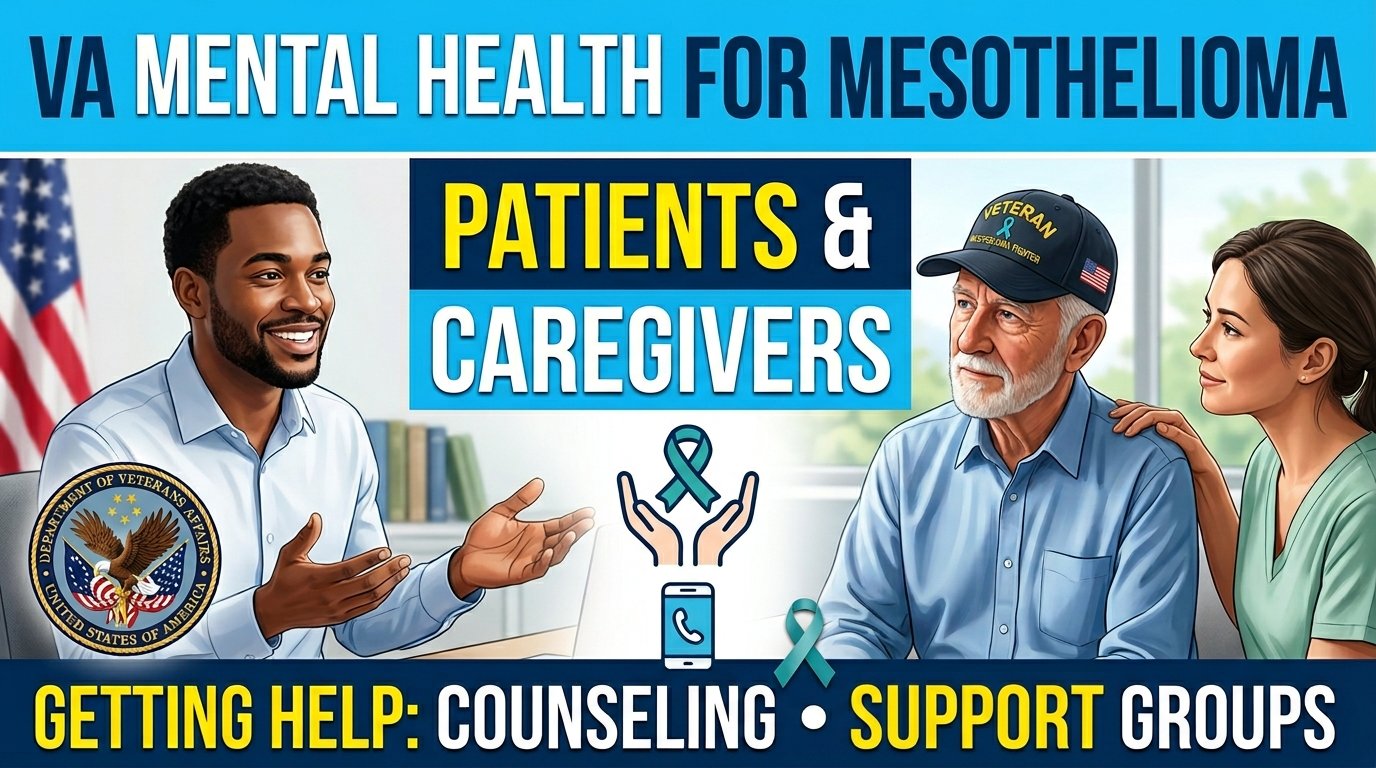
But you do not have to suffer in silence. The VA offers mental health services for veterans with service-connected conditions like mesothelioma. These services include individual counseling, group therapy, marriage and family counseling, and even support for caregivers.
And here is the most important part. You do not need a VA disability rating to access mental health care. Any veteran who served honorably is eligible for VA mental health services. Even if your VA claim is still pending. Even if you were denied in the past. Even for conditions not related to your service.
This guide will walk you through everything you need to know about VA mental health services for mesothelioma patients and their caregivers. You will learn what services are available, how to access them, how to support a loved one with mesothelioma, and how to take care of yourself.
No complicated government language. No confusion. Just clear, honest information to help you and your family through this difficult journey.
Part 1: Why Mental Health Support Matters for Mesothelioma Patients
The Emotional Toll of a Cancer Diagnosis
Mesothelioma is not just a physical disease. It is an emotional one too. Patients commonly experience:
Fear and anxiety: Fear of death. Fear of pain. Fear of leaving family behind. Anxiety before every scan and doctor’s appointment. Anxiety about treatment side effects.
Depression: The fatigue, the pain, the loss of independence. The inability to work or do the things you love. Feeling like a burden to your family.
Anger: Anger at the asbestos companies that caused this. Anger at the Navy or the military for not protecting you. Anger at yourself (even though it was not your fault).
Grief: Grieving the life you thought you would have. The retirement you planned. The grandchildren you might not see grow up. The trips you will never take.
Guilt: Feeling guilty for needing help. Feeling guilty for being tired. Feeling guilty for wanting to give up.
These emotions are normal. But they can become overwhelming. They can interfere with your treatment. They can damage your relationships. They can make you want to give up.
Why Veterans Are at Higher Risk
Veterans face additional mental health challenges. Many were taught to be tough. To not complain. To push through pain. This can make it harder to ask for help.
Veterans also have higher rates of PTSD, depression, and anxiety than the general population. A mesothelioma diagnosis on top of existing mental health conditions can be devastating.
The Good News
Mental health treatment works. Counseling can reduce anxiety and depression. Support groups can reduce isolation. Medications can help with sleep and mood. You do not have to suffer alone.
Part 2: VA Mental Health Services Available to Veterans
The VA offers a wide range of mental health services. Most are free. All are confidential.
Individual Counseling
One-on-one counseling with a licensed mental health professional (psychologist, psychiatrist, social worker, or counselor).
What you can work on:
- Coping with a mesothelioma diagnosis
- Managing anxiety and depression
- Processing anger and grief
- Improving communication with family
- Developing coping skills for pain and fatigue
How to access: Request a mental health appointment at your local VA medical center. You can also request telehealth (video) appointments.
Group Therapy and Support Groups
Group sessions where veterans with similar challenges meet to share experiences and support each other.
Types of groups available:
- Cancer support groups (specifically for veterans with cancer)
- General mental health groups (depression, anxiety, PTSD)
- Grief and loss groups
- Caregiver support groups
Benefits: Reduces isolation. Normalizes your experience. Learn from others who have been where you are.
How to access: Ask your VA mental health provider about available groups.
Marriage and Family Counseling
Mesothelioma affects the whole family. Tensions rise. Communication breaks down. Roles change.
What is covered: Couples counseling to improve communication and reduce conflict. Family sessions to help everyone understand the disease and work together.
How to access: Request couples or family counseling through your VA mental health provider.
PTSD Treatment
Many veterans have PTSD from their service. A mesothelioma diagnosis can trigger or worsen PTSD symptoms.
Evidence-based treatments available:
- Prolonged Exposure (PE)
- Cognitive Processing Therapy (CPT)
- Eye Movement Desensitization and Reprocessing (EMDR)
How to access: Ask your VA provider about PTSD specialty care.
Substance Use Treatment
Some veterans turn to alcohol or drugs to cope with their mesothelioma diagnosis. The VA offers confidential substance use treatment, including detox, counseling, and medication-assisted treatment.
How to access: Contact your local VA medical center’s substance use treatment program.
Suicide Prevention
If you are having thoughts of suicide, help is available immediately.
- Call 988 and press 1 (Veterans Crisis Line)
- Text 838255
- Chat online at veteranscrisisline.net
The Veterans Crisis Line is free, confidential, and available 24/7. You do not need to be enrolled in VA health care to use it.
Part 3: How to Access VA Mental Health Services
You Do Not Need a VA Disability Rating
This is critical to understand. You do not need a VA disability rating to access VA mental health care. Any veteran who served honorably is eligible.
Even if your mesothelioma claim is still pending. Even if your claim was denied. Even if you have never filed a claim. You can still get mental health care.
Step One: Enroll in VA Health Care
If you are not already enrolled, complete VA Form 10-10EZ (Application for Health Benefits). You can:
- Apply online at VA.gov
- Apply by mail
- Apply in person at your local VA medical center
Priority groups: Veterans with service-connected conditions (like mesothelioma) are in Priority Group 1 (highest priority, no copays).
Step Two: Request a Mental Health Appointment
Once enrolled, call your local VA medical center. Ask for a mental health appointment. Tell them you have a mesothelioma diagnosis and need support.
Same-day services: Many VA facilities offer same-day mental health appointments for urgent concerns. Call and ask.
Step Three: Attend Your Appointment
Your first appointment will be an intake. A provider will ask about your symptoms, your history, and your goals. They will help you create a treatment plan.
Telehealth Options
If you cannot travel to a VA facility, telehealth is available. You can have counseling sessions by video from your home. You need a computer or smartphone with a camera and internet connection.
How to access: Ask your VA provider about telehealth options.
Part 4: Mental Health Services for Caregivers
Mesothelioma does not just affect the patient. It affects the whole family. Caregivers – spouses, children, siblings, friends – experience their own mental health challenges.
Common Caregiver Challenges
- Exhaustion: Physical and emotional exhaustion from round-the-clock care
- Anxiety: Worry about the patient’s condition, finances, and the future
- Depression: Feeling hopeless, trapped, or disconnected from your own life
- Guilt: Feeling guilty for needing a break, thinking about yourself
- Anger: Anger at the disease, at the patient, at yourself
- Isolation: No time for friends, hobbies, or self-care
VA Support for Caregivers
The VA offers support for caregivers of veterans with serious illnesses.
Caregiver Support Line: 1-855-260-3274
- Information and resources for caregivers
- Connection to local caregiver support coordinators
Caregiver Support Groups: In-person and online groups for caregivers to share experiences and support each other.
Individual Counseling: Caregivers can receive counseling through the VA’s Caregiver Support Program.
Respite Care: Temporary relief for caregivers. The VA can provide in-home care or short-term nursing home placement so you can take a break.
How to access: Call the Caregiver Support Line or ask your VA social worker.
Part 5: Mental Health Services for Surviving Spouses
After a veteran dies from mesothelioma, the surviving spouse may experience complicated grief, depression, anxiety, and PTSD.
VA Services for Surviving Spouses
Bereavement counseling: Individual and group counseling for surviving spouses. Available through VA medical centers and Vet Centers.
CHAMPVA mental health coverage: Surviving spouses with CHAMPVA have coverage for mental health care (25 percent cost-share after deductible).
Vet Centers: Community-based counseling centers for veterans and their families. Vet Centers offer grief counseling, bereavement groups, and individual therapy. You do not need to be enrolled in VA health care to use Vet Centers.
Find a Vet Center: www.vetcenter.va.gov
Part 6: Coping Strategies for Mesothelioma Patients
While you wait for your VA appointment, here are strategies that can help.
For Anxiety
- Deep breathing: Inhale for 4 seconds, hold for 4 seconds, exhale for 4 seconds
- Grounding techniques: Name 5 things you can see, 4 things you can touch, 3 things you can hear, 2 things you can smell, 1 thing you can taste
- Limit news and social media: Constant bad news increases anxiety
- Talk about it: Say your fears out loud to someone you trust
For Depression
- Small goals: Do one small thing each day (get dressed, wash your face, sit outside for 5 minutes)
- Connect: Call or text a friend, even if you do not feel like it
- Light exposure: Spend time outside or near a bright light
- Sleep hygiene: Go to bed and wake up at the same time each day
For Anger
- Use the “stop” technique: When you feel anger rising, say “stop” out loud or in your head
- Take a time-out: Walk away from the situation for 10-20 minutes
- Write it down: Journal about your anger. Get it out of your head and onto paper.
- Physical activity: If you are able, walk, stretch, or do gentle exercise
For Grief
- Let yourself grieve: Do not try to “be strong.” Crying is healthy.
- Talk about your loved one: Share memories. Look at photos. Keep their memory alive.
- Create a ritual: Light a candle, visit a special place, write a letter
- Join a grief group: Being with others who understand helps
Part 7: How to Support a Loved One with Mesothelioma
If you are a family member or friend of someone with mesothelioma, here is how you can help.
What to Say
- “I am here for you.”
- “This is not your fault.”
- “You do not have to be strong all the time.”
- “It is okay to be scared, sad, or angry.”
- “Tell me what you need.”
What NOT to Say
- “Stay positive.” (Invalidates their real feelings)
- “Everything happens for a reason.” (Not helpful for someone with a terminal illness)
- “My uncle’s neighbor had cancer and…” (This is not about them)
- “You should try…” (Do not give medical advice)
How to Help
- Ask specific questions: “Can I bring you dinner on Tuesday?” NOT “Let me know if you need anything.”
- Offer practical help: Rides to appointments, childcare, grocery shopping, lawn mowing, pet care
- Just be there: Sometimes the best thing you can do is sit quietly with them. Hold their hand. Watch a movie together.
- Take care of yourself: You cannot pour from an empty cup. Take breaks. Get support for yourself.
Frequently Asked Questions
Do I need a VA disability rating to get mental health care?
No. Any veteran who served honorably is eligible for VA mental health care. You do not need a rating.
Is VA mental health care confidential?
Yes. What you say to your VA mental health provider stays confidential, with the same exceptions as any other provider (danger to self or others, child abuse).
Can I see a therapist outside the VA and have the VA pay for it?
Yes. If the VA cannot provide the mental health care you need in a timely manner, you may be eligible for Community Care (VCCP). Ask your VA provider.
What if I am a caregiver but not a veteran?
Caregivers can access support through the VA’s Caregiver Support Program. You do not need to be a veteran. Call 1-855-260-3274.
What if I am a surviving spouse?
You can access bereavement counseling through Vet Centers. If you have CHAMPVA, mental health care is covered.
What if I am having thoughts of suicide?
Call 988 and press 1 (Veterans Crisis Line). Help is available 24/7. You are not alone.
Resources
- Veterans Crisis Line: 988 (press 1) or text 838255
- VA Mental Health Services: www.mentalhealth.va.gov
- Caregiver Support Line: 1-855-260-3274
- Find a Vet Center: www.vetcenter.va.gov
- VA Facility Locator: www.va.gov/find-locations/
Final Thoughts: You Are Not Alone
Mesothelioma attacks the body. But it also attacks the mind. The fear, the sadness, the anger, the grief – these are not signs of weakness. They are signs that you are human.
You do not have to suffer alone. The VA has mental health services for veterans, caregivers, and surviving spouses. Individual counseling. Group therapy. Support groups. Bereavement counseling. All confidential. Most free.
Do not wait until you are in crisis. Reach out today. Call your local VA medical center. Ask for a mental health appointment. Talk to someone.
You served your country. You deserve to be served. Your mental health matters. You matter.
Disclaimer: This article provides general information about VA mental health services for veterans with mesothelioma and their caregivers. It does not constitute medical advice or mental health advice. If you are in crisis, call 988 and press 1 immediately. Every person’s situation is different. Always consult with qualified mental health professionals about your specific needs. If you have been diagnosed with mesothelioma, speak with a doctor immediately and contact your local VA medical center to understand your mental health benefits.